


BOSASO — When Puntland authorities rolled out a convoy of captured military vehicles, weapons and detainees on Tuesday in the Leeg area outside Bosaso, the display carried a message that extended far beyond the battlefield. It was less a military announcement than a political statement: Puntland was signalling its belief that Somalia’s Federal Government has moved beyond a constitutional dispute into an active contest for control of security institutions inside the autonomous state.
The regional administration said the vehicles and weapons were seized during an operation targeting what it described as federally recruited forces operating inside Puntland. Officials alleged that the group had been organized by Mogadishu under President Hassan Sheikh Mohamud and included personnel associated with the Puntland Security Force (PSF).
The Federal Government had not publicly responded to the allegations at the time of publication. Yet, irrespective of the competing narratives, the incident represents the clearest manifestation to date of a struggle that has been quietly building for months—one that increasingly risks reshaping Somalia’s fragile federal order.
Beyond the Vehicles
The military hardware displayed in Puntland is not, in itself, the story. The larger question is why rival Somali authorities now appear to be contesting control over armed formations inside one of the country’s most strategically important federal member states.
Security officials and political figures in Puntland argue that Mogadishu has steadily expanded its recruitment efforts within the region, seeking to establish federal military structures independent of Puntland’s chain of command.
Federal officials reject suggestions that such recruitment is unusual, insisting that Somali citizens have the constitutional right to join national security institutions regardless of regional political disagreements. That disagreement has transformed what was once a constitutional debate into a dispute over command, loyalty and armed authority.
The PSF Question
Few security institutions illustrate that transformation more clearly than the Puntland Security Force (PSF). Created more than two decades ago with international support, the PSF evolved into Puntland’s premier counterterrorism unit, conducting operations against ISIS-Somalia and Al-Shabaab while operating under the authority of the Puntland administration.
For years, its command structure remained largely outside national political controversy. That changed as relations between Mogadishu and Garowe deteriorated over constitutional changes, electoral changes and the distribution of federal powers.
Federal officials now maintain that elements of the PSF have been incorporated into the Somali National Army, while Puntland insists that the force remains exclusively under regional authority. Behind the legal arguments lies a more fundamental question: Who ultimately controls armed power within Somalia’s federal member states?
The Recruitment Campaign
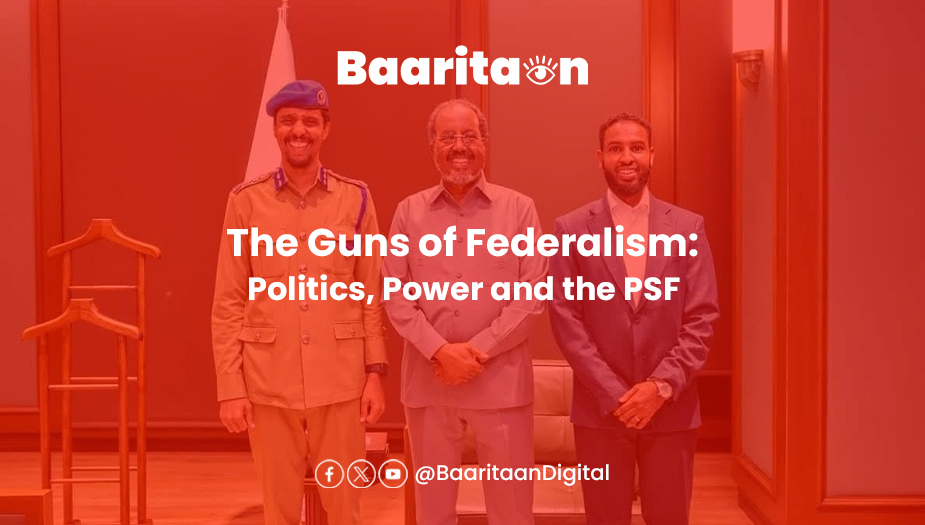
The current confrontation did not emerge overnight. It accelerated after President Hassan Sheikh Mohamud publicly hosted Col. Said Abdirizak, who was presented by current federal police chief Asad Diyaano, as the commander of PSF personnel serving within the Somali National Army. Diyaano, a former commander of the PSF, has become one of the leading figures supporting the Federal Government’s security initiative in Puntland.

Days later, Prime Minister Hamza Abdi Barre announced that the Federal Government intended to recruit 10,000 personnel from Puntland into the country’s national security institutions.
To Mogadishu, the initiative reflected the authority of a sovereign federal state. To Puntland, however, it represented the establishment of parallel security institutions within its territory. Regional officials repeatedly warned that recruiting armed personnel outside Puntland’s chain of command risked destabilising a region that remains central to Somalia’s campaign against ISIS.
The Jimcaale Precedent
The dispute nearly erupted into armed confrontation earlier this month. President Hassan Sheikh Mohamud’s appointment of Gen. Jimcaale Jaamac Takar, commander of the U.S.-trained Danab Special Forces, to lead the Somali National Army’s 54th Division in Garowe triggered one of Somalia’s most serious political and security crises in recent years.
Puntland viewed the appointment as evidence that Mogadishu intended to establish an operational federal military headquarters inside the state. Military deployments increased. Political rhetoric intensified. For several days, Somalia appeared closer to an internal security confrontation than at any point in recent memory.
The crisis ended not through force but through quiet negotiations involving Puntland officials, traditional elders and international diplomacy. Diplomatic sources indicated that the United States encouraged compromise, fearing that internal conflict would undermine ongoing operations against ISIS-Somalia.
The Latest Operation
Against that backdrop, Puntland’s announcement that it had seized military vehicles from forces allegedly linked to the Federal Government carries significance well beyond the tactical outcome.
If Puntland’s account is accurate, it would represent the first publicly acknowledged instance in which regional authorities have captured military equipment allegedly belonging to federally aligned forces recruited inside Puntland. If Mogadishu disputes the claims, the episode may become another chapter in an increasingly contested information war accompanying Somalia’s broader political crisis.
Either way, the incident demonstrates how security institutions have become the principal arena through which constitutional disagreements are now being contested.
A Contest Over Somalia’s Future
At its core, the dispute is no longer simply about the PSF, military vehicles or individual commanders. It reflects two competing visions of the Somali state. President Hassan Sheikh Mohamud’s administration has increasingly advocated stronger federal institutions, centralised command structures and greater national oversight of the country’s security forces.
Puntland, by contrast, argues that Somalia’s federal compact requires broad political consensus before such authority can be expanded, warning that unilateral decisions threaten both constitutional stability and regional autonomy. The consequences extend well beyond domestic politics. Puntland remains the centre of Somalia’s campaign against ISIS-Somalia, and any prolonged confrontation between federal and regional forces could complicate counterterrorism operations supported by international partners.
For now, the military vehicles displayed outside Bosaso represent more than captured equipment. They have become symbols of a deeper constitutional struggle over who commands Somalia’s armed forces, defines its federal system and ultimately exercises state authority. With neither side showing signs of retreat, the confrontation may prove to be not merely an isolated security incident, but another milestone in Somalia’s increasingly consequential battle over the future of its federal republic.