

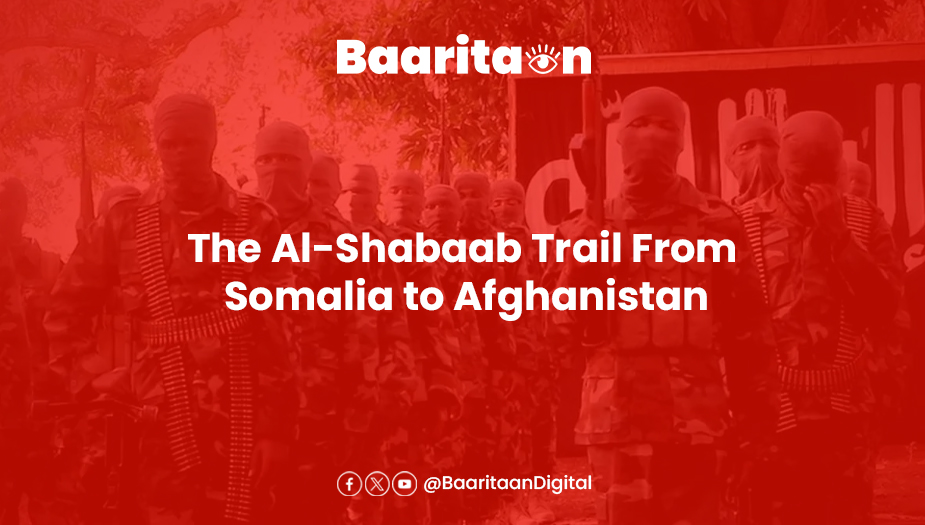

MOGADISHU, Somalia – A small number of Al-Shabaab fighters have traveled from Somalia to Afghanistan, according to a new United Nations assessment, highlighting the continuing movement of militants between conflict zones even as the Somali insurgency faces sustained military pressure.
The fighters’ movements were mentioned in a report by the United Nations Security Council’s Analytical Support and Sanctions Monitoring Team, which monitors Al Qaeda, the Islamic State and associated groups. The report, dated June 26 and circulated to the Security Council on Aug. 10, covers information received through June 9.
The report gives no number for the fighters who traveled to Afghanistan, does not identify them and does not say which part of Afghanistan they entered or whether they subsequently joined another militant organization.
Its wording is deliberately cautious. The monitoring team said that “a small number of Al-Shabaab fighters had travelled from Somalia to Afghanistan.” The report also said that the Somali government’s counterterrorism efforts had constrained, but not eliminated, the movement of foreign fighters into Somalia to join the Islamic State affiliate there.
The movement appears to be part of a wider pattern in which fighters and facilitators connected to militant groups move through established smuggling and migration routes rather than remaining permanently tied to a single battlefield.
The report said Al-Shabaab’s Jaysh Ayman wing includes non-Somali fighters recruited from across the region. Recruitment takes place through personal networks, social media and encrypted online platforms, while organized criminal groups help move fighters across porous borders and clan-linked routes into Somalia.
The United Nations did not say that Al-Shabaab has established a new operational presence in Afghanistan.
A small movement with a wider significance
The reference to fighters traveling from Somalia to Afghanistan is brief, but it comes against a broader backdrop of growing connections between militant networks in Africa, the Middle East and South Asia.
The UN assessment says the terrorist threat remained broadly stable globally during the six-month reporting period, but intensified in the Sahel and South Asia. Afghanistan remained a major concern because a number of militant organizations continue to operate there, despite efforts by the Taliban authorities to suppress the Islamic State’s Khorasan branch.
The report assessed Islamic State-Khorasan, or IS-K, as the most serious terrorist threat to the Taliban authorities and the wider region. The group suffered setbacks from counterterrorism operations but retained the ability to conduct occasional high-profile attacks.
The UN said IS-K had been rebuilding its capabilities and had access to modern tactical equipment, including drones, night-vision equipment and thermal imaging devices.
Against that background, the movement of even a small number of Al-Shabaab fighters from Somalia to Afghanistan is notable because it demonstrates that Somalia’s insurgency is not isolated from wider militant networks.
Still, the available evidence does not establish that the fighters traveled to Afghanistan as part of an organized Al-Shabaab deployment or that the movement represents a strategic decision by the group’s leadership.
The report provides no evidence of an Al-Shabaab operational command in Afghanistan.
Al-Shabaab’s links to Yemen are more substantial
The UN report provides considerably more detail about Al-Shabaab’s links to Yemen.
During the reporting period, the monitoring team said several Al-Shabaab fighters traveled to Yemen through coastal routes and moved into the provinces of Shabwah and Ma’rib. There, they met members of Al Qaeda in the Arabian Peninsula, or AQAP, to exchange expertise and coordinate logistics.
Some of the Al-Shabaab operatives later reportedly met with Houthi elements to discuss fighter movements and mutual support.
Between 150 and 400 Al-Shabaab fighters reportedly received training from Houthi elements, the report said, although it presented the figures as member-state reporting rather than independently verified information.
The relationship was temporarily disrupted after an Al-Shabaab logistical facilitator, Abdul Qadir Yahya Ali Ahmed al-Zabidi, was targeted in Yemen in February. According to the report, the cooperation subsequently resumed.
The UN said the relationship between AQAP and the Houthis had developed into a closer field partnership, including intelligence co-operation and the provision of military supplies.
For Somalia, the geographical connection is particularly significant. Al-Shabaab operates along a coastline facing one of the world’s most strategically important maritime corridors, while Yemen lies directly across the Gulf of Aden.
Al-Shabaab remains resilient in Somalia
Despite these international links, the UN report’s central assessment is that Al-Shabaab remains primarily a Somali insurgency.
The group appears to have changed its operational pattern after a surge in violence in 2025. Rather than maintaining the same broad level of attacks, it has increasingly concentrated on more targeted and strategic operations.
The group carried out fewer attacks in and around Mogadishu, according to the UN, while concentrating more activity in Hirshabelle, Lower and Middle Juba, Lower Shabelle and Galmudug.
Several senior figures were killed in Somali and partner operations.
Abdullahi Osman Mohamed Caddow, known as Engineer Isma’il, who oversaw Al-Shabaab’s improvised explosive device operations, was killed in December 2025.
Abdullahi Hassan Abdi Osoble, known as Abdullahi Wadaad, who was responsible for the group’s finances, was killed in January. His replacement, Mohamed Sahal Idl, known as Abu Usaama, was killed the following month.
But the losses have not dismantled the group’s leadership. Ahmed Diriye, the head of Al-Shabaab, remained active and was believed to be in southern Somalia, according to the UN.
The organization has also retained a functioning financial system.
The monitoring team estimated that Al-Shabaab’s monthly revenue collection in Mogadishu had declined from between $12 million and $15 million to between $5 million and $9 million as security measures increased.
Drought in Jubaland, Lower Shabelle and Middle Shabelle also reduced the amount the group could collect.
Yet the UN said Al-Shabaab continued to raise money through taxation, extortion and the exploitation of legitimate businesses. It also used third parties and identity documents to facilitate bank accounts and financial transfers.
The group has therefore remained capable of financing its operations despite losing revenue.
Islamic State remains under pressure in Puntland
The Islamic State affiliate in Somalia presents a smaller but persistent threat.
The UN estimated that Islamic State in Somalia had between 150 and 250 fighters, concentrated mainly in the Cal Miskaat mountains of Puntland.
Its territorial influence and operational capacity remained constrained by counterterrorism operations. But the report said that when the pace of security operations declined in January, Islamic State fighters temporarily reoccupied some positions that had previously been cleared.
The group subsequently attempted to rebuild support networks around Cal Miskaat, the Jaceel valley and the Golis Mountains.
The movement of foreign fighters into Puntland had declined, with the Islamic State affiliate discouraging potential recruits from traveling there. The UN warned that the trend could change if counterterrorism pressure weakened.
The group also continued to raise small amounts of money by extorting businesses in the coastal towns of Bosaso and Qandala.
The Afghan connection remains difficult to assess
The brief reference to Al-Shabaab fighters in Afghanistan should therefore be viewed in context.
The UN report describes a broader ecosystem in which militant groups move people, money and expertise across borders. It identifies organized crime networks, informal financial systems, migration routes and digital communications as important components of that ecosystem.
But the report does not establish a formal operational relationship between Al-Shabaab and the Taliban, nor does it say that Al-Shabaab has created a significant presence in Afghanistan.
That distinction is important.
Al-Shabaab has longstanding ties with Al Qaeda and maintains relationships with militant organizations outside Somalia. But the available UN assessment does not show that the reported movement of a small number of its fighters to Afghanistan amounts to a new alliance or an expansion of the group into South Asia.
Instead, the episode is best understood as another indication of the mobility of militants operating within an increasingly interconnected extremist environment.
Political divisions add to the risk
The security situation is also being shaped by Somalia’s internal political divisions.
Somalia’s federal government has been pushing constitutional and electoral reforms while facing opposition from political rivals and some federal member states. The dispute has become increasingly contentious as the country approaches its next electoral cycle.
The European Union Agency for Asylum said in July that Somalia’s political environment had become highly fractured, with disagreements over the electoral model and constitutional changes contributing to a volatile security environment.
The concern for security officials is that political divisions could complicate co-operation between Mogadishu and regional authorities at a time when Somalia is assuming greater responsibility for fighting Al-Shabaab.
The African Union Support and Stabilization Mission in Somalia, or AUSSOM, is authorised through the end of 2026. The mission is intended to support Somali forces as they take over increasing responsibility for national security.
That transition places greater importance on the ability of Somali federal and regional forces to maintain a common strategy.
A global network, but a local war
The UN report portrays a terrorist landscape in which major groups are increasingly decentralized.
Islamic State’s central leadership has suffered repeated losses, while its affiliates in Africa and elsewhere continue to operate. Al Qaeda’s senior leadership remains marginalized, but its regional branches — particularly in Africa and Yemen — retain significant capabilities.
For Al-Shabaab, the picture is similar.
The group remains deeply rooted in Somalia, where it raises money, recruits fighters and maintains influence over territory and communities. But its relationships extend beyond the country’s borders.
The reported movement of a small number of Al-Shabaab fighters to Afghanistan is therefore significant less because of the number involved than because it illustrates the ease with which militants can move between conflict theaters.
The UN report offers no evidence that those fighters represent the beginning of a major Al-Shabaab expansion into Afghanistan.
It does, however, provide a reminder that Somalia’s insurgency is connected to a wider militant ecosystem — one in which fighters can move from Somalia to Yemen or Afghanistan, financial networks can cross borders and organizations can exchange expertise even when their territorial ambitions remain local.
For Somali and international security officials, that makes the coming phase of the conflict more complicated: weakening Al-Shabaab inside Somalia may not be enough to prevent individual fighters from moving into other theaters, while instability elsewhere can create new routes, relationships and opportunities for the insurgency.