

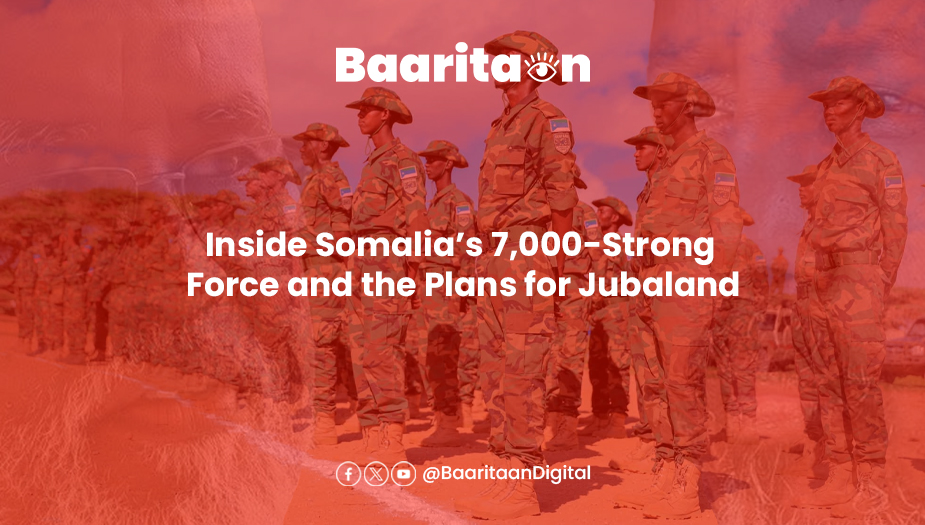

MOGADISHU — Somalia’s federal government is assembling more than 7,000 troops for a planned offensive against al Shabaab in the southern regions of Jubaland, according to security officials and government sources, in a move that could also deepen a political dispute between Mogadishu and the regional administration.
The force is being prepared for an operation aimed at pushing al Shabaab out of Middle Juba, including the towns of Jilib and Bu’aale, according to the sources.
But people familiar with the preparations said the federal government also hopes the deployment will strengthen its position against Jubaland President Ahmed Madobe, who has been locked in a dispute with President Hassan Sheikh Mohamud’s administration.
The sources said most of the troops had been recruited from Ethiopia’s Somali Regional State and trained in central Somalia, particularly around Guriceel and Dhuusamareeb.
“They completed their training in the central regions, particularly Guriceel and Dhuusamareeb,” one senior military officer said.
The force is being overseen by Brigadier General Sahal Abdullahi Omar, known as Khaalid, commander of the Somali National Army’s ground forces. Prime Minister Hamza Abdi Barre is overseeing the operation at the political level, the sources said.
The government did not immediately respond to requests for comment on the deployment.
Route into Jubaland
The troops are currently stationed in the Hananbuure area of Galgaduud region and are expected to move towards southern Somalia, according to security officials and people familiar with discussions inside the prime minister’s office.
Potential areas of deployment include Lower Shabelle and Gedo, the sources said.
Lower Shabelle borders Middle Juba, while Gedo, which is administered by Jubaland, shares a border with Middle Juba. The Jubba river runs through the area around Baardheere.
One government official said the operation would be justified publicly as an offensive against al Shabaab but could also be used to challenge Madobe’s control of Jubaland.
“If the ultimate objective were to liberate Middle Juba from al Shabaab, that would be a positive development,” the official said. “But the intention is to use the operation as a launching point into Jubaland.”
One official familiar with the preparations said an Arab country had provided funding and support for the recruitment, training and equipment of the force. The official did not identify the country.
Jubaland prepares its own offensive
Madobe is aware of the federal government’s plans and is expected to launch an operation in Middle Juba in the coming weeks, according to people familiar with the matter.
The operation has been given the name “Jubba Corridor”, the sources said.
The United States is expected to provide logistical support and air strikes for the operation, while Kenya is also expected to support the campaign, according to the sources.
Jubaland has been in a prolonged dispute with Mogadishu over political and security authority. Relations deteriorated sharply in November 2024 after federal forces were deployed to Ras Kamboni, triggering deadly clashes with Jubaland forces.
Madobe has remained a strong opponent of the federal government’s efforts to increase its authority over Somalia’s regional administrations.
America chooses its partner
Somalia’s federal government has asked the United States to allow federal troops to participate in the planned Middle Juba operation, but Washington rejected the request, according to a person who took part in discussions about the campaign.
“U.S. officials stressed that they did not want the liberation of Middle Juba to be politicised,” the person said. The United States has instead held direct discussions with Madobe.
A delegation of U.S. officials travelled to Kismayo in late July and met the Jubaland president, according to people familiar with the visit. Senior U.S. Africa Command officials involved in special operations also met Madobe in Nairobi at the beginning of August, the sources said.
The meetings focused on preparations for the planned offensive, they said.
The U.S. government recognises Somalia’s sovereignty and territorial integrity and has long supported the federal government in its campaign against al Shabaab.
The meetings with Madobe do not indicate a change in that position, according to people familiar with U.S. policy.
But the decision to work directly with Jubaland on an operation in territory under its control highlights the practical difficulties Washington faces in balancing Somalia’s federal government with regional administrations.
Battle for Jilib and Bu’aale
Middle Juba is strategically important because it contains Jilib, widely regarded as one of al Shabaab’s main strongholds and a key centre of its operations.
Capturing Jilib would represent a significant setback for the militant group, which has fought an insurgency against Somalia’s government for more than a decade.
It would not necessarily end the insurgency. Al Shabaab has repeatedly adapted to territorial losses by moving fighters into rural areas and maintaining clandestine networks in towns controlled by government forces.
Bu’aale is politically important for another reason. It is the formal administrative capital of Jubaland.
If federal forces were to capture the town, Mogadishu would gain a significant advantage in its dispute with Madobe. If Jubaland forces reached it first, Madobe would strengthen his position against the federal government.
The competition could complicate the campaign against al Shabaab if Somali forces focus on controlling territory from one another rather than coordinating operations against the militants.
Strategic importance
Jubaland occupies a strategically important part of southern Somalia, with access to the Indian Ocean through Kismayo, one of the country’s major ports.
The region also borders Kenya and is close to important maritime routes linking the western Indian Ocean with the Red Sea and Gulf of Aden.
Middle Juba contains significant agricultural land and other resources, while control of Jilib would provide an important military and political gain against al Shabaab.
For Kenya, security in Jubaland is closely linked to its own efforts to contain al Shabaab along its border. For the United States, the group remains one of the most significant militant threats in the region.
The coming weeks could therefore determine both the direction of Somalia’s campaign against al Shabaab and the balance of power between Mogadishu and Jubaland.
The key question is whether the federal government will allow Madobe’s forces to lead the offensive in Middle Juba or deploy its newly assembled force to compete for control of the territory. Either outcome could have consequences extending well beyond the battlefield.