

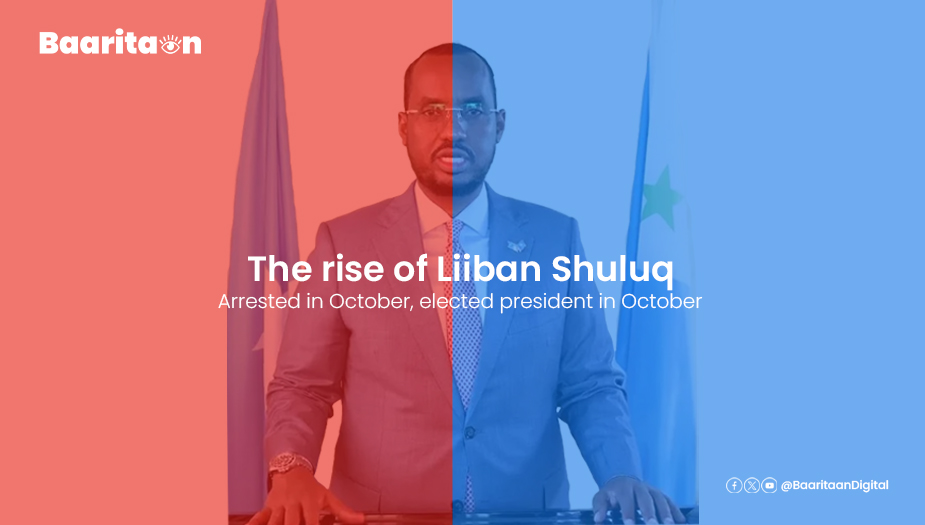

DHUSAMAREB, Somalia — Liiban Ahmed Hassan, widely known as Liiban Shuluq, has been elected president of Galmudug, placing a businessman with deep roots in local networks at the head of one of Somalia’s federal member states.
Galmudug lawmakers elected Liibaan on Thursday, October 22, 2026, giving him 72 votes. His rival, Abdulqadir Abdullahi Diriye, received 14 votes, while three ballots were declared invalid, according to Hussein Mohamed Nur, speaker of the Galmudug House of Representatives, who announced the result.
After his victory, Liibaan described the election as “a victory for the people of Galmudug” and “a step forward for democracy in Somalia”.
But the significance of his rise extends beyond the parliamentary vote. His career, as described by sources who spoke to Baaritaan, illustrates how commerce, clan relationships, humanitarian activity and participation in electoral processes can intersect in Somalia’s regional politics. His presidency will test whether those networks can be translated into effective public administration.
The election also took place amid concerns about the competitiveness of the race. Sources familiar with the political process told Baaritaan that the exclusion of influential candidates had shaped the contest.
The networks behind a political ascent
Liibaan is associated with southern Gaalkacyo, in Mudug region, an area long affected by clan-based disputes and competition over local authority. Sources who spoke to Baaritaan describe a career spanning livestock trading, humanitarian assistance and involvement in Galmudug’s political processes.
His date and place of birth have not been publicly confirmed. People familiar with his background told Baaritaan that he was born in Ethiopia’s Somali Region.
According to sources who spoke to Baaritaan, Liiban’s business activities began in the livestock trade, a major component of Somalia’s commercial relationship with Gulf markets. He remains involved in the sector, sources said, with one of his brothers managing parts of the business.
His public profile has also been shaped by humanitarian assistance to communities affected by drought. Sources described his support for people facing hardship as a visible part of his activities, particularly as his campaign for the Galmudug presidency gathered momentum.
Allegations and unanswered questions
In a political environment where state institutions have limited capacity and public services are uneven, business relationships and community networks can provide access to constituencies that formal political structures struggle to reach. Such networks can help political figures build support, but they can also raise questions about transparency, accountability and the relationship between private influence and public office.
Sources who spoke to Baaritaan alleged that Liiban had connections to clan-based armed groups and was involved in conflicts around Galkayo. Other accounts shared with Baaritaan alleged that he had dealings with Somali piracy networks, including claims that he supplied boats used to target vessels at sea.
Sources also raised allegations concerning the business activities of a brother involved in the livestock trade, including purported links to extremist groups.
From electoral machinery to the presidency
Liiban’s political experience includes participation in Galmudug’s 2021 state-level electoral process. Sources who spoke to Baaritaan said he served on an electoral committee and exercised influence over the selection of representatives from southern Galkayo.
In Somalia’s federal system, elections for regional leadership take place within a complex landscape of clan representation, political bargaining and relationships between state administrations and the federal government. The formal vote is only one part of that process; the negotiations and alignments preceding it can shape who competes and who ultimately assumes office.
Sources who spoke to Baaritaan said the exclusion of influential candidates affected the environment in which Liiban’s election took place. For Galmudug, the credibility of the election matters because the incoming administration must govern communities and political constituencies that may not all regard the result as representative.
An arrest that preceded his rise
On October 9, 2017, Galmudug security forces arrested Liibaan in Adado, where he was operating as a businessman, according to sources who spoke to Baaritaan.
The grounds for the arrest remain unclear. Sources said Liibaan attributed it to political disagreements with Ahmed Duale Gelle Haf, who was Galmudug’s president at the time.
The episode offers a striking contrast with his position today. A businessman who was detained during a period of political tension with the regional leadership has now secured the votes to lead Galmudug himself.
That contrast does not, on its own, establish a direct political connection between the arrest and his subsequent rise. It does, however, underscore the shifting relationships that can characterise regional politics in Somalia, where figures may move between commercial influence, political opposition and formal office.
The test of governing
Liibaan takes office as Somalia faces a deepening political crisis over the 2026 elections, with tensions between the federal government and regional administrations threatening the country’s political transition. All eyes will be on how he navigates the dispute and positions Galmudug between competing political camps, particularly in his dealings with President Hassan Sheikh Mohamud’s administration.
At home, he must address insecurity, drought and displacement while demonstrating that his presidency serves interests beyond the coalition that elected him. His leadership will be tested by his ability to strengthen institutions, manage public resources transparently and engage political opponents.
Ultimately, Liiban’s challenge is twofold: to govern Galmudug effectively and to navigate Somalia’s electoral crisis without deepening divisions. How he responds could shape both his political credibility and Galmudug’s role in the country’s uncertain transition.