

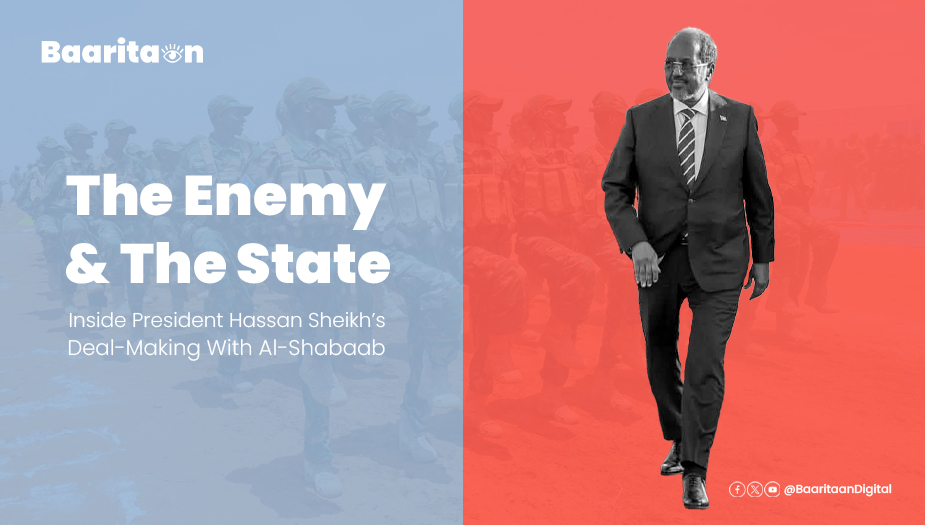

MOGADISHU — Somalia’s fight against Al-Shabaab is entering a dangerous new phase. An investigation published on Tuesday by Africa Intelligence alleges that elements of President Hassan Sheikh Mohamud’s administration have maintained an informal understanding with figures linked to the Al-Qaeda-affiliated militant group, while simultaneously using accusations of Al-Shabaab collaboration to pressure or attack political rivals.
If substantiated, the allegations would expose a striking contradiction at the heart of Somalia’s security strategy: a government that publicly describes Al-Shabaab as an existential enemy while allegedly maintaining channels to some of the same networks it says it is fighting.
The implications extend far beyond Mogadishu. Somalia’s federal political crisis has increasingly become intertwined with the command of security forces, disputes over constitutional authority and the future of the African Union’s peace-support mission.
At the same time, Western governments are reassessing whether the Somali government can be relied upon to lead the counterinsurgency effort. The result is a potentially dangerous convergence of political rivalry, intelligence operations and counterterrorism.
An alleged back channel
According to Africa Intelligence, the federal administration has recruited several people associated with Al-Shabaab into government security and immigration structures and has maintained informal contacts with elements of the militant organisation. The publication reports that the arrangement has coincided with a significant reduction in high-casualty car-bomb and suicide attacks in central Mogadishu.
The decline in attacks is real, although its explanation is contested.
The last major Al-Shabaab attack in Mogadishu was in August 2024, and the capital subsequently experienced a prolonged period without the kind of mass-casualty assault that had become a grim feature of life in the city. The Associated Press attributed the improvement to a combination of intelligence operations, tighter security and what it described as a “ring of steel” around Mogadishu.
Africa Intelligence, however, offers a more controversial explanation, linking the reduction to alleged contacts between government officials and Al-Shabaab figures.
The publication specifically points to the return of Mahad Mohamed Salad as director of Somalia’s National Intelligence and Security Agency, or NISA. It reports that Salad has family connections to senior Al-Shabaab commander Mahad Karate.
Those claims are serious and should not be treated as established fact without independent corroboration. But they raise an important question: whether the decline in attacks reflects improved intelligence and security capabilities, an operational shift by Al-Shabaab, informal understandings between intermediaries — or some combination of all three.
The distinction matters because Al-Shabaab has not disappeared.
The group remains capable of conducting complex attacks and retains substantial influence across parts of southern and central Somalia. US and international assessments continue to regard it as a major terrorist threat. The quieter streets of Mogadishu therefore cannot be taken as evidence that the insurgency has been defeated.
From fighting Al-Shabaab to fighting political opponents
The more consequential allegation is that the federal government has increasingly used the threat of Al-Shabaab as a political instrument.
Somalia’s federal system has been under severe strain as President Hassan Sheikh Mohamud has sought to strengthen Mogadishu’s authority over regional administrations.
The confrontation reached a dramatic point in March, when Somali federal forces took control of Baidoa, the capital of South West State. Abdiaziz Hassan Mohamed Laftagareen resigned shortly afterwards, days after being re-elected for another five-year term. Reuters reported that the takeover followed months of deteriorating relations between Laftagareen and Mogadishu, including his opposition to constitutional changes pursued by the federal government.
The episode demonstrated the extent to which Somalia’s security forces have become entangled in federal politics.
The government portrayed its intervention as necessary to preserve stability and prevent political conflict. Critics saw the deployment as an attempt by Mogadishu to impose its authority over a federal member state.
The political consequences were immediate.
With Laftagareen gone, an interim administration took over in South West State, while political figures close to Mogadishu moved to position themselves for the next stage of the contest.
The dispute is particularly troubling because South West State is also a frontline area in the war against Al-Shabaab.
Every federal soldier deployed to secure a regional capital or confront a local militia is a soldier who is not necessarily available for operations against the jihadists.
That does not mean federal deployments automatically benefit Al-Shabaab. But it creates an obvious strategic risk: political warfare can consume the same military resources required for counterinsurgency.
Jubaland is the next test
The confrontation is now increasingly focused on Jubaland and its president, Ahmed Mohamed Islam, widely known as Ahmed Madobe.
Mogadishu and Jubaland have been locked in a long-running dispute over federal authority, elections and control of security forces, particularly in the strategic Gedo region along the Kenyan border.
The federal government’s critics fear that the same political and security playbook used in South West State could be deployed against Jubaland.
The danger is that a campaign conducted in the name of fighting Al-Shabaab could instead deepen the political fragmentation that has repeatedly weakened Somalia’s counterinsurgency.
This is not merely a theoretical concern.
Somalia’s security architecture depends on cooperation between the federal government, federal member states, clan-based local forces and international partners. When those actors turn their weapons and resources against one another, Al-Shabaab gains strategic breathing room.
A US Congressional Research Service assessment published in July warned that Al-Shabaab had already regained territory amid political distractions and uncertainty over the future of the African Union mission.
The group does not need to defeat the Somali army in a conventional battle.
It can benefit simply from the government’s inability to concentrate its forces.
The intelligence question
The allegations surrounding NISA are particularly sensitive because intelligence cooperation has been central to the relative improvement in Mogadishu’s security.
The Somali government has invested heavily in intelligence-led operations, checkpoints, surveillance and the disruption of militant networks.
That strategy appears to have produced results in the capital. But intelligence agencies inevitably operate in the shadows, making them particularly vulnerable to accusations that political intelligence is being mixed with counterterrorism.
Reports of tensions between Hassan Sheikh Mohamud and NISA director Mahad Salad have themselves surfaced during the political disputes surrounding Galmudug and the federal government’s attempts to influence regional politics. Local reporting in May described disagreements between the president and Salad over political manoeuvring in Galmudug, although those reports were not independently verified.
The significance of NISA therefore extends beyond terrorism.
Who controls the intelligence service controls information about militants, political opponents, regional leaders and armed networks.
In a country where politics and security are inseparable, that makes the intelligence service one of the most powerful institutions in the state.
Western patience is running out
The allegations have emerged at precisely the moment when Somalia’s international security architecture is under unprecedented financial pressure.
On 1 July, the United States informed the African Union that it would not provide funding for AUSSOM beyond 31 December 2026. The decision threatens the logistics system on which the roughly 12,000-strong AU mission depends. Reuters reported that the US move could put the future of the mission at risk because AUSSOM relies heavily on the UN Support Office in Somalia for food, fuel, medical services, transport and other essential logistics.
The decision is not occurring in isolation.
The Institute for Security Studies reported that Washington’s decision reflected frustration with the Somali government’s failure to take full ownership of its security responsibilities and sustain progress against Al-Shabaab.
The financial consequences are potentially enormous.
The United States has provided nearly $2bn to UNSOS and substantial bilateral assistance to Somali and African Union forces over the years.
Yet Washington is now questioning whether continued international investment is producing the security and political results it was intended to achieve.
That is an extraordinary reversal.
For years, Somalia’s international partners have argued that the country must eventually take responsibility for its own security. The transfer of responsibility was supposed to be the ultimate objective of the international military presence.
But if international forces withdraw before Somalia’s political institutions and security forces are capable of replacing them, the transition could produce precisely the vacuum that international donors have spent two decades trying to prevent.
AUSSOM’s precarious future
The African Union mission’s financial problems were already severe before the American decision.
The UN says AUSSOM is authorised to receive logistical support from UNSOS for up to 11,826 uniformed personnel. The support includes food, water, fuel, medical infrastructure, casualty evacuation, transport, engineering, communications and counter-IED assistance.
The United Nations has warned that liquidity shortages could affect AUSSOM’s operations and has called for a broader donor base and multi-year financing.
The European Union has attempted to fill part of the gap, committing €75m to AUSSOM in April and describing itself as the mission’s largest supporter.
But European money cannot automatically replace the logistical architecture previously supported by Washington.
The danger is therefore not simply that Somalia will receive less foreign assistance.
It is that the international security system surrounding the Somali government could begin to fracture at precisely the moment when the federal government is itself becoming more politically isolated.
The contradiction at the centre
Somalia now faces a paradox.
On one side, the government can point to tangible security improvements in Mogadishu. The capital is safer than it was during the worst years of Al-Shabaab’s urban bombing campaign. Intelligence operations have disrupted militant networks, and the government has expanded its security forces.
On the other, the country remains politically divided, Al-Shabaab remains resilient outside the capital, federal and regional forces are increasingly at odds, and international donors are questioning whether Mogadishu’s political priorities are compatible with the counterterrorism mission.
That is the central issue raised by the Africa Intelligence allegations.
If the Somali government is indeed maintaining discreet channels to elements within Al-Shabaab while using the organisation’s alleged collaborators as justification for confronting political opponents, then the distinction between counterterrorism and political consolidation becomes dangerously blurred.
The government could argue that intelligence contacts are a necessary part of fighting an insurgency. Governments routinely communicate with enemies, defectors and intermediaries in wartime.
But the credibility of such contacts depends on their purpose.
If they are being used to obtain intelligence, encourage defections or prevent attacks, they form part of a conventional counterinsurgency strategy.
If they are instead being used selectively to protect political interests, neutralise rivals or manipulate the distribution of military force, the consequences are profoundly different.
The risk of a security vacuum
The most dangerous outcome may not be an immediate return to the bombings that once paralysed Mogadishu.
It could be slower and less visible.
International confidence could erode. Foreign military assistance could decline. Regional administrations could increasingly rely on their own forces. Federal troops could become tied down in political confrontations. AUSSOM could lose the logistical support necessary to maintain its positions.
And Al-Shabaab could wait.
The group has repeatedly demonstrated its ability to exploit political fragmentation. It does not need to capture Mogadishu tomorrow to benefit from the crisis. It needs only to survive, recruit, collect taxes, intimidate local populations and wait for government forces to weaken.
That is why the emerging dispute between Mogadishu and its Western partners matters.
The question is no longer simply whether Somalia can defeat Al-Shabaab.
It is whether the country’s political leadership can resist the temptation to use the machinery of counterterrorism for political consolidation — and whether its international partners still believe that it can.
Nevertheless, the answer will determine what remains of Somalia’s security transition when the current international support architecture begins to disappear at the end of this year. And if the allegations of an informal understanding with Al-Shabaab prove accurate, the central irony of Somalia’s war may be that the group does not need to seize power to win. It may only need Somalia’s political system to keep fighting itself.