
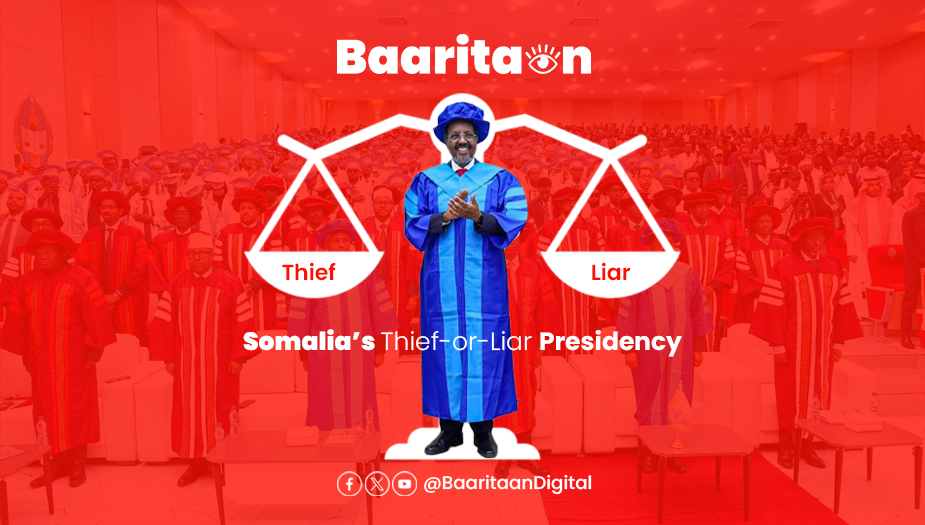

MOGADISHU, Somalia — Which is worse for a country: a politician who steals its money or one who deceives its people?
That question, posed in different forms across Somalia after President Hassan Sheikh Mohamud’s remarks in Mogadishu on July 12th, sounds almost philosophical. It is not. In a country where public land is contested, citizens are being evicted and political institutions are themselves the subject of dispute, the answer has an economic dimension.
Speaking at a graduation ceremony, Mr Hassan Sheikh said that “the person who plunders public property is less harmful than the person who robs people of their minds and reason”. His comments were widely interpreted as a rebuke of opposition politicians whom he accused of misleading the public.
The response from his critics was that the comparison itself was dangerous.
A politician who steals public money does not merely remove cash from a government account, they argue. He removes resources from schools, hospitals, roads and security. He weakens institutions and reduces citizens’ confidence in the state. In the long run, that can leave people more vulnerable to precisely the misinformation that the president says is the greater threat.
The argument has acquired particular force because of a controversy over land in Mogadishu.
Public land, private interests
Over the past year, government efforts to reclaim land described as public property have resulted in demolitions and forced evictions in parts of the capital. Images of homes reduced to rubble in multiple districts in 2025 drew attention to the government’s campaign to reclaim disputed public land.
The issue did not disappear in 2026.
A May report by the EU Agency for Asylum noted that people living on public or government land in Mogadishu remained exposed to eviction. The federal government has said it intends to relocate vulnerable families affected by evictions, with the public-works ministry announcing a plan to resettle about 12,000 households.
The government’s stated argument is straightforward: land belonging to the state cannot simply be occupied indefinitely.
But critics ask a harder question: what happens when the state itself becomes the disputed party in the ownership of land?
Reports and opposition accusations have alleged that public land has been transferred or sold to private interests. Some residents have further alleged that properties belonging to families with longstanding ownership documents have been seized. Those allegations remain contested and should not be treated as proof of unlawful transfers.
Yet the economic issue does not depend on proving every allegation.
A functioning property market requires confidence that ownership is protected by predictable rules rather than political connections.
If citizens believe land can be taken by an authority without transparent procedures, compensation or an independent mechanism for resolving disputes, the value of property rights falls. Investment becomes riskier. Informal transactions become more attractive. Political connections become more valuable.
That is not simply a legal problem. It is an economic one.
The economics of eviction
For a displaced Somali family, the distinction between public land and private land is not an academic one.
The loss of a home can mean the loss of a shop, livestock, rental income or a location from which a family earns its living. For people already displaced by conflict or drought, another eviction can mean another move to an informal settlement with limited access to water, sanitation and employment.
The EUAA’s recent assessment highlights the particular vulnerability of displaced people in Mogadishu, including those living on government land.
That makes the government’s proposed resettlement programme important. But resettlement does not automatically resolve the underlying problem.
If the state removes people from land without establishing a transparent system for determining ownership, the policy may simply redistribute insecurity rather than resolve it.
And if public land is subsequently commercialised, the question becomes even more politically sensitive: who gains from the land’s rising value, and who bears the cost of acquiring it?
The president’s argument
This is where the president’s distinction between the thief and the liar begins to look too narrow.
Political misinformation can certainly damage a country. A government cannot function if citizens are deliberately misled about elections, security or public policy.
But the theft of public resources has a peculiar characteristic: its consequences can survive for decades.
A missing public-health budget may mean fewer doctors. A missing education budget may mean fewer graduates. A diverted infrastructure project may raise transport costs for businesses for years.
Land is even more complicated because it is scarce.
A government that controls valuable urban land controls an asset whose value can rise dramatically as a city grows. The allocation of that asset therefore creates winners and losers.
If public land is allocated transparently through competitive procedures, the state can potentially generate revenue and direct it towards public investment.
If it is allocated opaquely, it can become a mechanism for transferring wealth from the public to a small group of insiders.
That is why critics regard the president’s formulation as missing the point.
They are not necessarily arguing that misinformation is harmless. They are arguing that corruption can create the very conditions in which misinformation becomes powerful.
A country already divided over power
The land dispute is unfolding alongside a much larger political confrontation.
Somalia’s parliament approved constitutional amendments in March that extended the terms of parliament and the presidency and established a new electoral framework. The changes were presented by the government as part of a long-running effort to move the country towards direct elections. Critics argued that they altered the political rules without sufficient consensus and effectively prolonged the government’s tenure.
By May, talks between the government and opposition had broken down, with the end of the president’s original four-year mandate approaching without agreement on an electoral transition.
The dispute then spilled into violence.
Clashes in Mogadishu in early June, amid preparations for an opposition rally, highlighted the increasingly dangerous confrontation between government forces and opposition supporters. The United Nations and the United States called for restraint.
This is a costly environment in which to debate the morality of political speech.
Every confrontation over constitutional authority carries an economic cost. Businesses cannot easily plan when the political rules are uncertain. Investors become cautious. Public resources are diverted towards security. International donors must spend more time managing political risk.
And ordinary citizens bear much of the cost.
When public assets become political assets
There is a deeper problem here.
Somalia has spent years attempting to rebuild a state from the remnants of civil war. Its central challenge has never been simply to create government institutions. It has been to convince citizens that those institutions represent something larger than whoever happens to control them.
Public land is a useful test.
If a plot of land belongs to the public, its value should ultimately accrue to the public. If it is sold, citizens should be able to know why it was sold, for how much, through what process and where the proceeds went.
The same principle applies to public money.
This is why the language of “stealing public wealth” resonates so strongly in Somalia. The issue is not merely whether money disappears. It is whether citizens believe that the state treats public assets as a common resource or as an instrument of political power.
The president’s critics therefore have a point when they reject the implied hierarchy between corruption and misinformation.
A government cannot demand that citizens trust its information while refusing to provide credible answers about public assets.
The thief and the liar
Somali political culture has long understood the power of words. Opposition lawmaker Abdirahman Abdishakur Warsame responded to the president by invoking the poet Salaan Carrabey: “The tongue has its own strength; the sword cuts the neck.”
The line captures something important about the current dispute. Political language can mobilise people, legitimise governments and discredit opponents.
But words do not exist independently of material conditions.
A family whose house has been demolished does not experience the state as an argument about misinformation. It experiences it as a bulldozer.
A business owner facing uncertain property rights does not experience constitutional reform as an abstract exercise. He experiences it as investment risk.
A citizen watching public money disappear does not need a political theory to understand that the money cannot be spent twice.
This is why Somalia’s “thief or liar?” debate ultimately asks the wrong question.
The country does not have to choose between the two.
It needs institutions capable of constraining both.
The most dangerous politician may not be the thief or the liar in isolation. It may be the politician who controls public resources, controls the institutions meant to scrutinise those resources and then persuades citizens that those demanding accountability are the real threat.
For a country attempting to build a functioning economy and a credible democracy at the same time, that is the more important distinction.
Public wealth is not the property of the government. It belongs to the public. And the value of a government is measured not by how much power it can accumulate, but by how effectively that power can be constrained.