

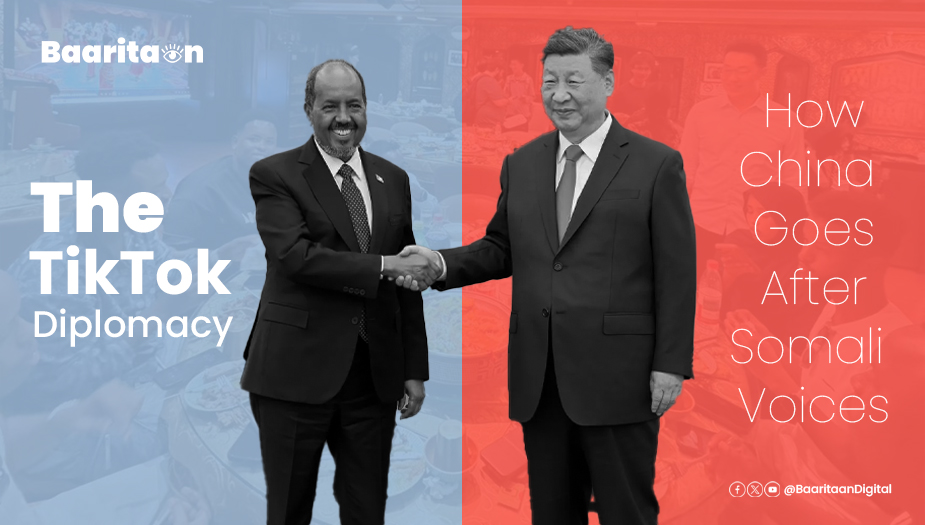

MOGADISHU — China is expanding its campaign to shape public opinion in Somalia beyond diplomatic meetings, development projects and state-to-state relations, with sources telling Baaritaan that Beijing is increasingly targeting Somali social-media personalities with large online audiences. The initiative involves cooperation between the Chinese embassy in Mogadishu and Somalia’s federal Ministry of Information, with selected individuals being taken to China and encouraged to produce favourable content for their followers.
The programme appears particularly focused on TikTok, where influential creators can reach large numbers of young Somalis without the appearance of conventional political messaging. Sources familiar with the programme told Baaritaan that the Ministry of Information has acted as an intermediary in identifying individuals who could participate in the trips.
Some people approached about the initiative were reportedly told that they would be expected to publicly praise China’s political system, including its Communist party-led model of government. Sources also pointed to videos published by Somali participants after travelling to China, saying the material contained messages that portrayed the country, its government and its political system overwhelmingly positively.
One source told Baaritaan that the original strategy was aimed at bringing established television and radio journalists to China, but that resistance from some journalists, strained relationships between sections of the media and the Ministry of Information, and Beijing’s reluctance to engage with independent outlets prompted a change of direction. “The plan was initially to take traditional media — television and radio — but some refused, while relations between some of them and the Ministry of Information were not good,” the source said. “China was also reluctant to deal with independent media, so the approach was reconsidered. Now they are targeting people who are famous on social media, especially TikTok.”
The reported shift is politically significant because influencers occupy a different position from conventional journalists. A television reporter normally works within an editorial organisation, while a TikTok creator can communicate directly with followers through videos that appear personal, spontaneous and informal. A trip organised through diplomatic channels can therefore be transformed into travel content, lifestyle footage or entertainment while simultaneously carrying a political message. For Beijing, that provides a way to project influence through personalities who may be perceived by audiences as independent voices rather than representatives of a foreign government.

From state propaganda to borrowed voices
China has spent years refining its international communications strategy, particularly as its government has faced mounting criticism over human rights, censorship and the treatment of Uyghurs and other predominantly Muslim communities in Xinjiang. Rather than relying exclusively on official broadcasters and diplomatic statements, Beijing has increasingly sought foreign voices capable of presenting a more sympathetic picture of the country. Research by the Australian Strategic Policy Institute documented the use of foreign influencers to amplify Beijing’s preferred narratives on Xinjiang, noting that outside voices can give state-backed messages the appearance of greater credibility.
The attraction of influencers is straightforward: they can reach audiences that distrust official institutions. A Chinese government statement about Xinjiang may immediately be understood as propaganda, while a Somali creator filming inside China can appear to be simply documenting personal experience. The political message can therefore be embedded inside footage of skyscrapers, universities, factories, railways, shopping centres and tourist sites. The viewer sees an individual’s journey rather than an official campaign, even when the journey itself has been facilitated by state institutions.
This approach has already been documented in relation to China’s attempts to defend its record in Xinjiang. Foreign journalists and online creators have been taken on organised visits where access, itineraries and interviews are managed by Chinese authorities or state-linked organisations. Such visits frequently emphasise economic development, religious harmony and modernisation while challenging allegations of systematic repression. The strategy allows Beijing to answer criticism not only through its own officials but through visitors who can return home and tell audiences that they personally saw a prosperous and peaceful China.
That wider campaign is particularly relevant to Somalia because of its predominantly Muslim population. Beijing has a clear interest in preventing criticism of its treatment of Uyghurs from gaining political traction in Muslim-majority societies. A Somali influencer praising China after a carefully organised visit can therefore serve a broader strategic purpose, especially if the content reaches young audiences who may have little access to independent information about Xinjiang. The political value is not necessarily in persuading everyone, but in weakening the credibility of criticism and replacing it with a competing narrative.
Xinjiang and the battle over China’s reputation
The controversy surrounding Xinjiang remains one of the greatest challenges to China’s international image. The Chinese government says its policies in the region are designed to combat terrorism, separatism and extremism and rejects accusations of widespread human-rights abuses. The United Nations human rights office, however, said in 2022 that serious violations had taken place and that the arbitrary and discriminatory detention of Uyghurs and other predominantly Muslim groups could constitute international crimes, particularly crimes against humanity.
Beijing has responded to international criticism with an extensive diplomatic and media campaign. Chinese officials regularly describe Xinjiang as peaceful, prosperous and stable, while foreign visitors are shown carefully selected locations and presented with government-approved accounts of the region. The objective is not simply to deny allegations but to create an alternative visual reality: functioning cities, happy families, economic growth and modern infrastructure. Social media makes that strategy particularly powerful because carefully selected images can travel rapidly without being accompanied by the context normally provided in investigative journalism.
The reported Somali programme should therefore be understood within this wider struggle over China’s international reputation. If Somali creators are being selected because of their popularity, taken to China through official arrangements and encouraged to praise the political system, their content could become part of a much larger information campaign. The concern is not that every positive observation about China is false, but that audiences may not know the circumstances under which those observations were produced. Political influence becomes considerably harder to detect when it is presented through apparently ordinary personal experiences.
Beijing and Mogadishu’s expanding alliance
The media initiative is also unfolding during a period of rapid expansion in China-Somalia relations. Beijing and Mogadishu upgraded their relationship to a strategic partnership in 2024, strengthening cooperation across diplomacy, development, infrastructure, trade and people-to-people exchanges. China has consistently backed Somalia’s sovereignty and territorial integrity, including Mogadishu’s position on Somaliland, making Beijing an important diplomatic partner for President Hassan Sheikh Mohamud’s government.
The relationship has continued to deepen in 2026. Chinese and Somali officials have held high-level discussions on expanding political and economic cooperation, while Beijing has reiterated its support for Somalia’s territorial integrity. China also has strategic interests in the Horn of Africa and the Gulf of Aden, a crucial maritime corridor connecting the Indian Ocean to the Red Sea and the Suez Canal. The growing political relationship gives Beijing significant incentives to cultivate goodwill not only among Somali officials but also among the wider Somali public.
Information and technology have increasingly become part of that relationship. Chinese officials have discussed cooperation with Somali counterparts in communications, information technology and the digital economy, while media and cultural exchanges have also expanded. That convergence of diplomacy, technology and information creates an environment in which political influence can operate through several channels at once. A media programme involving influencers may therefore be only one component of a much broader effort to establish Beijing as a trusted political, economic and technological partner.
For President Hassan Sheikh Mohamud’s administration, closer relations with Beijing offer obvious benefits. China has the financial capacity, diplomatic weight and infrastructure expertise that Somalia needs as it attempts to rebuild after decades of conflict and institutional collapse. Beijing also offers political support without the governance conditions often attached to assistance from Western governments. But the absence of those conditions can also make China’s model attractive to governments that face criticism over democratic accountability, press freedom and political competition.
The information battlefield inside Somalia
Somalia’s own media environment makes the reported campaign particularly sensitive. Journalists work in a system marked by political pressure, threats from armed groups, financial insecurity and restrictions on access to official information. Independent outlets can struggle to survive, while governments have repeatedly been accused of attempting to influence or intimidate critical reporting. In such an environment, a wealthy foreign power can gain influence without directly censoring a single journalist.
The mechanism can be much subtler: invitations, international travel, accommodation, access to senior officials, exclusive interviews, professional networking and future opportunities. Once influential media figures become dependent on those relationships, critical reporting can become more difficult even without explicit instructions. The danger is not necessarily direct propaganda imposed from above; it is the gradual creation of an information ecosystem in which favourable coverage is rewarded and uncomfortable questions become costly.
That makes the reported targeting of TikTok personalities especially important. Many online creators do not describe themselves as journalists and may not operate under formal editorial standards. Their audiences often follow them because of personality and perceived authenticity rather than political expertise. If such creators are given sponsored access to China but do not disclose the political and financial arrangements behind their trips, viewers may interpret government-sponsored messaging as independent testimony.
The politics of praise
The allegation that participants were expected to publicly praise China’s political system is therefore one of the most consequential elements of the programme described to Baaritaan. Governments regularly invite journalists, academics and public figures on international exchanges, and positive coverage following such visits is not automatically evidence of propaganda. The critical issue is whether participants are free to criticise what they see, whether they can access people outside official circles and whether audiences are told who organised and financed the trip.
If participation depends on promoting a particular political system, the character of the programme changes. It becomes less about cultural exchange and more about political influence. The distinction matters because China is not simply promoting tourism or economic development; it is defending a governing model centred on the Chinese Communist party, state control of the media and a political system that does not permit competitive national elections between rival parties.
For Somali audiences, transparency would provide an important safeguard. The Ministry of Information should explain the criteria used to select participants, the number of people involved, the organisations responsible for organising the visits and whether participants were given instructions regarding their social-media content. The Chinese embassy should clarify its role, including whether it funds travel, approves participants, controls itineraries or expects creators to promote particular political messages.
The influencers themselves also have a responsibility to their audiences. If a trip is sponsored, organised or facilitated by a foreign government, followers should be told. If access is conditional on producing promotional content, that should be disclosed as well. Such transparency would not prevent a creator from praising Chinese infrastructure, criticising Western policy or expressing admiration for China’s development. It would simply allow the audience to judge the message with knowledge of its origins.
A strategic partnership with a political price
There is an uncomfortable parallel between Beijing’s information strategy and the political pressures facing Somalia itself. China has built an exceptionally powerful state-controlled information system in which independent media face severe restrictions and the Communist party exercises extensive influence over political communication. Somalia is a fragmented and pluralistic political environment, and the two systems should not be treated as equivalent. But both governments understand that controlling or influencing the flow of information can strengthen political power.
For Mogadishu, the danger is that closer strategic relations could gradually extend beyond infrastructure, investment and diplomacy into the information sphere. Foreign assistance does not automatically compromise media independence, but the absence of transparency can create precisely that risk. If Somali institutions become gatekeepers for access to foreign-funded media opportunities, they can influence which voices receive international exposure and which are excluded.
The issue is ultimately larger than China. Somalia is increasingly becoming a theatre in the competition between global powers seeking political alliances, economic access and public legitimacy in the Horn of Africa. Turkey, Qatar, the Gulf states, the United States, European countries and China all maintain different forms of influence in the country. Beijing’s advantage is its willingness to combine infrastructure, diplomacy, technology and political messaging into a single strategic package.
That makes the media question impossible to separate from the broader geopolitical contest. Whoever shapes the information environment can influence how ordinary Somalis understand foreign governments, international disputes and their own country’s political choices. Social media is therefore not merely entertainment; it is becoming a battlefield over national perception and political allegiance.
Who is speaking through the screen?
The central question raised by the sources who spoke to Baaritaan is straightforward: when a Somali influencer praises China after a government-linked visit, are audiences hearing an individual’s independent assessment or a message shaped by the authorities that arranged the journey?
That question cannot be answered by watching the final video alone. It requires knowing who selected the creator, who paid for the travel, who designed the itinerary, what access was granted, what conversations were excluded and whether the participant was expected to deliver a particular political message. Without those details, a sophisticated influence operation can remain almost invisible.
China has learned that modern propaganda does not always need to look like propaganda. It can arrive as a travel vlog, a restaurant review, a city tour or a smiling selfie beside a high-speed train. It can be delivered by a foreigner speaking the language of the audience and addressing followers by name. The more ordinary the presentation, the harder the political machinery behind it becomes to see.
For Somalia, that should prompt scrutiny rather than hostility towards legitimate engagement with China. Chinese investment, technology, trade and diplomatic support can be valuable to a country rebuilding its institutions and economy. But strategic partnership should not become political dependency, and economic cooperation should not quietly evolve into control over the information Somali citizens receive.
The responsibility now falls on Mogadishu, Beijing and the influencers themselves to answer the questions raised by the programme described to Baaritaan. Who chooses the participants? Who pays? What are they asked to say? What are they allowed to question? And are Somali audiences told when a supposedly personal social-media story is part of a government-backed campaign?
The answers will reveal whether China’s growing media presence in Somalia is genuine cultural diplomacy — or the latest front in Beijing’s global struggle to manufacture political legitimacy abroad. For Beijing, the prize is influence. For Somalia, the stakes are the independence of its information space. And increasingly, the contest is being fought not in government offices or television studios, but on the screens of millions of mobile phones.