


MOGADISHU – For more than three decades, the United States approached Somalia as a state-building project: strengthen the federal government, support international peace operations, train national security forces, and contain Al-Shabaab through a broad international coalition.
But a new chapter appears to be emerging.
The most important shift in Washington’s Somalia policy may not be happening inside Mogadishu’s government institutions — it may be happening along Somalia’s coastline, border zones, and strategic ports.
From Bosaso to Kismayo, and from Somaliland’s Red Sea coastline to Jubbaland’s borderlands with Kenya, the United States appears to be placing greater emphasis on locations that directly connect Somalia to wider global security interests: the Red Sea, the Gulf of Aden, Bab al-Mandab, international shipping routes, and counterterrorism operations.
The message behind this emerging approach is clear: Washington is increasingly looking at Somalia not only as a country requiring stabilization, but as a strategic battlefield located at the crossroads of some of the world’s most important maritime corridors.
From State-Building to Strategic Partnerships
Recent diplomatic and security engagements between U.S. officials and Somali regional authorities indicate a possible recalibration of American priorities.
Over a short period, American officials have increased engagement with actors in Puntland, Jubbaland, and Somaliland, while Washington has simultaneously reassessed its financial commitments to international security mechanisms supporting Somalia.
The United States’ decision to withdraw support for the UN Support Office in Somalia (UNSOS) beyond the current authorization period for AUSSOM has created major uncertainty around the future of the African Union mission. AUSSOM depends heavily on international logistical support, including fuel, transportation, medical services, and operational assistance.
The decision reflects growing frustration in Washington over Somalia’s slow security-sector reforms, political divisions, and continued dependence on foreign assistance despite years of international investment.
This does not necessarily represent an American withdrawal from Somalia. Instead, it may represent a transition from a broad nation-building model toward a narrower strategy focused on direct security partnerships and strategically valuable territories.
Bosaso: The Port Where Somali Geography Meets Global Competition
Among the most significant locations in this evolving strategy is Bosaso, Puntland’s commercial and maritime hub.
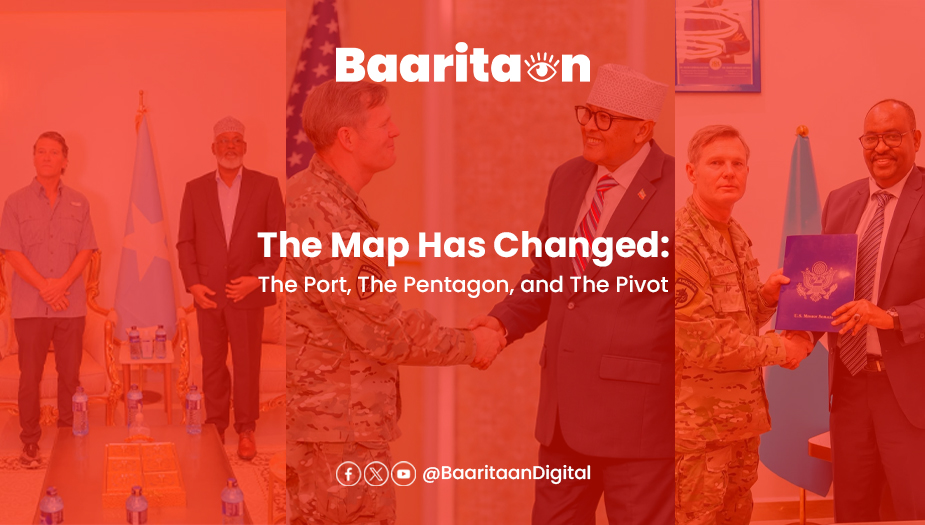
The meeting between Puntland President Said Abdullahi Deni and senior U.S. AFRICOM officials, including Major General Claude K. Tudor Jr., highlighted discussions focused on counterterrorism cooperation, maritime security, and expanding security coordination.
Bosaso’s importance comes from geography.
Located near the Gulf of Aden, the port sits close to one of the world’s most sensitive maritime regions. The Bab al-Mandab passage connects the Red Sea with the Indian Ocean and serves as a vital route for international trade and energy transportation.
For Washington, instability in this region is not only a Somali security issue. It is connected to broader concerns involving piracy, weapons trafficking, extremist networks, and threats to global commerce.
The logic resembles American security thinking elsewhere: establish flexible partnerships in locations where geography provides strategic advantages.
Jubbaland: The Southern Front of a New Security Calculation
Jubbaland represents another important piece of the emerging American approach.
The region’s significance comes from its location along the Kenya-Somalia border and its long history as a frontline area in the fight against Al-Shabaab.
A U.S. congressional and security delegation’s engagement with Jubbaland leadership reflects growing American interest in regional actors capable of contributing directly to counterterrorism operations.
The argument gaining influence in Washington is that security partnerships should be built with actors who can deliver measurable results on the ground rather than relying exclusively on centralized institutions that have struggled to overcome political and administrative challenges.
This approach resembles elements of the previous “dual-track” engagement philosophy, where Washington maintained relationships with both federal institutions and regional authorities when pursuing security objectives.
Somaliland and the Red Sea Factor
Somaliland has also become increasingly relevant in discussions about regional security.
Its coastline, stretching along the Gulf of Aden, places it near one of the world’s most important maritime routes.
Engagement between Somaliland President Abdirahman Mohamed Abdullahi “Cirro” and Major General Claude Tudor focused on security cooperation, maritime stability, counterterrorism, piracy, and organized crime.
Somaliland has long argued that its stability and geographic position make it a valuable security partner for international actors concerned with Red Sea security.
For the United States, the strategic question is increasingly straightforward: who can help secure critical maritime corridors and counter emerging threats?
The Mogadishu-Washington Relationship Faces a New Test
While Washington has expanded engagement with regional actors, relations with Somalia’s federal government have entered a more complicated phase.
The traditional American model depended heavily on supporting the Federal Government of Somalia, strengthening national institutions, and using international missions as pillars of stabilization.
However, recent U.S. policy decisions suggest a growing demand for accountability, measurable security progress, and greater Somali ownership of national defense.
The reduction of international support for AUSSOM logistics represents one of the clearest examples of this pressure. Analysts warn that without alternative financing arrangements, the mission could face serious operational challenges.
Washington’s position appears to be that international assistance cannot continue indefinitely without corresponding political reforms and security achievements.
The Trump Doctrine and the “America First” Calculation
The broader transformation fits into the foreign-policy philosophy of the Trump administration, which has emphasized that U.S. engagement abroad should produce direct strategic benefits for America.
Under this approach, partnerships are increasingly evaluated through questions such as: Does this relationship improve U.S. security? Does it protect important trade routes? Does it reduce terrorist threats? Does it strengthen reliable local partners?
Somalia’s strategic geography makes it impossible for Washington to ignore, but the method of engagement appears to be changing.
The United States may be moving away from a model centered primarily on building a single national security structure and toward a network-based model built around strategic partners.
A New Somali Security Landscape?
The emerging picture is not necessarily a complete American departure from Mogadishu. Rather, it suggests a redistribution of attention.
Puntland offers maritime access and counterterrorism relevance. Jubbaland offers a southern security corridor against Al-Shabaab. Somaliland offers a stable coastline overlooking critical shipping lanes. Together, these regions represent a geographic map of American interests in the Horn of Africa.
The central question now is whether this strategy will strengthen Somalia’s security architecture or deepen political divisions between Mogadishu and the regions. Washington’s calculation appears to be that security realities cannot wait for political consensus.
But Somalia’s future may depend on whether these new partnerships become a foundation for national stability — or another chapter in the country’s long struggle over power, sovereignty, and foreign influence.
The map of American engagement in Somalia is changing. The question is no longer whether Washington considers Somalia strategically important. The question is: which parts of Somalia will define America’s next strategic chapter?