

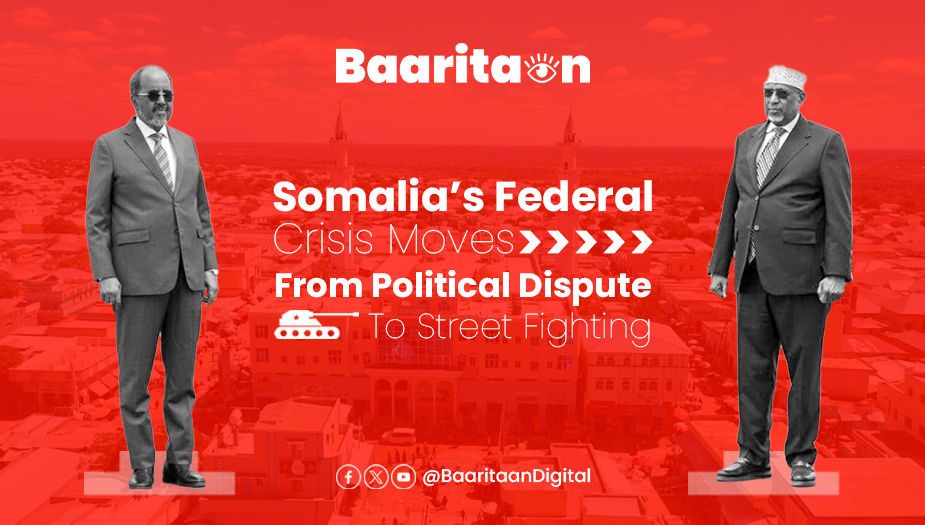

MOGADISHU, Somalia — Heavy fighting in Baidoa on Monday has transformed Somalia’s unresolved constitutional dispute into another armed confrontation over political authority, with forces loyal to ousted South West State President Abdiaziz Hassan Mohamed Laftagareen attacking positions held by federal troops and the administration of his successor, Adan Mohamed Nur “Adan Madobe.”
The assault is the clearest indication yet that the federal government’s intervention in South West State has failed to produce the political settlement it promised. Instead, it has created a regional administration whose authority remains contested, a former president who retains an armed constituency, and a capital increasingly dependent on federal troops for its security.
Baaritaan can reveal that Laftagareen-aligned forces entered Baidoa from two directions and engaged two battalions of federal forces, with fighting intensifying in the city centre.
The confrontation is also politically awkward for President Hassan Sheikh Mohamud. His government backed the process that removed Laftagareen, helped establish a new political order in Baidoa and supported Adan Madobe’s election. Yet, barely two months after Madobe’s election, his administration is struggling to demonstrate that it can control the territory it claims to govern.
That raises a more fundamental question: has Mogadishu strengthened Somalia’s federal system—or simply replaced one disputed regional authority with another that depends on federal military power?
Madobe’s legitimacy problem
Adan Madobe’s presidency began under unusually difficult circumstances. He was elected South West State president on June 10 after winning 88 votes in the regional parliament. But the process was contested, with opposition figures boycotting or rejecting the election and critics accusing Mogadishu of engineering the outcome.
The political optics were particularly damaging. Madobe was, until his election, the speaker of Somalia’s federal parliament. His move from the leadership of the national legislature to the presidency of a federal member state has allowed opponents to portray his election not as an autonomous South West decision but as an extension of Hassan Sheikh’s political project.
The criticism is not merely rhetorical. Madobe’s administration survives in a city secured by federal forces, while Laftagareen’s camp continues to claim a political mandate of its own.
That creates a credibility problem for Madobe: if the administration requires Mogadishu’s soldiers to defend its capital, how much of its authority is genuinely regional? This is the argument Laftagareen’s supporters are now exploiting.
Their military campaign does not have to defeat the Somali National Army outright. It only needs to demonstrate repeatedly that Madobe cannot govern South West without federal protection. Monday’s attack does exactly that.
Hassan Sheikh’s federal gamble
The larger vulnerability belongs to Hassan Sheikh Mohamud. The president has pursued a more assertive federal government, arguing that Somalia needs stronger national institutions, constitutional reform and a transition toward direct elections. But the strategy has collided with the political structure that Somalia has built since the adoption of federalism.
The country’s regional governments possess their own political constituencies, security forces and claims to autonomy. Puntland, Jubaland and opposition groups have increasingly challenged Mogadishu’s interpretation of the constitution and its electoral authority. South West State became the latest battlefield.
In March, the regional administration suspended cooperation with Mogadishu, signalling the depth of the federal rupture. Federal intervention followed, culminating in Laftagareen’s removal and the installation of a new political order.
For Hassan Sheikh, the calculation appeared straightforward: remove a defiant regional leader, secure Baidoa, install a cooperative administration and restore federal authority. The problem is that military control is not the same thing as political legitimacy. Monday’s fighting exposes that distinction.
The government can control Baidoa with federal troops. But if an armed opposition can repeatedly enter the city, mobilise local commanders and challenge the administration, Mogadishu has not resolved the underlying political dispute. It has merely militarised it.
The president’s mandate is the national version of the same dispute
That is why the Baidoa crisis cannot be separated from Hassan Sheikh’s own mandate controversy.
The president’s four-year mandate was due to expire in May. His government maintains that constitutional amendments adopted by parliament extended the terms of the presidency and parliament to five years, carrying them into 2027. The opposition rejects that interpretation and argues that Hassan Sheikh’s original constitutional mandate expired on May 15.
This is not a technical constitutional disagreement. It goes to the heart of the political legitimacy of the Somali state.
Hassan Sheikh’s government argues that parliament had the authority to amend the constitutional framework and establish a new electoral timetable. His opponents argue that institutions whose own mandates were expiring could not legitimately rewrite the rules governing their continued tenure. That dispute has produced a dangerous symmetry.
Hassan Sheikh says the constitutional process gives him authority to remain in office. Laftagareen says the political process that removed him from Baidoa was illegitimate. Both disputes ultimately revolve around who has the right to define legitimacy. The difference is that Hassan Sheikh controls the federal security apparatus. Laftagareen controls armed supporters.
The opposition is gaining an argument, even without winning a battle
The Somali opposition has seized on Baidoa as evidence for its broader claim that Hassan Sheikh’s centralising strategy is destabilising the country.
Opposition leaders, including figures associated with the Somali Future Council, have rejected the president’s mandate extension and demanded a negotiated electoral framework. Talks between the government and opposition have repeatedly failed to produce agreement. International partners, including the United States and Britain, have been pushing for another effort to break the deadlock.
The opposition’s strongest argument is therefore not necessarily that Laftagareen should return to power. It is that Hassan Sheikh’s method of resolving political disputes is producing more disputes. South West is the clearest example.
The federal government intervened to prevent a political confrontation from becoming a regional crisis. It removed Laftagareen and backed a successor. But the result has been recurring armed clashes, a heavily militarised capital and an administration whose legitimacy remains contested.
The same pattern is visible elsewhere.
Relations between Mogadishu and other federal member states have deteriorated over constitutional reform, elections and control of territory. Analysts have described the federal government’s authority as increasingly contested, with disagreements intersecting with wider disputes over security and the distribution of power.
The danger for Hassan Sheikh is that each new confrontation strengthens the opposition’s central narrative: that Somalia is moving from negotiated federalism toward centralised rule backed by security forces.
Baidoa exposes the limits of Mogadishu’s strategy
There is an important irony in the government’s position.
Hassan Sheikh came to power promising to rebuild the Somali state and strengthen national institutions. Yet the more the federal government intervenes directly in regional politics, the more it risks turning federal member states into battlegrounds over the president’s own political survival.
Baidoa illustrates the problem perfectly. Laftagareen’s removal did not eliminate his political constituency. Madobe’s election did not end the dispute. Federal troops did not make the political settlement permanent. Instead, the government now has to defend the settlement militarily. That is an expensive and strategically dangerous proposition for a country already fighting al-Shabaab.
Every federal unit deployed to protect Baidoa from a rival political faction is a unit that cannot be concentrated elsewhere. Somalia’s security forces are already stretched, while al-Shabaab remains capable of exploiting political fragmentation and gaps in government control.
The political crisis therefore risks becoming a security crisis—and the security crisis can, in turn, make the political crisis harder to solve.
A humanitarian crisis caught between political factions
For ordinary residents, the constitutional argument is increasingly irrelevant compared with the consequences of armed competition.
Baidoa is one of Somalia’s most important humanitarian centres and hosts hundreds of thousands of displaced people. Recent reporting says Somalia is experiencing roughly 2mn people at emergency levels of food insecurity, while drought, conflict and shrinking humanitarian assistance are worsening conditions.
Medical humanitarian groups have also warned of severe malnutrition among children in displacement sites around Baidoa. This makes the political struggle particularly dangerous.
A contest between Hassan Sheikh and Laftagareen, or between Madobe and his opponents, is being fought in a city where a large civilian population has little capacity to absorb another round of displacement.
If fighting becomes prolonged, the humanitarian consequences could rapidly outlast the political calculations that produced it.
The real threat to Hassan Sheikh
The immediate question is whether Laftagareen’s forces can maintain their positions inside Baidoa. The more important question is whether Hassan Sheikh can continue to impose political settlements through federal power without creating a broader coalition against him.
His government has already faced sustained resistance from opposition figures and federal member states over the constitutional and electoral process. International partners have warned that Somalia needs an inclusive political agreement to prevent the electoral dispute from escalating further. Baidoa makes that warning more urgent.
If the president’s political opponents conclude that negotiations cannot change the balance of power, they have fewer incentives to compromise. If regional leaders conclude that cooperation with Mogadishu means accepting federal intervention in their internal politics, they have fewer incentives to remain aligned with the centre.
And if armed actors conclude that political concessions can be obtained through force, the entire federal system becomes more fragile.
That is the central weakness of Hassan Sheikh’s current strategy: it may win individual confrontations while losing the larger contest for political consent.
Madobe may be the immediate loser
For Adan Madobe, the danger is even more direct. His presidency was supposed to demonstrate that South West State had moved beyond the Laftagareen confrontation. Instead, his administration is now being tested by the very armed network that Mogadishu claimed to have neutralised.
The fact that Laftagareen-aligned forces can challenge Baidoa after his election undermines the image of a settled government. Madobe can survive politically if federal forces keep control of the city.
But that comes with a price. The longer he depends on federal troops, the easier it becomes for his opponents to describe him as Mogadishu’s representative rather than an autonomous South West leader. That is a particularly damaging charge in a federal system built around regional political legitimacy.
Somalia’s crisis is no longer just about elections
The conventional description of Somalia’s current turmoil is an electoral crisis. It is now something larger. It is a crisis over the meaning of federalism itself.
Who controls regional elections? Who appoints or removes regional leaders? When can Mogadishu intervene militarily? How much authority does a federal member state retain? And, ultimately, who has the constitutional right to exercise national power? These questions remain unanswered.
Monday’s fighting in Baidoa is the latest evidence that Somalia’s political class has not found a way to answer them peacefully.
For Hassan Sheikh, the danger is that his effort to consolidate the federal state could produce the opposite result: a collection of increasingly distrustful regions, armed political factions and opposition movements united less by ideology than by resistance to Mogadishu.
For Madobe, the danger is that his presidency becomes synonymous with federal military protection rather than popular political legitimacy.
For Laftagareen, Monday’s assault offers a powerful political message even if his forces ultimately withdraw: he can still make Baidoa ungovernable without his consent. And for Somalia, that may be the most troubling development of all. A country preparing for another contested electoral transition cannot afford to have its political disputes repeatedly cross the line into armed conflict. Yet Baidoa suggests that Somalia is moving in precisely that direction.