

KAMPALA – Wars are not always fought with bullets. Sometimes they are fought over a phrase in a communiqué, a carefully chosen adjective, or a sentence that disappears before leaders put their names to an agreement.
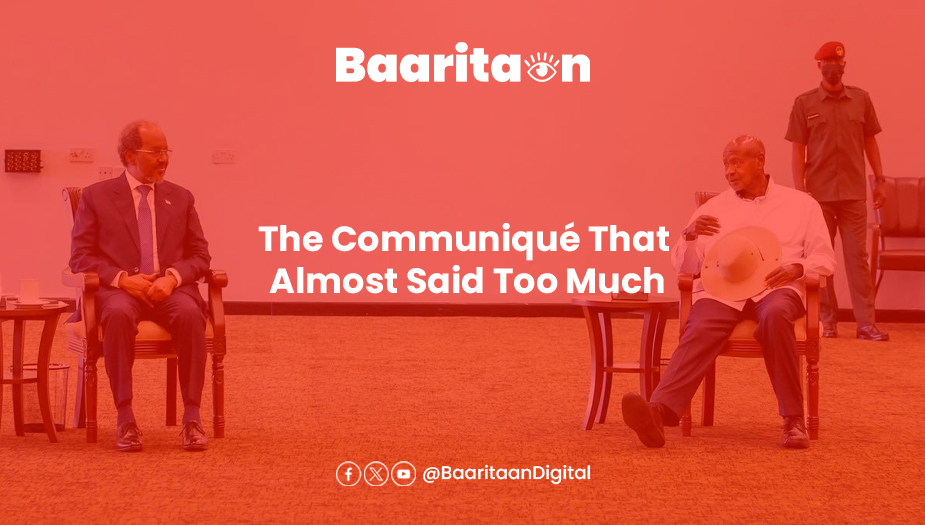
That quieter struggle unfolded behind closed doors at the African Union Support and Stabilization Mission in Somalia (AUSSOM) summit in Uganda’s lakeside suburb of Munyonyo, where presidents, defence ministers and military commanders gathered to discuss the future of the regional campaign against al-Shabaab.
Officially, the summit was focused on security.
But behind the formal agenda, accounts from participants and regional observers suggest a deeper disagreement emerged: whether Somalia’s security crisis can be addressed without directly confronting the country’s unresolved political disputes.
At the centre of that debate was Somali President Hassan Sheikh Mohamud.
According to multiple diplomatic and regional accounts after the meeting, Hassan Sheikh objected to draft language calling for “inclusive political dialogue” in Somalia. The president publicy argued that constitutional disputes, electoral disagreements and tensions between Mogadishu and federal member states were matters of national sovereignty and should not become part of the mandate of AUSSOM or troop-contributing countries.
The wording was later revised before the communiqué was adopted.
The change has drawn attention from critics of the Federal Government, who argue that removing explicit reference to political dialogue risks overlooking the internal disputes that have contributed to Somalia’s instability. They contend that military efforts against al-Shabaab cannot achieve lasting success if political divisions, federal tensions and questions over representation remain unresolved.
A draft communiqué circulated ahead of the summit had included language urging “inclusive political dialogue,” reflecting a broader position among some African and international partners that reconciliation and political consensus are essential components of long-term stabilization, particularly as donors weigh the future financing of AUSSOM.
However, the final communiqué adopted in Munyonyo removed that specific reference.
Instead, it emphasized a unified Somalia, democratic governance, stronger national institutions and cooperation among Somali authorities, while avoiding a direct call for dialogue between competing political actors.
According to diplomatic accounts, the revision followed Hassan Sheikh’s objections that Somalia’s political affairs fell outside the mission’s security mandate. Supporters of the government view the change as a defence of sovereignty, while critics see it as a missed opportunity to acknowledge the political challenges that continue to shape Somalia’s security environment.
What the Final Communiqué Says
The adopted communiqué reaffirms the commitment of troop-contributing countries to defeating al-Shabaab, accelerating force generation, improving intelligence cooperation and securing sustainable funding for AUSSOM.
It also supports strengthening Somalia’s national security institutions and gradually transferring greater responsibility for security operations to Somali forces.
On political matters, however, the language remains cautious.
Rather than explicitly urging dialogue among Somalia’s political stakeholders, the communiqué focuses on strengthening democratic governance, national institutions and cooperation between the Federal Government, federal member states and traditional leaders.
It encourages unity and national interests but stops short of identifying political disputes or calling for a structured process to address them.
Whether the final wording represents a negotiated compromise or a victory for one side of the debate cannot be determined from the communiqué alone. But the changes highlight a growing disagreement over whether Somalia’s stabilization effort should address only armed threats or also the political conditions that contribute to insecurity.
AUSSOM’s Two Competing Visions
The dispute over the communiqué reflects two competing interpretations of what AUSSOM is meant to achieve.
One view sees the mission primarily as a security operation: defeating al-Shabaab, supporting Somali forces and creating the conditions for the government to assume full responsibility for national security.
The other argues that Somalia’s security challenges cannot be separated from its political crisis. Supporters of this view point to disputes over constitutional reform, federal authority, elections and political inclusion as factors that continue to weaken national cohesion and create openings for instability.
These tensions have become increasingly visible in recent years.
Relations between Mogadishu and Puntland have deteriorated over constitutional amendments, electoral reforms and disagreements over the distribution of federal authority. Political disputes have increasingly affected security arrangements, including questions surrounding force integration, leadership appointments and military coordination.
Against that backdrop, even a phrase such as “inclusive political dialogue” carries significant political meaning.
For the Federal Government, such language may create the impression that external actors are being invited to intervene in domestic political questions.
For opposition figures and some regional actors, however, avoiding such language may reinforce concerns that political disagreements are being treated as secondary issues rather than as drivers of instability.
Sovereignty and International Dependence
The Munyonyo debate also exposes a long-standing contradiction in Somalia’s recovery process.
The Federal Government maintains that Somalia is a sovereign state with the authority to determine its own political and constitutional future.
At the same time, Somalia’s security system remains heavily dependent on African military support, international financing and external logistical assistance.
That dependence creates a difficult balance.
Regional partners argue that countries contributing troops, resources and political support naturally have an interest in the broader conditions that determine whether security gains can last.
Mogadishu argues that security assistance should not become a pathway for outside actors to influence Somalia’s political direction.
Both arguments carry weight.
Beyond a Single Sentence
The disagreement over the communiqué may appear minor when viewed only as a diplomatic editing dispute.
But within Somalia’s wider political landscape, it represents a much larger question: who defines the path to stabilization?
Is Somalia’s crisis primarily a military challenge requiring stronger security institutions and continued operations against al-Shabaab?
Or is it a political crisis in which military action alone cannot address the deeper causes of conflict?
The Munyonyo communiqué does not resolve that debate.
Instead, its carefully measured language reflects the difficult reality facing Somalia and its international partners: they remain committed to defeating al-Shabaab while navigating unresolved questions over federalism, political legitimacy, inclusion and national reconciliation.
For Somalia’s opposition voices and critics of the current political direction, the removed reference to dialogue represents a warning that security gains may remain fragile without meaningful political reform.
For the government, the episode reinforces a different principle: Somalia’s future must be shaped primarily by Somalis themselves.
In the end, the battle over a single sentence revealed a much larger struggle — not only over the wording of a communiqué, but over the future meaning of stabilization in Somalia.