

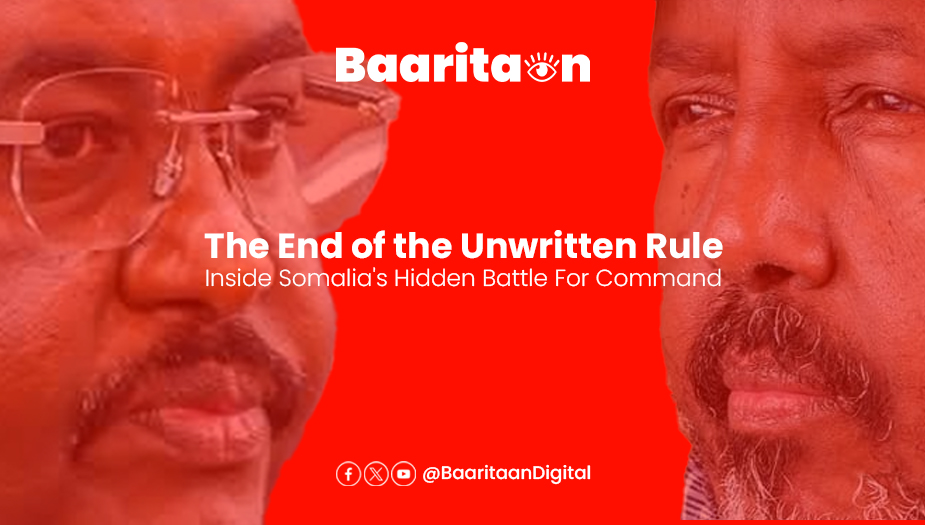

GAROWE — For years, Somalia’s federal crisis has resembled a constitutional quarrel wrapped in political theatre. Presidents argued over powers, regional leaders boycotted meetings and lawyers disputed clauses that were never fully agreed upon. Yet one unwritten rule largely survived: whatever the political dispute, the country’s rival authorities would avoid openly competing for armed control inside one another’s territory.
That rule appears to have broken down.
This week Puntland launched the most sweeping internal security operation in its modern history—not against ISIS-Somalia or Al-Shabaab, but against armed formations that it says were recruited, organised or absorbed by Somalia’s Federal Government inside Puntland itself.
The operation may prove to be remembered not as another episode in Somalia’s long-running centre-periphery dispute, but as the moment the federal argument acquired a military dimension.
Regardless of how Mogadishu characterises the events, the operation marks one of the most consequential confrontations between Somalia’s federal authorities and one of its most powerful member states since the country’s federal system was established.
Security institutions become the battleground
The largest operation took place outside Galkayo, where Puntland forces entered a fortified military installation occupied by personnel who had declared themselves part of the Federal Government’s security structures, including fighters associated with elements of the Puntland Security Force (PSF).
Regional authorities later announced the arrest of 101 individuals, among them senior commanders, while reporting that approximately 60 people were wounded during the operation.
Officials also displayed dozens of seized weapons, military vehicles, communications equipment and police assets, claiming some had originally been donated to Somalia by international partners — including China— but had never previously been allocated to Puntland.
Among those detained, Puntland identified Abdikadir Shiine, commander of the Federal Police’s U.S.-trained Joint Elite Team (JET), a specialised formation reportedly comprising between 70 and 80 officers.
If independently confirmed, the operation would represent the clearest indication yet that Somalia’s political disagreements have evolved into direct competition over armed authority inside a federal member state.
An 48-hour ultimatum backed by force
The raids followed President Said Abdullahi Deni’s decision to issue a 48-hour ultimatum requiring all armed groups operating outside Puntland’s recognised command structure to register with regional security authorities and surrender unauthorised weapons.
The administration declared that any military formations remaining outside state control would be considered illegal.
Puntland Police warned that anyone refusing to comply would face prosecution under regional law while also cautioning neighbouring administrations against providing refuge to armed groups leaving Puntland territory.
Within hours of the deadline, local officials and community leaders reported that several units claiming affiliation with the Federal Government had crossed into neighbouring Galmudug overnight. Others entered negotiations through traditional elders seeking peaceful reintegration into Puntland’s security institutions.
The role of clan mediation, not generals
The military operation has unfolded alongside intensive negotiations led by clan elders, whose influence continues to shape Somalia’s security landscape despite decades of state-building efforts.
Political figures involved in the discussions said elders persuaded several commanders who had joined federal security structures over the past ten months to surrender their weapons voluntarily and allow their personnel to be absorbed into Puntland’s official forces.
In Bosaso, authorities assumed control of a former PSF facility following negotiations rather than combat, with government-appointed committees overseeing the transfer of military equipment.
Those developments suggest Puntland has sought to combine coercive measures with traditional mechanisms of conflict resolution rather than relying exclusively on force.
The dispute behind the operation
The immediate confrontation reflects a broader disagreement over the future structure of Somalia’s state.
President Hassan Sheikh Mohamud has increasingly argued that a functioning federal republic requires stronger national institutions and greater central oversight of security forces.
Federal officials maintain that Somali citizens have the constitutional right to join national military institutions regardless of political disputes between Mogadishu and regional administrations.
Puntland disputes that interpretation.
Regional officials argue that recruiting armed personnel inside a federal member state without its consent amounts to establishing parallel security institutions and undermines the federal balance established after years of political negotiations.
For Garowe, the issue extends beyond individual units or commanders. It concerns whether authority over internal security can gradually shift to the centre without a negotiated constitutional settlement.
Months of rising tensions
The latest confrontation follows months of steadily deteriorating relations.
The dispute accelerated after President Hassan Sheikh Mohamud hosted Col. Said Abdirizak, introduced by Federal Police Commissioner Asad Osman Abdullahi (Diyaano) as commander of PSF personnel incorporated into the Somali National Army.
Soon afterwards Prime Minister Hamza Abdi Barre announced plans to recruit 10,000 personnel from Puntland into Somalia’s national security institutions.
To federal officials, the initiative represented the normal exercise of sovereign authority.
To Puntland, it appeared to signal the creation of parallel armed structures operating beyond regional control.
The disagreement deepened further after President Hassan Sheikh appointed Gen. Jimcaale Jaamac Takar, commander of the U.S.-trained Danab Special Forces, to lead the Somali National Army’s 54th Division based in Garowe.
That appointment brought Somalia closer to an internal security confrontation than at any point in recent years before mediation by traditional elders and diplomatic partners helped ease tensions.
A widening political divide
The latest operation has also widened Somalia’s political divisions.
Jubaland publicly endorsed Puntland’s actions, accusing the Federal Government of politicising national security institutions while warning that internal military competition risks diverting attention from operations against Al-Shabaab and ISIS-Somalia.
Reports from local officials indicate that some federally aligned forces withdrawing from Puntland have relocated into Galmudug, while Puntland has warned neighbouring administrations against offering sanctuary to armed groups it considers outside the law.
Those developments suggest the dispute is beginning to spill beyond Puntland itself.
International implications
The timing is particularly sensitive.
Puntland has become the centre of Somalia’s campaign against ISIS-Somalia and remains one of the country’s most capable security partners for international counterterrorism efforts.
Western governments have invested heavily in specialised Somali security units over the past decade with the objective of building a coherent national security architecture.
Instead, some of those institutions are increasingly becoming part of Somalia’s broader constitutional contest.
Diplomats privately acknowledge that prolonged confrontation between Mogadishu and Puntland could complicate operations against extremist organisations at a time when both ISIS-Somalia and Al-Shabaab continue to pose significant threats.
More than a regional dispute
Puntland’s latest operation may ultimately be remembered less for the number of detainees or captured weapons than for what it reveals about the direction of Somalia’s federal experiment.
The country’s political debate has shifted from constitutional interpretation to practical questions of military command.
Whether Somalia evolves into a more centralised state or preserves a highly decentralised federal model will depend not only on negotiations in Mogadishu but increasingly on developments in places such as Galkayo and Bosaso, where competing interpretations of the constitution are now being tested by competing security institutions.
For Puntland, the operation represents the restoration of a single chain of command within its territory. For the Federal Government, the broader objective remains the construction of genuinely national security institutions.
Reconciling those two ambitions may prove to be one of the defining political challenges facing Somalia’s federal republic. The strategic consequences, however, remain uncertain. Somalia’s most consequential battle is no longer only against jihadist insurgents. Increasingly, it is over a more fundamental question: who commands the state itself?
Why the stakes now extend beyond Puntland
The confrontation comes at a particularly precarious moment for Somalia’s international security architecture.
While Puntland and Mogadishu dispute the constitutional boundaries of federal authority, the external framework that has underpinned Somalia’s security for nearly two decades is itself entering an uncertain transition.
The most immediate concern is the future of the African Union Support and Stabilisation Mission in Somalia (AUSSOM). Diplomats acknowledge that the mission faces its most serious financial challenge since replacing ATMIS in 2025 after Washington informed the African Union that it would no longer support financing for the UN logistical support system sustaining AUSSOM beyond December 2026 unless a new funding model is agreed. The decision threatens the logistics network that supplies food, fuel, medical evacuation and transport for roughly 12,000 African Union personnel operating across Somalia.
African leaders sought to contain the uncertainty during high-level consultations in Kampala in late July, agreeing in principle that AUSSOM should continue for at least another 18 to 24 months while alternative financing mechanisms are explored. Senior officials from AUSSOM, the United Nations Transitional Assistance Mission in Somalia (UNTMIS) and Somali security institutions have also intensified coordination meetings over the future of security assistance, underscoring growing concern that Somalia could enter a funding vacuum just as political tensions deepen.
For international partners, the timing could hardly be worse.
Somalia is simultaneously confronting an increasingly bitter constitutional dispute over electoral reforms and federal power-sharing. Constitutional amendments adopted by the Federal Parliament earlier this year, including changes linked to the country’s electoral framework and political timetable, have widened divisions between Mogadishu and several federal member states. Puntland and Jubaland continue to reject the changes, while South West State also suspended relations with the Federal Government earlier this year amid accusations of political interference. Analysts increasingly describe the country’s political crisis as the deepest since the adoption of the provisional constitution in 2012.
The electoral dispute has also acquired an international dimension. Diplomatic efforts involving the United States, Türkiye and other international partners have sought to encourage dialogue between the Federal Government and opposition groups over Somalia’s 2026 political transition, reflecting concern that a prolonged constitutional impasse could undermine both security operations and international assistance.
Against that backdrop, Puntland’s latest security operation is likely to resonate well beyond Garowe.
For Puntland officials, dismantling what they describe as parallel federal military structures is presented as a constitutional necessity aimed at preserving the integrity of Somalia’s federal settlement and preventing overlapping chains of command inside one of the country’s most important counterterrorism theatres.
Federal authorities, by contrast, continue to argue that building genuinely national security institutions requires the integration of personnel from every region under a unified command.
That disagreement now unfolds at a moment when Somalia’s external security guarantees are becoming less certain, donor patience is visibly wearing thin, and international partners are increasingly linking future financial and military support to political consensus among Somali stakeholders.
The convergence of those pressures means the current dispute is no longer simply about Puntland or Mogadishu. It has become a test of whether Somalia can reconcile competing visions of federalism while preserving the security architecture on which much of the country’s counterterrorism strategy still depends.