


MOGADISHU — Somalia’s political crisis has entered a new and potentially consequential phase after the Somali Future Council, the country’s newly consolidated opposition coalition, appealed directly to the African states supplying troops to the African Union Support and Stabilization Mission in Somalia (AUSSOM), urging them to make any future security engagement conditional on a negotiated political settlement.
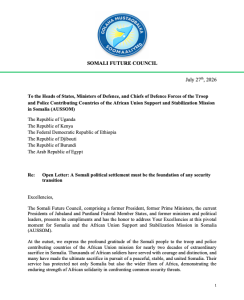
The letter, addressed to the heads of state, defense ministers, and military chiefs of Uganda, Kenya, Ethiopia, Djibouti, Burundi, and Egypt, represents one of the opposition’s strongest diplomatic offensives since President Hassan Sheikh Mohamud’s constitutional term expired in May.
More significantly, it seeks to redefine the conversation surrounding Somalia’s security crisis. Rather than portraying al-Shabaab as the country’s primary challenge, the opposition argues that Somalia’s greatest threat has become a crisis of political legitimacy.
“The absence of a legitimate government the world can trust and engage with” is now the central obstacle to defeating terrorism, the letter argues.
That framing directly challenges the narrative advanced by Villa Somalia, which has consistently maintained that security operations and constitutional reforms should proceed under the authority of the current federal government.
Shifting the Debate
For nearly two decades, Somalia’s international partners have approached the country’s stabilization through a familiar formula: strengthen state institutions, expand the Somali National Army, and gradually transfer security responsibilities from African peacekeepers to Somali forces.
The Somali Future Council contends that this sequencing has broken down.
Instead of security creating political stability, the opposition argues, Somalia’s unresolved political crisis is now undermining the security gains painstakingly achieved by African troops and Somali forces alike.
Their message is blunt: without political legitimacy, there can be no sustainable security transition.
That argument arrives as AUSSOM faces mounting financial uncertainty, shrinking donor enthusiasm, and increasing pressure to demonstrate measurable progress after almost twenty years of international military engagement.
A Direct Appeal to Africa
Unlike previous opposition statements directed primarily at Western diplomats or the United Nations, this letter targets African capitals that have borne the human cost of Somalia’s long war.
Uganda, Burundi, Kenya, Ethiopia, Djibouti, and now Egypt collectively provide the military backbone of AUSSOM.
By acknowledging nearly two decades of sacrifice while warning that those sacrifices risk being squandered by Somalia’s political deadlock, the opposition is asking African leaders to move beyond a purely military role and become active stakeholders in resolving Somalia’s constitutional crisis.
The timing is significant.
African leaders are expected to consider AUSSOM’s future amid persistent funding shortfalls, battlefield setbacks against al-Shabaab, and growing uncertainty over Somalia’s political direction.
Rather than requesting additional military support, the Somali Future Council argues that future assistance should be conditioned on an inclusive political agreement.
A Question of Legitimacy
At the heart of the letter lies a constitutional argument.
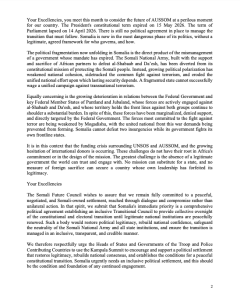
The opposition notes that Parliament’s term expired on 14 April 2026, followed by the expiration of President Hassan Sheikh Mohamud’s constitutional mandate on 15 May 2026. In its view, Somalia is now operating without a mutually agreed constitutional framework governing executive authority or the political transition.
The federal government disputes that interpretation, arguing that constitutional and institutional processes continue while political negotiations remain ongoing.
The disagreement is more than legal.
It strikes at the core of who possesses the authority to negotiate with international partners, command the security forces, and oversee the country’s transition toward new elections.
Security and Politics Become Intertwined
Perhaps the letter’s most politically sensitive accusation concerns the Somali National Army and relations between Mogadishu and the federal member states.
The opposition alleges that Puntland and Jubaland—both of which continue military operations against al-Shabaab and the Islamic State affiliate in northern Somalia—have been politically marginalized despite remaining on the front lines of Somalia’s counterterrorism campaign.
According to the Somali Future Council, divisions between the federal government and regional administrations have fragmented the national security architecture at precisely the moment greater unity is required.
Whether international partners share that assessment remains uncertain.
Many external actors have long viewed political disputes between Mogadishu and federal member states as an obstacle to state-building. Yet few have publicly linked continued security assistance to the establishment of a new political arrangement.
The opposition is now urging them to do exactly that.
The Transitional Council Proposal
The letter advances a concrete political proposal: the creation of an inclusive Transitional Council to oversee Somalia’s constitutional and electoral transition until new national institutions can be established.
Such a body, the opposition argues, would restore political legitimacy, guarantee the neutrality of state institutions, and rebuild confidence among Somalia’s competing political actors.
For President Hassan Sheikh Mohamud, however, accepting such an arrangement would almost certainly require sharing executive authority during one of the country’s most politically consequential periods.
There is little indication that Villa Somalia is prepared to embrace that course.
Raising the Diplomatic Stakes
The decision to copy the letter to the African Union Commission, the AU Peace and Security Council, IGAD, African members of the UN Security Council, the United States, the United Kingdom, the European Union, Türkiye, and the United Nations Transition Mission in Somalia underscores the opposition’s broader diplomatic strategy.
Rather than limiting its campaign to domestic politics, the Somali Future Council is attempting to internationalize Somalia’s constitutional dispute by persuading external partners that political legitimacy—not military capacity—is now the decisive variable in Somalia’s stabilization.
Whether that message gains traction remains unclear.
African governments have historically been reluctant to intervene directly in Somalia’s internal political disputes, preferring to emphasize dialogue among Somali stakeholders while maintaining security cooperation.
Yet the opposition’s appeal comes at a moment when donors are reassessing long-term commitments to Somalia and AUSSOM faces significant financial and operational pressures.
A Major Turning Point
The letter is unlikely, by itself, to alter the course of Somalia’s politics.
But it marks a notable escalation in the country’s political contest.
For the first time since the expiration of the federal government’s constitutional mandate, Somalia’s principal opposition coalition has formally asked the countries providing the soldiers who underpin the Somali state to make continued security support contingent upon a negotiated political settlement.
That represents more than diplomatic messaging.
It is an attempt to shift the center of gravity in Somalia’s crisis—from the battlefield to the negotiating table, and from counterterrorism to constitutional legitimacy.
Whether African leaders embrace that argument may shape not only the future of AUSSOM but also the trajectory of Somalia’s fragile state-building project.