


GAROWE — Somalia has stepped back from the brink of what could have become its most serious internal political and military confrontation in years after weeks of tensions between the Federal Government and Puntland ended not with gunfire, but with quiet negotiations.
The peaceful return of Gen. Jimcaale Jaamac Takar, commander of the U.S.-trained Danab Special Forces based at the Ligle military camp outside Garowe, on July 16 defused fears that his arrival could trigger armed clashes between forces aligned with President Hassan Sheikh Mohamud’s administration and Puntland’s regional government under President Said Abdullahi Deni.
For nearly a month, Jimcaale remained in Mogadishu and later Las Anod following his appointment by President Hassan Sheikh as commander of the Somali National Army’s 54th Division, headquartered in Garowe. While Villa Somalia presented the appointment as part of routine military restructuring, Puntland viewed it as an unprecedented federal attempt to establish a parallel security structure inside a federal member state.
Growing Divide
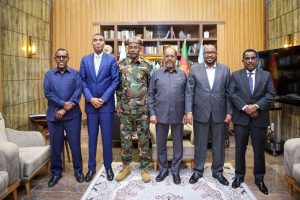
The appointment became public after President Hassan Sheikh Mohamud, accompanied by Prime Minister Hamza Abdi Barre and several political figures opposed to Puntland President Said Abdullahi Deni, formally received Gen. Jimcaale at Villa Somalia on June 15, 2026. It came against the backdrop of steadily deteriorating relations between Mogadishu and Puntland.
The two sides remain deeply divided over constitutional amendments, electoral reforms and the balance of power between Somalia’s federal government and its regional administrations. Puntland suspended recognition of federal institutions after constitutional changes adopted in 2024, arguing that they lacked the broad political consensus required under Somalia’s provisional constitution.
According to Puntland officials and political sources familiar with the dispute, Jimcaale’s appointment represented the first visible phase of a broader federal strategy to expand its security footprint inside Puntland. Those officials allege that Mogadishu had spent months recruiting, training and organizing forces inside Puntland with the expectation that Jimcaale would command them from Garowe.
Open Challenge
Any remaining ambiguity over Mogadishu’s intentions appeared to disappear during Somalia’s Independence Week celebrations.
In a nationally televised address on July 3, Prime Minister Hamza Abdi Barre openly declared that the Federal Government intended to recruit 10,000 security personnel from Puntland, arguing that citizens throughout Somalia have an equal right to serve in national institutions regardless of regional political disputes.
President Hassan Sheikh later defended the government’s broader security agenda during the same celebrations.
According to documents reviewed by Baaritaan and officials familiar with the program, more than $1 million has reportedly been spent on recruiting, equipping and organizing federal-aligned forces inside Puntland. Puntland officials further claim that foreign governments supportive of Villa Somalia contributed to aspects of the initiative, although those allegations have not been independently verified.
The Escalation and Talks
Rather than proceeding directly to Puntland, Jimcaale first traveled to Las Anod, where negotiations quietly began. Meanwhile, Puntland adopted new security measures prohibiting armed forces operating outside its command structure and banning the movement of weapons not officially registered with regional authorities.
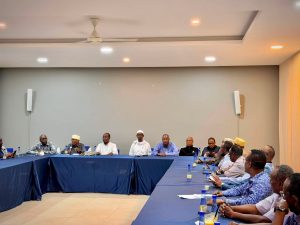
Military deployments increased around Garowe, raising fears that competing security forces could quickly slide into open confrontation. Instead of escalating, influential traditional elders, senior politicians and Puntland officials from the Nugaal region opened discreet negotiations with Jimcaale while he remained in Las Anod.
Those talks ultimately produced a compromise that allowed the Danab commander to return peacefully to Garowe.
Officials from both sides told Baaritaan that the preliminary understanding includes Puntland restoring one year of salary and benefits for Jimcaale and his troops, while the commander is expected to publicly withdraw from exercising the federal appointment that triggered the dispute. The reported agreement also commits both sides to avoid actions that could threaten Puntland’s security, stability and political cohesion.
Washington’s Role
Diplomatic sources say the United States played an important, though largely invisible, role in encouraging both sides to negotiate.
Washington has invested heavily in Somalia’s Danab Special Forces and remains focused on supporting operations against ISIS-Somalia, whose remaining strongholds are concentrated in Puntland’s Cal Miskaad mountains.
According to diplomats familiar with the discussions, American officials feared that a confrontation inside Puntland would divert elite counterterrorism units away from operations against ISIS and undermine hard-earned security gains.
Instead, U.S. interlocutors reportedly urged both sides to resolve their dispute politically while maintaining focus on their common security threat.
A Larger Contest
The peaceful resolution of the Jimcaale dispute removed an immediate security threat, but it did not resolve the underlying political conflict.
At its core, the confrontation reflects competing visions of Somalia’s future. President Hassan Sheikh’s administration continues to pursue a more centralized model of state-building built around national institutions, direct elections and stronger federal authority. Puntland, meanwhile, insists that meaningful constitutional consensus must precede any further transfer of political or security powers to Mogadishu.
As Somalia moves toward another critical political transition, disputes over military command, electoral reform and constitutional authority are becoming increasingly intertwined.
The Garowe standoff ultimately demonstrated that dialogue can still prevail over confrontation. But it also underscored how fragile Somalia’s federal compact has become—and how easily political competition could undermine national security if left unmanaged.
For Somalia’s leaders, the lesson extends well beyond this single crisis: negotiations remain far less costly than armed confrontation. For international partners, the episode illustrates that external engagement is most effective when it reinforces Somali-led compromise rather than becoming another source of political division.