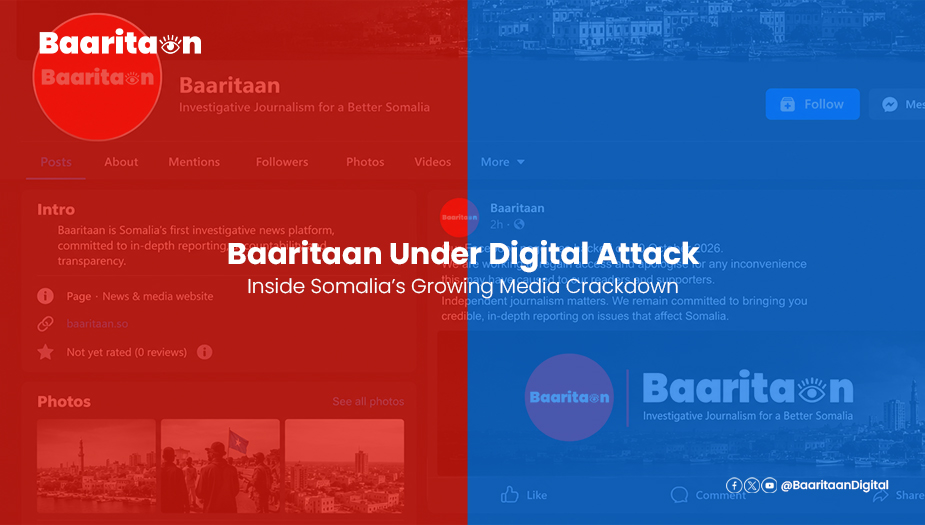

MOGADISHU, Somalia — Baaritaan, Somalia’s first investigative news platform’s Facebook page, was hacked on 10 October, raising renewed concerns about digital attacks against independent media and efforts to restrict critical reporting as the country navigates a contentious political transition.
The incident comes amid a broader pattern of online attacks against Somali journalists and media organisations, including Facebook page suspensions, suspicious copyright claims and attempts to disable accounts. Media watchdogs have warned that such tactics can undermine independent reporting and restrict public access to information on matters of public interest.
The hacking of Baaritaan’s Facebook page raises urgent questions about the security of independent news platforms and whether online mechanisms are being exploited to target media outlets critical of powerful political and institutional interests.
The incident comes at a sensitive moment for Somalia, where disputes over constitutional changes, electoral arrangements and the future of federal institutions have intensified political tensions and increased the importance of independent journalism.
Media watchdogs document a growing pattern
The Somali Journalists Syndicate (SJS), a local press freedom organisation, reported in September 2026 that Somali journalists and media organisations were experiencing a growing wave of online attacks, including Facebook account removals, fake copyright claims and attempts to falsely memorialise accounts belonging to living journalists.
In a separate investigation published in September, SJS documented incidents involving journalists and media outlets whose Facebook pages or content had become unavailable. The organisation raised concerns about the possible exploitation of platform reporting systems to silence critical reporting.
The watchdog’s findings point to a growing challenge for independent Somali media, many of which depend on Facebook to distribute investigations and reach audiences in Somalia and across the diaspora.
Although account restrictions can occur for a variety of reasons, repeated attacks affecting outlets that report on politically sensitive subjects warrant transparent investigations by technology companies and relevant authorities.
For investigative platforms such as Baaritaan, losing access to a major distribution channel can disrupt reporting, reduce audience reach and limit the public’s ability to scrutinise decisions made by those in power.
Questions over political pressure
Concerns about online attacks have emerged alongside allegations of pressure against journalists and media outlets critical of Somalia’s federal authorities.
In April 2026, SJS raised concerns over reports that federal cabinet discussions had addressed media outlets and journalists critical of the government. The organisation also reported that media executives had raised concerns about threats from senior officials.
Other investigations by the syndicate have examined allegations involving suspicious copyright complaints and possible links between individuals conducting online attacks and government-related communications work. Those allegations require independent verification and do not establish that federal authorities directed the hacking of Baaritaan’s page.
The incident nevertheless underscores the need for clarity about whether government agencies have contacted Meta, Facebook’s parent company, concerning Baaritaan or its reporting.
The Federal Ministry of Information, the National Communications Authority and other relevant institutions should publicly clarify whether they are aware of the incident and whether any requests have been made concerning the platform’s Facebook page or published content.
Any allegation of direct government involvement must be assessed against verifiable evidence, including account-security records, communications with platform operators and documented requests to restrict content. Establishing responsibility is essential to ensuring accountability and avoiding unsupported conclusions.
Political transition raises the stakes
Somalia is navigating a period of heightened political uncertainty following constitutional changes approved by parliament in March 2026. The changes triggered disagreements over the electoral timetable, the presidential term and the broader framework for the country’s political transition.
The disputes have deepened divisions between the federal government and opposition figures over the legitimacy and implications of the new constitutional arrangements.
Independent media are essential during such periods. Journalists provide citizens with information about political negotiations, public institutions, security operations and decisions that may affect the country’s future.
When news organisations lose access to their digital platforms, the consequences extend beyond the affected outlet. Audiences may lose access to investigations, public-interest reporting and information needed to assess competing political claims.
The reported hacking of Baaritaan’s page therefore raises broader concerns about the ability of independent journalists to operate without interference during a politically sensitive period.
Meta must investigate
Meta should investigate the reported hacking of Baaritaan’s Facebook page on 10 October and clarify whether the incident involved unauthorised access, fraudulent complaints, account restrictions or another mechanism.
The company should explain what measures are available to protect news organisations against account takeovers and the misuse of its reporting and enforcement systems. It should also provide a transparent process for restoring access when a media organisation’s account has been compromised.
The company’s response is particularly important given concerns documented by SJS about online attacks against Somali journalists and media organisations. In its September reporting, the syndicate said it had sought explanations from Meta regarding the wider pattern of incidents.
A specific response from Meta concerning Baaritaan’s page was not available for inclusion in this article at the time of writing.
The federal government and relevant agencies should also be given an opportunity to respond to questions about the incident. Any statements received from the Ministry of Information, the National Communications Authority or other institutions should be included in subsequent reporting.
A wider press freedom challenge
Somalia remains a difficult environment for journalists, with concerns over threats, arrests, insecurity and political pressure continuing to affect independent reporting.
Reporters Without Borders ranked Somalia 126th out of 180 countries and territories in its 2026 World Press Freedom Index, reflecting the challenges facing the country’s media sector.
The Committee to Protect Journalists has also documented cases involving journalists accused of offences related to social media accounts and politically sensitive reporting, illustrating the risks that can arise when digital activity intersects with political and security institutions.
These cases do not establish a connection to the hacking of Baaritaan’s page. They do, however, underline the importance of transparent procedures, independent investigations and protections against the misuse of legal or administrative powers to intimidate journalists.
The authorities must ensure that legitimate journalism is not subjected to arbitrary restrictions, while technology companies must take effective action against unauthorised access and coordinated abuse of their platforms.
Protecting the public’s right to know
The hacking of Baaritaan’s Facebook page is more than a technical disruption. It raises questions about the security of independent reporting channels and the ability of journalists to reach the public without interference.
As Somalia approaches a critical period in its political transition, citizens need independent journalism to scrutinise government decisions, investigate allegations of wrongdoing and provide reliable information about developments affecting the country.
A transparent investigation into the incident is necessary to establish how the page was compromised, identify those responsible and determine whether any wider effort to target independent media was involved.
Responsibility should be established through evidence, and any individuals or institutions found to have engaged in unlawful interference should be held accountable.
Protecting independent journalism is essential to public accountability. The ability of news organisations to investigate and report without fear must remain a fundamental part of Somalia’s democratic and political future.