

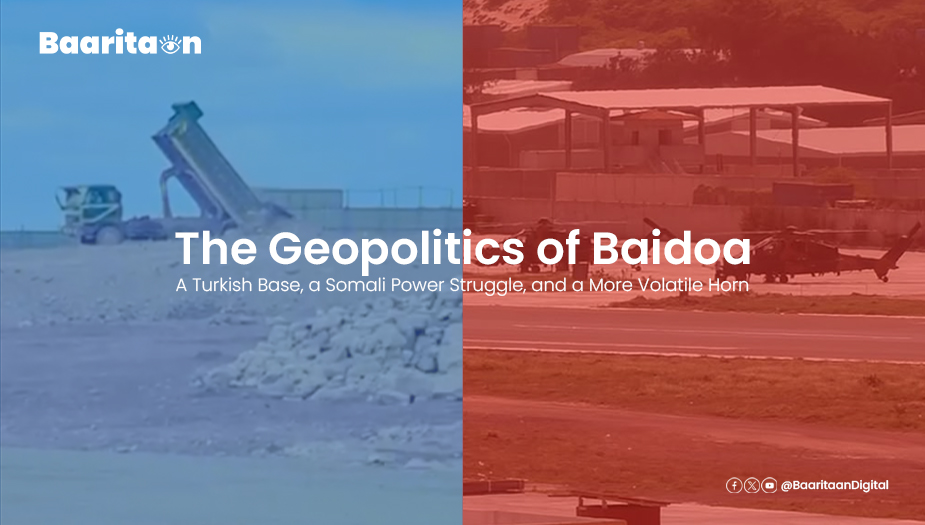

MOGADISHU — Baidoa, the capital of Somalia’s South West State, has become the latest test of whether foreign security partnerships can strengthen a fragile state without becoming entangled in its politics.
Fighting that erupted again this week between forces loyal to South West State’s current president, Adan Mohamed Nur Madobe, and fighters aligned with his predecessor, Abdiaziz Hassan Mohamed Laftagareen, has brought the dispute back into focus. It has also placed Turkey in an awkward position.
Ankara has spent more than a decade cultivating influence in Somalia. It has built hospitals, roads and public institutions, trained Somali soldiers and established one of Africa’s most consequential bilateral defence relationships. More recently, Turkish officials have also become involved in efforts to encourage dialogue among Somalia’s political factions.
That combination—military partner and would-be mediator—is increasingly difficult to reconcile.
The question is not whether Turkey has influence in Somalia. It plainly does. The question is whether it can use that influence to promote a political settlement while remaining sufficiently trusted by actors who believe that Turkish military power is helping the federal government consolidate control.
A political dispute with a military solution
The immediate dispute in Baidoa dates back to March, when federal forces took control of the city after a political rupture between President Hassan Sheikh Mohamud’s government and Mr Laftagareen.
Mr Laftagareen subsequently resigned, while Mr Madobe emerged as the head of a new South West administration backed by Mogadishu. Mr Laftagareen and his supporters rejected the arrangement. Since then, Baidoa has experienced repeated outbreaks of violence.
The latest fighting has involved attacks on government and military positions and reports of explosive drones being used over the city. Health workers have treated dozens of casualties.
UNICEF has warned of the impact on children, while Médecins Sans Frontières says its teams treated 69 wounded people, including five children, at Bay Regional Hospital.
For Somalia’s federal government, the strategic calculation is understandable. Losing Baidoa would undermine its authority over one of the country’s most important federal member states and create a precedent for armed opposition to federal decisions.
But military control does not necessarily resolve the political problem. Indeed, the repeated return of Laftagareen-aligned forces to the battlefield suggests that the government’s military gains have not eliminated the political constituency behind the former president. That is where Turkey becomes important.
Turkey’s unusually deep footprint
Few foreign countries have invested as heavily in Somalia as Turkey.
Ankara’s relationship with Mogadishu began principally as a humanitarian and development project. It has since evolved into a broad strategic partnership covering commerce, infrastructure, education, maritime affairs and defence.
Turkey now trains Somali forces and supports the development of national security institutions. Its military presence has expanded, including the deployment of combat aircraft and helicopters. The arrangement has obvious advantages for both governments.
Somalia obtains training, equipment and a powerful external partner at a time when it is attempting to rebuild its armed forces after decades of fragmentation.
Turkey obtains strategic access to a country sitting on the approaches to the Red Sea and the Gulf of Aden, while building political and commercial influence in a region where competition among outside powers is intensifying. The relationship is therefore more than a conventional aid programme. It is a strategic bargain.
For Mogadishu, Turkish support can help compensate for weaknesses in domestic military capacity. For Ankara, Somalia offers a relatively receptive partner and a platform from which to deepen its influence in the Horn of Africa.
But the closer the security relationship becomes, the harder it is for Turkey to appear entirely detached from Somalia’s internal political conflicts. This is particularly sensitive because Turkey has also presented itself as a facilitator of Somali dialogue.
The mediator’s dilemma
Turkish officials have engaged representatives of the federal government and opposition figures in an effort to reduce tensions over elections, constitutional reform and the distribution of political power.
Ankara says its policy is based on respect for Somali sovereignty and non-interference. That position is diplomatically sensible. Yet mediation depends less on what a mediator says than on what the parties believe it can—and will—do.
Mr Laftagareen’s camp has reasons to question Ankara’s neutrality. Its opponents, meanwhile, have little reason to want Turkey to reduce its security support.
This puts Ankara in a familiar position for an ambitious middle power: it wants to be indispensable to the government without becoming unacceptable to its opponents. That balancing act is becoming harder.
The allegations over Turkish air power
Baaritaan has spoken to security sources who allege that Turkish-operated aircraft have been prepared or deployed in connection with the federal military buildup around Baidoa.
There have also been allegations from Laftagareen-aligned figures that Turkish aircraft have participated directly in operations against their forces.
Turkey has a confirmed military presence in Somalia. Turkish-trained Somali units have also been involved in federal security operations. But public evidence does not establish every allegation concerning Turkish aircraft and particular strikes around Baidoa. That distinction matters.
If Ankara is perceived to be providing direct battlefield assistance in a domestic political confrontation, its claim to be an impartial facilitator will become harder to sustain.
If, by contrast, its military role remains confined to the broader mandate of strengthening Somalia’s national security institutions, Turkey will have greater room to argue that its political engagement is separate from military operations. The difference may look technical. In Somali politics, it is not.
Why Baidoa matters to Ethiopia and Egypt
The strategic significance of Baidoa extends beyond Somalia. The city sits in a region bordering Ethiopia and is an important political and military centre in the country’s south-west.
Turkey’s growing presence therefore intersects with a wider contest involving Ethiopia and Egypt. Egypt has strengthened its security relationship with Somalia in recent years, partly against the backdrop of its strategic dispute with Ethiopia over the Nile and the Grand Ethiopian Renaissance Dam.
Ethiopia, meanwhile, regards developments along its Somali frontier as matters of national security. A substantial Turkish military aviation presence in Baidoa would consequently attract attention in Addis Ababa.
There is speculation that Turkish facilities could eventually accommodate assets belonging to other partners, including Egypt.
But the possibility illustrates the wider strategic problem. What begins as a Somali internal dispute can quickly acquire a regional dimension because Somalia is located at the intersection of several competing security relationships.
The economics of influence
There is also an economic calculation behind Turkey’s involvement. Somalia’s state institutions remain weak and its security sector heavily dependent on foreign assistance. Whoever supplies training, equipment and infrastructure acquires influence over how institutions develop.
Turkey has been particularly successful at converting relatively modest economic engagement into long-term political access.
Its companies have won major infrastructure and service contracts. Turkish institutions operate educational and humanitarian programmes. Turkish Airlines connects Somalia to a broad international network through Istanbul.
Security cooperation adds another layer. A country that trains soldiers, supplies equipment and helps build military infrastructure develops relationships that can last for decades.
That is valuable to Ankara. It is also why Turkey has an interest in political stability. But stability and political consolidation are not always the same thing.
A federal government may regard the consolidation of its authority as necessary for stability. A federal member state or opposition movement may regard the same process as centralisation. Foreign partners can easily become caught between those interpretations.
The reconciliation effort
A Somali parliamentary delegation led by former speaker Mohamed Mursal Sheikh Abdirahman has now entered the picture.
The delegation has held talks in Baidoa and previously engaged Mr Laftagareen in Nairobi. Its objective is to create space for dialogue between the rival camps.
This is important because a durable settlement cannot be imposed entirely from Mogadishu.
South West’s political dispute involves local elites, traditional elders, security commanders and communities whose interests do not necessarily coincide with those of the federal leadership.
A negotiation that excludes these actors could produce another agreement between political elites without resolving the incentives that repeatedly send armed men back into the streets. Turkey could assist such a process. But it may be better positioned to do so indirectly.
Rather than becoming the visible architect of a Baidoa settlement, Ankara could use its relationships with the federal government and political opposition to encourage a Somali-led process, while making clear that military cooperation is not intended to determine the political outcome.
That would preserve more of the credibility it has accumulated over the past 15 years.
The danger of outsourcing the political settlement
Somalia has repeatedly relied on foreign actors to help manage its internal crises. The problem is not foreign assistance itself. Somalia’s security institutions could not have developed as quickly without international support.
The danger arises when external security guarantees begin to substitute for domestic political agreements. If one faction believes that it can ultimately prevail because it has stronger foreign military backing, negotiations become less attractive.
If the opposing faction believes that it must seek its own external sponsor to survive, the conflict becomes internationalised. That is how internal political disputes turn into proxy contests. Somalia has experienced enough of that history to recognise the danger.
A test for Mogadishu too
The federal government also faces a strategic choice. It can continue to treat the Baidoa crisis primarily as a challenge to national security and attempt to impose control through force.
Or it can use its military advantage to create the security conditions for a political settlement that gives its opponents a reason to abandon armed resistance.
The second option is more difficult. It requires compromise over political representation, security arrangements and the relationship between the federal government and South West State.
It may also require Mogadishu to distinguish between political opponents and armed threats. That distinction has become increasingly blurred.
And a test for Turkey
For Turkey, Baidoa is an unusually revealing case. Ankara has built influence in Somalia partly because it has avoided behaving like a conventional great power.
Its appeal has rested on a mixture of development, diplomacy, commercial engagement and security assistance. That model works when the recipient state broadly agrees on what national interest means.
Somalia increasingly does not. If Turkey becomes identified too closely with one faction in an unresolved federal dispute, it risks diminishing the political capital that makes its wider Somali strategy effective.
If it remains engaged with all sides while supporting Somalia’s national institutions, it could strengthen its position as one of the few external actors able to speak to competing camps. The difference will depend on restraint.
The next battle may be political
Baidoa’s military balance may change again. But the central problem will remain unless Somalia resolves the political questions underneath the fighting: who has the authority to determine South West’s leadership, how federal and state institutions share power, how elections are organised and how security forces are kept from becoming instruments of political competition.
Foreign military assistance can help Somalia answer some of those questions indirectly by strengthening state institutions. It cannot answer them itself. That is the paradox of Turkey’s role.
The more useful Ankara becomes to Somalia’s security sector, the more important it becomes that its political role remains carefully separated from the exercise of military power.
For now, Turkey is trying to do two things at once: help Somalia become strong enough to govern itself and maintain enough access to its political factions to help them settle their disputes.
Baidoa is testing whether those objectives are complementary. If the fighting continues, Ankara may discover that being Somalia’s most important security partner makes it harder, not easier, to be accepted as an honest broker.
And Somalia may discover a more uncomfortable truth: no foreign partner, however powerful or well intentioned, can substitute for a political settlement that Somali actors themselves regard as legitimate.