

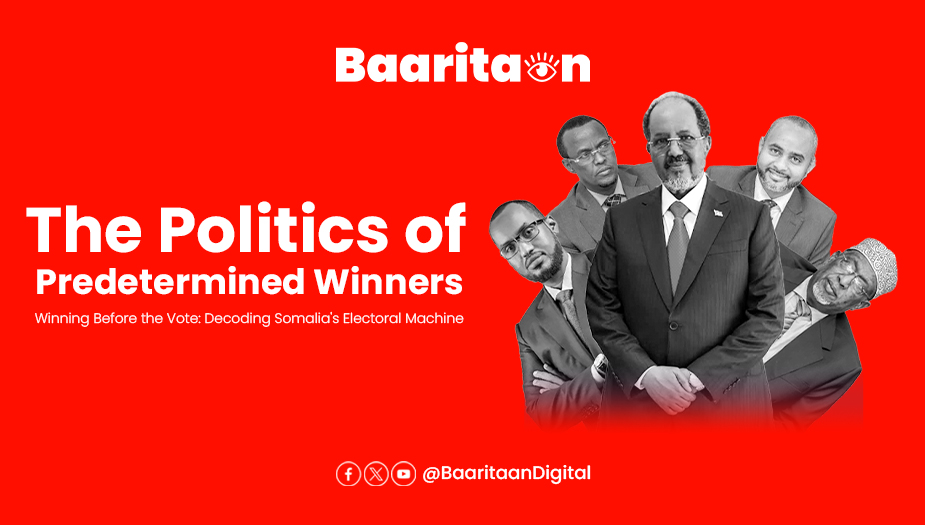

MOGADISHU – By every outward appearance, Somalia is entering another electoral cycle. In reality, the country’s most consequential political contests may already be over.
Since returning to power in May 2022, President Hassan Sheikh Mohamud has pursued what increasingly appears to be a deliberate strategy of political preemption: neutralize competition before ballots are cast, consolidate influence over federal member states, and ultimately engineer the political arithmetic needed to secure another presidential term.
The battlefield is no longer the ballot box. It is the candidate selection process itself. Across Somalia’s federal member states, the pattern is becoming increasingly difficult to ignore.
Rather than allowing political competition to determine outcomes, Villa Somalia is accused of systematically narrowing the field — using patronage, political coercion, and state leverage to ensure that preferred candidates emerge without meaningful resistance. The objective is straightforward: eliminate uncertainty before election day.
South West State: The Blueprint
The takeover of South West State established the model. Aden Mohamed Nur “Aden Madoobe” selected as the region’s leader after every credible political challenger had effectively disappeared from the race. Among those sidelined was Sharif Hassan Sheikh Aden — a former Speaker of Parliament and former President of South West State — once regarded as the most formidable political force in the region.
Opposition politicians contend that a combination of political pressure and financial inducements dismantled the competition before voters or delegates could decide the outcome. The election itself became little more than a formal endorsement of a decision allegedly made elsewhere. That precedent has since become a governing template.
Galmudug: Manufacturing Consensus
The same political choreography is now unfolding in Galmudug. Villa Somalia is widely believed to have settled on Libaan Shuluq as its preferred successor while systematically discouraging rival candidacies.
Former President Ahmed Abdi Karie “Qoorqoor”, once expected to defend his office, reportedly faced overwhelming political and security pressure to withdraw. Mahad Mohamed Salad — the powerful Director of the National Intelligence and Security Agency (NISA) and one of Hassan Sheikh’s closest allies — was likewise compelled to abandon his own presidential ambitions.
What emerged was not a competitive election, critics argue, but a carefully managed succession. When every serious contender exits before campaigning begins, elections cease to function as instruments of democratic choice.
Parliament: Controlling the Legislature
The presidency’s ambitions extend beyond the federal member states. The contest for Speaker of the House of the People has become another arena in which Villa Somalia appears determined to shape the outcome before lawmakers cast their votes. President Hassan Sheikh is widely viewed as backing Ports Minister Abdikadir Jama.
Meanwhile, according to multiple political sources, other potential candidates — including Foreign Minister Abdulsalam Dhaay and State Minister for Interior Saadaad Aliyow — have reportedly come under pressure to abandon their campaigns. Whether through persuasion or political intimidation, the effect is the same: reducing electoral uncertainty by shrinking political competition.
Hirshabelle: The Next Political Battlefield
Attention is now turning toward Hirshabelle. Although its presidential election remains months away, preparations inside Villa Somalia are reportedly already underway.
Incumbent President Ali Gudlawe seeks another term, yet government insiders suggest he no longer enjoys the confidence of the presidency. Instead, Villa Somalia is said to be searching for a more reliable political ally.
If recent history serves as a guide, Hirshabelle may become the latest example of a broader political doctrine in which elections ratify decisions already reached within the presidential palace.
The Real Prize: Villa Somalia
These regional contests are not isolated struggles for local power. They are stepping stones toward Somalia’s next presidential election.
For more than a year, opposition leaders have accused President Hassan Sheikh of delaying consensus on the country’s electoral framework. The administration insists constitutional reforms must come first. Critics offer a different explanation. Delay, they argue, is not a symptom of political disagreement—it is a strategy.
Every federal member state brought under the influence of Villa Somalia strengthens the president’s negotiating position during future constitutional talks, parliamentary bargaining, and ultimately the presidential election itself. Control the regions. Shape Parliament. Manage the negotiations. Then manage the presidency. This is the sequence opponents believe is unfolding.
Democracy Without Competition?
No democracy can remain credible if political competition exists only on paper. Somalia’s federal system was designed to diffuse power, encourage political pluralism, and prevent excessive centralization.
Yet if regional elections increasingly become exercises in executive management rather than genuine contests, the country risks replacing electoral competition with political choreography.
The issue is no longer whether President Hassan Sheikh Mohamud is winning elections. The more profound question is whether Somalia’s elections are still deciding who governs—or merely confirming decisions already made behind the walls of Villa Somalia.
The answer will define not only Hassan Sheikh’s political legacy but also the future credibility of Somalia’s fragile democratic experiment.