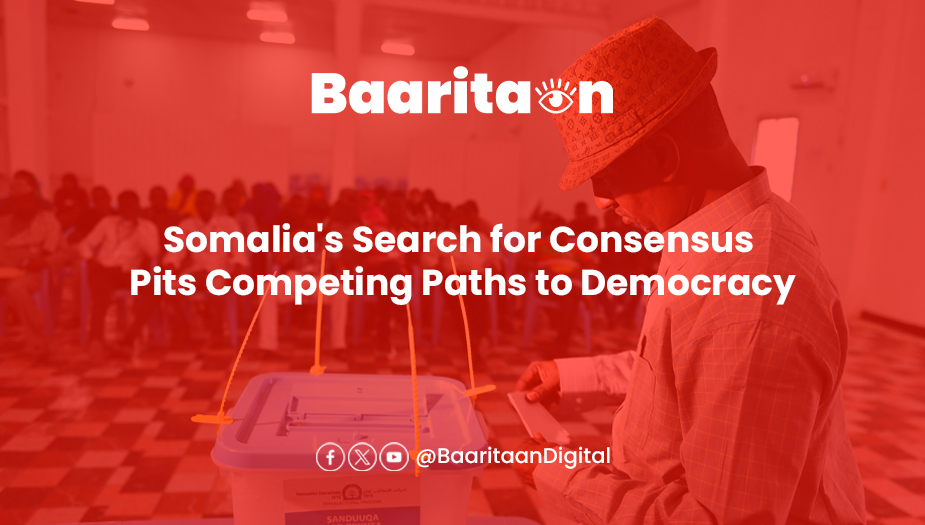

MOGADISHU — Somalia’s long-running debate over how to conduct its first nationwide direct elections in decades has entered a decisive phase, with political leaders weighing three competing electoral frameworks that reflect fundamentally different visions for the country’s democratic transition.
Negotiations in Mogadishu, facilitated by the United States, the United Kingdom, Türkiye, the European Union and the United Nations, have intensified in recent weeks as federal and opposition leaders seek to break a political impasse that has delayed agreement on the country’s electoral roadmap. Diplomats familiar with the talks say the coming weeks will be critical in determining whether Somalia can achieve a negotiated transition before constitutional and political tensions deepen further.
Although each proposal endorses direct citizen participation, they differ significantly on how Somalia should balance democratic reform with political stability.
President Hassan Sheikh Mohamud’s administration continues to advocate for a rapid transition toward one-person, one-vote elections centered on national political parties and administered by the National Independent Electoral Commission. Government officials argue that the approach would accelerate Somalia’s departure from the longstanding 4.5 clan-based political system in favor of modern party politics.
The Somali Future Council (SFC), however, has advanced what many negotiators describe as “a more gradual transitional model”. Its Transitional Direct Elections Model (TDEM) preserves the existing 4.5 political accommodation during the transition while, for the first time, allowing Somali citizens to directly elect individual members of parliament. Under the proposal, traditional elders would retain their limited constitutional role in allocating clan-designated seats, while voters — not delegates — would determine who ultimately represents them in Parliament. Elections would be jointly administered by federal and state implementation committees, reflecting Somalia’s federal political structure.
Supporters argue that the model recognizes Somalia’s current political realities while creating an irreversible pathway toward universal suffrage. Rather than attempting an immediate transformation of the country’s political system, the proposal seeks to combine direct public participation with the institutional arrangements that have underpinned political consensus since the adoption of the federal framework.
A third proposal, presented by the Nabad & Nolol political association led by president Mohamed Abdullahi Farmajo, offers a hybrid approach. Citizens would vote for political parties rather than individual candidates, parliamentary seats would be distributed through national proportional representation, and political parties would subsequently nominate members of parliament according to their share of the national vote. The framework also proposes a temporary National Transition Team to oversee implementation during a six-month transition.
The differences between the proposals extend beyond electoral mechanics.
The government’s framework envisions political parties becoming the principal drivers of the representation.
The Nabad & Nolol proposal similarly places political parties at the center of the transition, although through a proportional representation system designed to encourage nationally organized parties.
The SFC proposal, by contrast, prioritizes direct voter choice while preserving existing political guarantees during the transition. Instead of asking political stakeholders to abandon the current constitutional balance overnight, it attempts to build confidence through an incremental approach — allowing citizens to elect their representatives directly while maintaining the political arrangements many leaders consider essential for stability during this phase of state-building.
The debate comes at a sensitive moment for Somalia. Constitutional disagreements over electoral reforms have strained relations between the Federal Government and several Federal Member States, while international partners have repeatedly encouraged Somali leaders to reach a broad political consensus.
At the same time, reports that the United States intends to end its financial support for U.N. logistical assistance to the African Union stabilization mission have added urgency to efforts to conclude the negotiations, underscoring growing international expectations that Somalia’s political institutions assume greater responsibility for the country’s future.
Despite their differences, the three proposals share a common objective: replacing Somalia’s indirect electoral model with direct citizen participation. The central question facing negotiators is no longer whether direct elections should take place, but which transitional model is most likely to command broad political consensus while preserving national stability.
For many observers, the success of the negotiations may ultimately depend less on selecting a perfect electoral system than on agreeing to one that the country’s diverse political stakeholders are prepared to implement together.
In Somalia’s political history, durable agreements have rarely emerged from outright victories. More often, they have been built through negotiated compromises capable of balancing democratic aspirations with the practical realities of governance.