

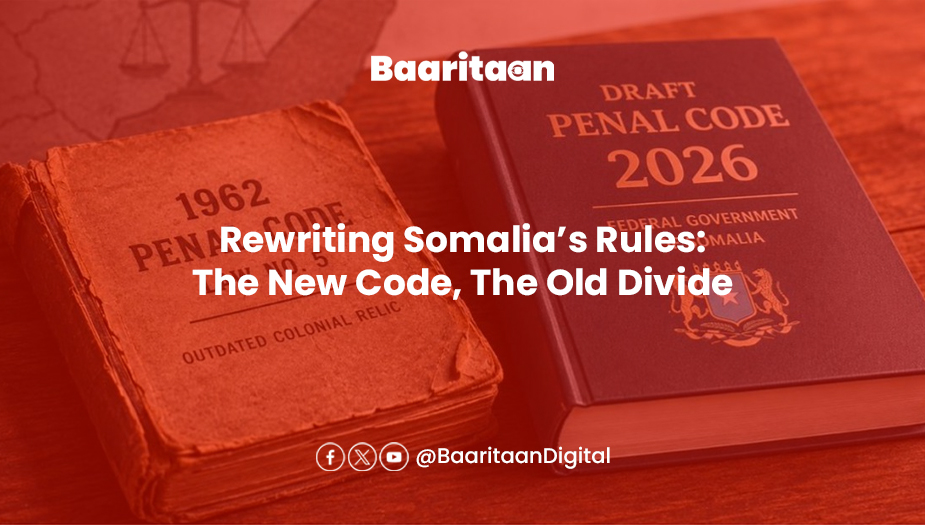

MOGADISHU — Somalia’s attempt to replace its decades-old criminal justice framework has become the latest arena in a much broader struggle over the country’s political identity, constitutional order, and relationship with international legal standards.
The draft Penal Code, intended to replace the criminal law adopted in 1962, was introduced as part of efforts to modernize Somalia’s justice system after years of institutional collapse, conflict, and fragmented governance. Supporters argue that a new criminal code is necessary to address contemporary challenges, including terrorism, organized crime, corruption, digital offences, and evolving security threats.
But the legislation has triggered growing concern among legal experts, civil society actors, and international observers who argue that some provisions risk undermining fundamental rights protections and could place Somalia in tension with obligations under international human rights conventions.
The debate reflects a deeper dilemma facing Somalia: how to build a modern state that incorporates Islamic legal principles and domestic political realities while remaining consistent with constitutional guarantees and global human rights commitments.
A Long-Delayed Reform Becomes a Political Battlefield
Somalia’s current Penal Code was enacted more than six decades ago, before the collapse of the central government in 1991 and before the emergence of the country’s federal political system. Successive governments have sought to replace or amend the law, but decades of instability prevented a comprehensive overhaul.
The new draft arrives at a moment when Somalia is already experiencing significant political tensions over constitutional amendments, electoral reforms, and the distribution of authority between the Federal Government and regional administrations.
As a result, what began as a legal reform project has become part of a much larger argument about the future shape of the Somali state.
Government officials have presented the legislation as an effort to create a justice system that reflects Somalia’s constitutional framework, including the role of Islam, while providing stronger tools to combat crime and insecurity.
Critics, however, argue that some provisions represent a major expansion of state authority and could create new restrictions on individual freedoms if approved without substantial revisions.
The Clash Between Domestic Law and International Standards
A recent special briefing by The Somali Wire, published by Sahan Research, examined the draft legislation and highlighted several areas where it argues the proposed law conflicts with internationally recognized human rights norms.
The briefing raises concerns over provisions relating to criminal punishments, freedom of expression, judicial powers, and the incorporation of Islamic criminal principles into statutory law.
The analysis argues that while Somalia has the sovereign authority to design a legal system reflecting its constitutional and religious identity, certain provisions require closer examination to ensure they comply with international agreements that protect individual rights and prohibit forms of punishment considered incompatible with modern human rights standards.
The controversy is not simply about individual articles within the draft. It represents a broader question confronting many Muslim-majority states: how to reconcile religiously informed legal traditions with international human rights frameworks developed through global treaties and institutions.
Freedom of Expression and the Expanding Role of Criminal Law
One of the most sensitive areas of debate concerns the relationship between criminal law and freedom of expression.
Rights advocates warn that broad or vaguely defined offences could create uncertainty over what constitutes a criminal act, potentially allowing authorities to interpret the law in ways that restrict legitimate public debate.
In a country where journalists, activists, and political opponents have historically operated under significant pressure, critics fear that expanding criminal provisions without clear safeguards could further narrow the space for dissent and public accountability.
Supporters of the draft argue that stronger legal mechanisms are necessary to address misinformation, incitement, and threats to national security, particularly in a country facing persistent challenges from armed groups and political instability.
The disagreement reflects a recurring tension in post-conflict states: whether security concerns should justify expanded state powers or whether fragile democracies require stronger protections against government overreach.
The Role of Islamic Law in Somalia’s Legal Future
At the center of the debate is the question of how Somalia defines the relationship between Sharia, constitutional law, and international obligations.
Islam is recognized as the state religion under Somalia’s Provisional Constitution, and Islamic principles have historically influenced Somali legal practice. However, Somalia is also party to international human rights agreements that establish obligations regarding due process, equality before the law, and protection from certain forms of punishment.
The draft Penal Code attempts to navigate these competing legal traditions, but critics argue that the current wording leaves unresolved questions about how conflicts between religious principles, constitutional protections, and international commitments would be handled.
The outcome could establish an important precedent for Somalia’s future legal system.
A Reform Arriving at a Moment of Political Uncertainty
The Penal Code debate is unfolding against the backdrop of Somalia’s wider political confrontation.
The country is currently divided over constitutional changes and the transition toward a proposed “one person, one vote” electoral system championed by President Hassan Sheikh Mohamud. Opposition groups have questioned the process through which constitutional amendments were advanced and have called for broader political consensus before major institutional changes are implemented.
The criminal law debate has therefore become connected to a larger concern: whether Somalia’s institutions are developing through inclusive political agreement or through decisions made by those currently holding power.
For international partners that have invested billions of dollars in Somalia’s state-building efforts, the Penal Code represents more than a legal document. It is a test of whether Somalia’s emerging institutions can balance security, sovereignty, democratic governance, and human rights commitments.
The Road Ahead
Parliament now faces a difficult choice.
Rejecting reform would leave Somalia dependent on an outdated legal framework created before the country’s modern political realities emerged. Approving the draft without significant scrutiny, however, could deepen concerns about rights protections and increase tensions with domestic and international stakeholders.
The challenge for Somali lawmakers is not simply writing a new Penal Code. It is defining what kind of state Somalia seeks to become.
The final version of the legislation will reveal whether Somalia’s legal transformation will be built around compromise and institutional confidence—or whether the country’s unresolved political divisions will continue to shape even the most fundamental rules governing society.