

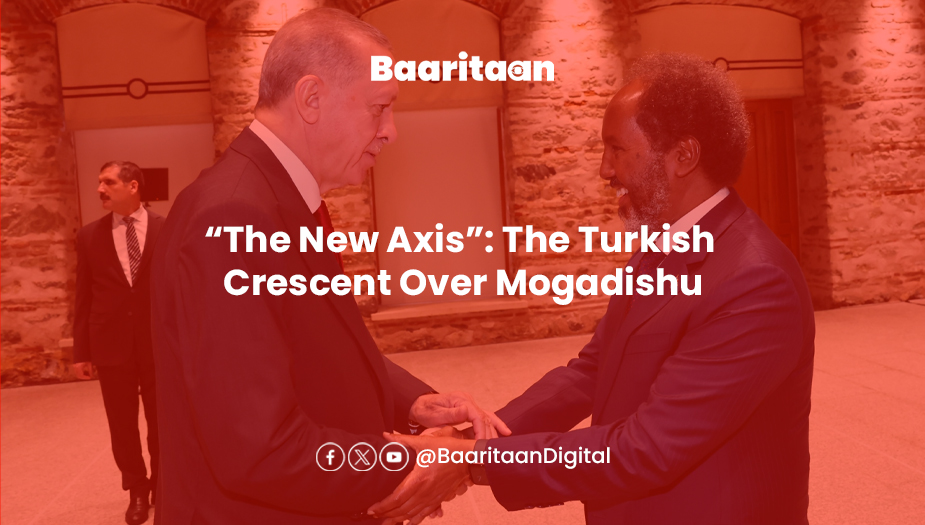

MOGADISHU/ANKARA — Few bilateral relationships in Africa have transformed as dramatically over the past fifteen years as that between Somalia and Türkiye.
What began with President Recep Tayyip Erdoğan’s landmark visit to famine-stricken Mogadishu in 2011 has evolved into a partnership encompassing nearly every pillar of the Somali state: humanitarian aid, infrastructure, healthcare, education, defence, diplomacy, maritime security and offshore energy.
Now, Ankara is assuming yet another role—that of political mediator.
This week, senior Turkish officials hosted separate consultations with Somalia’s Federal Government and opposition representatives in Mogadishu in an attempt to ease a deepening political impasse over constitutional reforms and the country’s electoral roadmap. The talks underscore how Turkey’s influence has expanded beyond development and security into the sensitive arena of Somalia’s domestic politics. (Al-Monitor)
For supporters, Ankara’s engagement represents a rare example of sustained, long-term state-building by an international partner.
For critics, Turkey’s expanding footprint raises increasingly difficult questions about sovereignty, transparency and whether Somalia risks becoming strategically dependent on a single foreign power.
From famine relief to state-building
When Erdoğan became the first non-African leader to visit Mogadishu in more than two decades in August 2011, Somalia was enduring one of the worst famines in modern history.
Unlike many international partners whose engagement remained largely humanitarian, Turkey embedded itself inside Somalia’s reconstruction.
Turkish agencies financed hospitals, schools, roads and government institutions while Turkish companies assumed management roles at Mogadishu’s international airport and seaport. Turkish Airlines became the first major international carrier to resume direct flights to Mogadishu, helping reconnect Somalia to global markets.
The Turkish-built Recep Tayyip Erdoğan Training and Research Hospital became one of East Africa’s largest public hospitals, while thousands of Somali students received scholarships to Turkish universities.
The strategy reflected Ankara’s broader Africa policy—combining humanitarian assistance with commercial investment, diplomacy and security cooperation to cultivate enduring political relationships. (Financial Times)
Security became the cornerstone
Over time, humanitarian diplomacy gave way to strategic cooperation.
The establishment of Camp TURKSOM in Mogadishu in 2017 marked Turkey’s largest overseas military training mission.
Thousands of Somali soldiers have since graduated from the academy.
Military cooperation accelerated dramatically following the February 2024 Defence and Economic Cooperation Framework Agreement.
The deal committed Turkey to assisting Somalia in rebuilding its navy, protecting its Exclusive Economic Zone and modernising defence institutions over a ten-year period. Since then, Ankara has expanded military assistance through training, equipment and naval deployments supporting maritime security and offshore energy operations.
Somali officials argue that no other bilateral partner has invested as consistently in rebuilding the country’s security architecture.
The government has repeatedly maintained that the agreements are exercises of Somalia’s sovereign right to choose its security partners.
Energy changes the equation
If military cooperation deepened the partnership, hydrocarbons transformed its geopolitical significance.
Following agreements signed in 2024, Turkey began offshore seismic exploration and prepared for deep-water drilling off Somalia’s Indian Ocean coast.
For Mogadishu, offshore hydrocarbons represent a potential economic windfall capable of reshaping one of Africa’s poorest economies.
For Ankara, Somalia offers access to frontier energy resources while reinforcing Turkey’s ambition to become an influential maritime power stretching from the Eastern Mediterranean to the western Indian Ocean.
The energy partnership has also intensified domestic political debate.
Opposition politicians have questioned the limited public disclosure surrounding exploration agreements, arguing that Parliament should exercise stronger oversight over contracts involving strategic national resources. Critics have called for greater transparency regarding fiscal terms, revenue-sharing mechanisms and long-term commercial obligations.
Government officials reject allegations that Somalia has ceded control over its resources, insisting that all petroleum reserves remain under Somali sovereignty and that foreign investment is indispensable given the country’s limited technical and financial capacity.
Turkey’s newest role: political mediator
Turkey’s influence is now extending into Somalia’s internal political crisis.
In recent days, Turkish officials have facilitated consultations between representatives of the Federal Government and opposition groups as disputes over constitutional amendments, electoral reforms and federal relations threaten to deepen political fragmentation. (Al-Monitor)
According to official statements, the discussions focused on restoring dialogue and reducing political tensions ahead of broader negotiations.
Yet the mediation effort also exposed the limits of Ankara’s influence.
Puntland and Jubbaland declined to participate, questioning Turkey’s neutrality given its close strategic relationship with the Federal Government. Their absence highlighted the challenge of translating Ankara’s bilateral leverage into nationwide political consensus.
For Turkish diplomats, however, mediation reflects a broader foreign-policy doctrine: positioning Turkey as a regional problem-solver capable of combining hard power with diplomacy.
Beyond Somalia: a Horn of Africa strategy
Turkey’s Somalia policy increasingly serves broader geopolitical objectives.
Ankara successfully mediated between Somalia and Ethiopia following the diplomatic crisis triggered by Ethiopia’s 2024 memorandum of understanding with Somaliland. The Ankara Declaration restored dialogue between Mogadishu and Addis Ababa and elevated Turkey’s standing as a diplomatic broker in the Horn of Africa.
Turkey has consistently reaffirmed its support for Somalia’s territorial integrity while maintaining channels of communication across the region, reinforcing what officials describe as the “One Somalia” policy.
A vacuum others are leaving
Turkey’s expanding role also reflects changing international priorities.
As Western governments reassess military commitments and reduce some forms of assistance, analysts argue that Ankara has moved quickly to fill parts of the emerging strategic vacuum. Turkey’s growing military support, infrastructure investment and energy partnerships have increased its leverage at a time when Somalia continues to confront the threat posed by al-Shabaab and uncertainty over long-term international support. (The Washington Post)
Opportunity—and accountability
Few Somalis dispute that Turkey has made visible contributions to rebuilding public infrastructure, healthcare, education and security institutions.
The central debate is no longer whether Turkey has helped Somalia.
Rather, it is whether the unprecedented breadth of Ankara’s involvement—from airports and ports to military training, offshore energy and political mediation—requires stronger parliamentary oversight, greater contractual transparency and more robust public accountability.
Supporters argue that strategic partnerships are essential for a country emerging from decades of conflict.
Critics contend that durable state-building depends not only on capable partners but also on institutions able to scrutinise those partnerships.
The next phase
Turkey’s Somalia policy has entered a new phase.
It is no longer simply a humanitarian donor, infrastructure investor or defence partner. It has become an increasingly influential political actor, a diplomatic mediator and a stakeholder in Somalia’s long-term economic future.
That evolution carries opportunities for reconstruction and regional stability, but also new tests. As Ankara helps broker domestic dialogue while expanding its security and energy footprint, its success will be judged not only by the projects it builds or the agreements it signs, but by whether its engagement strengthens Somalia’s institutions rather than deepening dependence on a single external partner.
For both Mogadishu and Ankara, the next chapter of their relationship may prove the most consequential yet.