

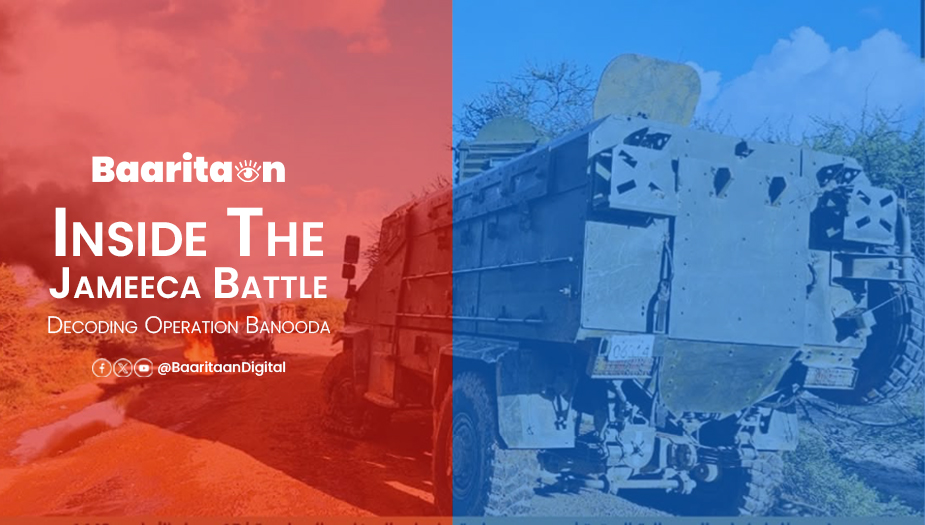

MOGADISHU, Somalia — The battle near Jameeca on Monday, 26 October, has raised urgent questions about the planning and execution of Operation Banooda, a Somali government offensive whose military objectives intersect with a wider political struggle over control of South West State.
Sources familiar with developments surrounding the operation told Baaritaan that government forces suffered substantial casualties during the fighting between Leego and Buurhakaba, while military vehicles and logistical supplies were also lost or damaged. The precise scale of the losses remains a central point of contention as military authorities work to establish what happened.
The battle has generated competing accounts of the number of soldiers killed, the fate of missing personnel and the equipment captured or destroyed. It has also prompted questions about the coordination of advancing forces, the availability of reinforcements and the circumstances in which the government convoy came under attack.
Al-Shabaab has claimed that 321 government soldiers and allied fighters were killed. Sources who spoke to Baaritaan provided a separate. That figure remains a reported estimate rather than an established casualty total. The government has not released a comprehensive breakdown of its losses.
The significance of Jameeca, however, extends beyond the disputed numbers. The fighting has exposed the operational risks facing a military campaign that seeks to confront an entrenched insurgency while the federal government is simultaneously engaged in a politically sensitive contest over authority in southern Somalia.
How the fighting unfolded
Sources familiar with Operation Banooda told Baaritaan that the offensive involved planned movements along two principal axes: one connecting Baledogle and Buurhakaba, and another running between Baidoa and Daynuunay.
The reported arrangement was intended to support an advance towards Buurhakaba while improving government forces’ ability to operate along the strategic corridor linking Mogadishu and Baidoa.
According to documents seen by Baaritaan, the operation involved senior Somali National Army officers assigned to overall command and to the separate axes of advance. An eight-page operational document was reportedly prepared to guide the mission.
The document’s command structure identifies Colonel Adow Mohamed Sahal as the overall operational commander, with other senior officers assigned responsibilities along the two routes. The details of the document, including its final approval and the precise orders issued to individual units, remain important questions for the military leadership to address.
Sources described the fighting as a major confrontation involving government forces and al-Shabaab near Jameeca, where the insurgents used explosives-laden vehicles during the attack.
The Somali Defence Ministry acknowledged that the engagement resulted in damage to military vehicles. The government also said its forces inflicted substantial casualties on al-Shabaab.
The sequence of events leading to the attack remains unclear. In particular, questions persist over the extent of the intelligence available to commanders before the advance, whether the movements of the separate forces were adequately coordinated and how the military responded when the fighting intensified.
Sources who spoke to Baaritaan said the operation has prompted debate over its management and the decisions made before the troops entered the area.
Those questions do not, by themselves, establish that the plan was defective or that any individual commander was responsible for the losses. They do, however, underline the importance of a detailed operational review that examines the decisions taken before, during and after the engagement.
The casualty figures and the missing soldiers
The most contentious issue remains the number of government personnel killed. Al-Shabaab claimed it had killed 321 soldiers and allied fighters and seized military equipment.
Meanwhile, two Somali soldiers told Reuters that dozens of government troops had been killed. One said he helped transport the bodies of 40 soldiers and more than 100 wounded personnel to hospitals in Mogadishu. A surviving officer, Abshir Abdikarim, told the Associated Press that he had seen at least 20 dead soldiers.
The government offered a different emphasis. Somalia’s Defence Ministry said its forces had killed about 75 al-Shabaab fighters and wounded 56, while acknowledging that explosives-laden vehicles had damaged army vehicles. It did not publish a government casualty figure.
Soldiers who have been reported missing may subsequently return to their units, while wounded personnel may be evacuated to different medical facilities. Prisoners and those killed during the fighting must also be recorded separately.
Sources familiar with the military response told Baaritaan that senior authorities were still seeking a clearer picture of the casualties, with reports reaching the leadership differing in both scope and detail. The immediate challenge is to reconcile the accounts from field commanders with hospital admissions, unit personnel records and information about soldiers who have returned to base.
For families awaiting news, the distinction is critical. An accurate accounting would establish not only the scale of the losses but also the fate of individual soldiers whose status remains uncertain. The discrepancy leaves a central question unanswered: how badly was the government force damaged, and what does the battle reveal about the strategy that sent it along the road to Buurhakaba?
Emergency preparations at the military hospital
Sources who spoke to Baaritaan described an urgent mobilisation of staff at the Somali National Army Hospital in Mogadishu following the fighting. According to insiders, messages instructed medical personnel to report to the emergency department under a designation described as “Disaster Level 5”.
The messages reportedly called staff into work in anticipation of a substantial influx of casualties. Sources also said the number of wounded personnel being transported for treatment was increasing, while some soldiers were reportedly being kept at military facilities in Lower Shabelle for security reasons.
If confirmed, the response would illustrate the pressure that a major battlefield engagement can place on military medical services. Evacuating wounded personnel from a contested area requires transport, secure routes, coordination between units and sufficient capacity to receive casualties.
The medical response also raises practical questions about whether evacuation arrangements were adequate for the scale of the operation and whether military facilities had sufficient capacity to handle the reported influx.
A consolidated medical assessment would help establish the number of wounded soldiers, the facilities treating them and the status of personnel still awaiting evacuation or identification.
Vehicles and supplies: the logistical consequences
Sources who spoke to Baaritaan alleged that more than 10 military vehicles were destroyed during the fighting, with additional vehicles damaged or captured. The government has acknowledged damage to military vehicles but has not published a comprehensive inventory of the equipment affected.
The exact number of vehicles lost, their condition and the circumstances in which they were abandoned, damaged or captured remain unresolved.
The distinction has operational significance. Destroyed vehicles may require replacement, while damaged vehicles may be repaired and returned to service. Equipment captured by an opposing force may be unavailable to the military for an extended period, even if it is subsequently recovered.
Losses involving transport vehicles can also affect the delivery of ammunition, food, fuel and medical supplies. In an operation advancing through contested territory, those functions are essential to maintaining a military presence and responding to attacks.
Sources told Baaritaan that the reported equipment losses have become part of the wider discussion about the conduct of Operation Banooda and the government’s capacity to sustain the advance. The next step should be a documented assessment of vehicles deployed, equipment recovered, losses confirmed and supplies requiring replacement.
Operation Banooda and the road to Buurhakaba
Sources familiar with the operation told Baaritaan that Banooda Operation had three broad objectives: weakening al-Shabaab’s operational capacity, improving security along the Mogadishu–Baidoa road and extending federal government authority in areas where its influence remains contested.
The road connecting the capital with Baidoa is strategically important. It facilitates the movement of government personnel and supplies and supports commercial and civilian traffic. Insecurity along the corridor can increase the cost and risk of travel, disrupt trade and complicate the delivery of assistance.
For the government, securing the route would represent a practical military gain. But holding a road is different from maintaining durable control over the surrounding territory.
That distinction is particularly important in southern Somalia, where al-Shabaab has repeatedly demonstrated its ability to attack government forces, disrupt transport and threaten areas outside the insurgents’ immediate strongholds.
The Jameeca battle therefore raises a strategic question: whether the military has the logistical depth and operational coordination required to maintain progress after encountering determined resistance. The answer will depend on the losses suffered, the equipment available for subsequent movements and the lessons drawn from the engagement.
The political contest in South West State
Operation Banooda is taking place following forces loyal former South West State president Abdiaziz Hassan Mohamed Laftagareen tookover several towns in Baay region including BuurHakaba and Berdaale. Federal forces took control of Baidoa in March 2026, after which Laftagareen forced to have resigned.
Sources who spoke to Baaritaan said the operation’s wider objectives included extending federal authority in areas where supporters of the former regional leader retain political influence and, in some places, an armed presence. This context gives the offensive a political dimension beyond the fight against al-Shabaab.
The federal government’s relationship with South West State has been shaped by disagreements over political legitimacy, constitutional arrangements and the distribution of authority between Mogadishu and regional administrations.
Sources told Baaritaan that this overlapping security and political environment forms an important part of the background to Operation Banooda.
Command responsibility and operational scrutiny
Insiders who spoke to Baaritaan identifies senior military officers reportedly involved in planning and implementing the operation. It also describes an eight-page plan setting out responsibilities along the two principal axes. The document is central to questions about how the operation was organised, but its existence does not establish whether the mission was adequately planned or whether orders were followed.
A thorough review would need to establish what intelligence commanders possessed before the advance, whether the risks of an ambush were properly assessed and how the operation was expected to respond if one force encountered sustained resistance.
It should also examine the timing of reinforcements, the availability of medical evacuation, communications between field units and the speed at which information reached senior military officials. Sources familiar with the response told Baaritaan that the information reaching the country’s leadership differed, complicating the process of establishing the scale of the losses.
If field reports were delayed or inconsistent, the military should explain how casualty assessments are compiled and how commanders distinguish preliminary reports from confirmed figures. The purpose of such an inquiry should be to establish what happened and identify any institutional shortcomings, rather than assign responsibility before the evidence has been examined.
The allegation involving Turkish aircraft
The battle has also prompted questions about whether Turkish military aircraft may have mistakenly struck Somali government forces. Former Somali national security adviser Abdisaid Muse called for an independent investigation into allegations that Turkish F-16 fighter jets or armed drones might have hit Somali National Army positions during the fighting on 26 October.
Somalia’s Office of National Security rejected the allegation on 27 October, describing reports of a Turkish airstrike against Somali troops near Leego as false and misleading.The government’s denial is an important part of the account. The allegation itself has not been established as the cause of the military losses.
Opposition sources who spoke to Baaritaan said the issue has added to demands for clarity about the circumstances of the fighting and the military support available to government forces. Resolving the question would require examination of operational records, flight information, communications between ground forces and air units, and any available evidence from the battlefield.
If no strike occurred, a clear account of the relevant records would help address the allegations. If evidence points to an incident involving friendly forces, the authorities would need to establish what happened and whether any procedural failures occurred.
The investigation should remain focused on evidence rather than assumptions about Somalia’s security partnership with Türkiye.
Lessons from previous military setbacks
The Jameeca engagement has revived concerns about the vulnerability of Somali government forces during major offensives. Sources who spoke to Baaritaan cited earlier battles at Galcad in January 2023, Ceel Dheer in May 2023 and Cowsweyne in August 2023 as examples of engagements in which government forces suffered serious losses.
The casualty figures associated with those incidents differ between accounts, and the numbers should be assessed individually before being used to draw conclusions about the scale of losses over time. The broader question is whether the military has adequately incorporated lessons from earlier attacks into its intelligence gathering, convoy protection, command arrangements and logistical planning.
Territorial advances can create an impression of progress while leaving forces exposed along the routes that sustain them. An army may enter a town yet remain vulnerable if it cannot protect the roads used to transport reinforcements and supplies.
For Operation Banooda, the ability to sustain an advance may be as important as the ability to begin one. A formal review comparing the Jameeca battle with previous engagements could help establish whether the same operational vulnerabilities are recurring or whether the losses arose from circumstances specific to this encounter.
What happens next?
The immediate priority is to establish an authoritative account of the fighting. Sources told Baaritaan that senior officials were seeking clearer information on the losses. The government should now provide a consolidated assessment distinguishing confirmed fatalities from wounded, missing and captured personnel, alongside an inventory of military vehicles and supplies destroyed, damaged or recovered.
The military should also clarify the status of the reported Danab casualties and the circumstances surrounding the emergency medical response.
A separate operational review should examine the planning of the advance, coordination between the forces moving along the two axes, the intelligence available to commanders and the arrangements for reinforcement and casualty evacuation.
The allegation concerning Turkish aircraft should be addressed through an evidence-based process, with the findings made public to the extent that operational security permits. These steps would help establish whether the battle exposed shortcomings that can be corrected and whether Operation Banooda remains capable of achieving its stated objectives.
A test of military credibility
The Jameeca fighting has left the government facing two related challenges: sustaining its campaign against al-Shabaab and demonstrating that it can account for the soldiers sent into battle.
Security officials points to a serious confrontation, significant casualties and damage to military equipment. But the final human and material cost remains unsettled, and the circumstances leading to the losses require a clearer explanation.
Operation Banooda cannot be judged solely by the number of militants the government says it has killed or by the claims made by its opponents. Its effectiveness must also be measured by whether it secures territory and transport routes, protects military personnel and establishes conditions for lasting security.
For the government, the larger test is whether it can turn a costly battle into an opportunity to improve military planning, strengthen accountability and restore confidence in the conduct of its operations.
The next phase of Operation Banooda will show whether Mogadishu can do more than advance into contested territory: whether it can hold what it takes, sustain the forces deployed there and explain the cost of doing so.