

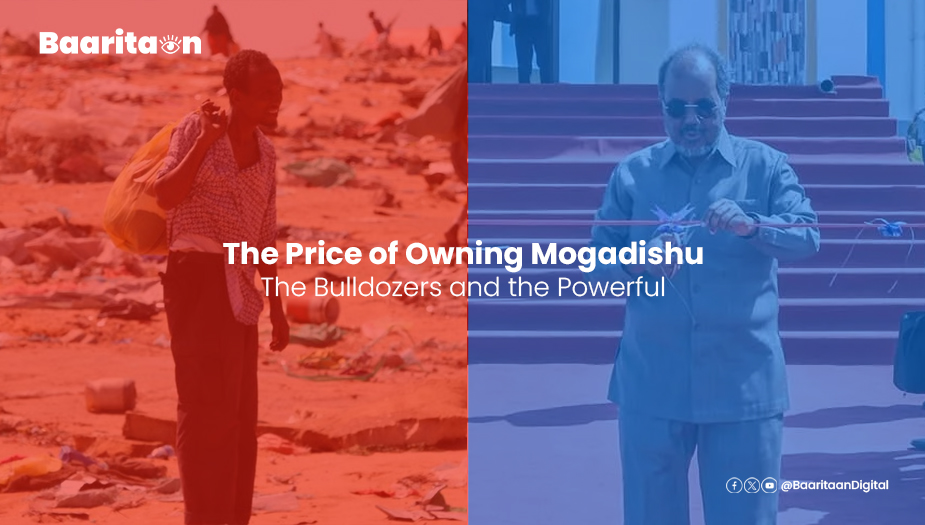

MOGADISHU, Somalia — Disputed land transfers and forced evictions in Mogadishu are weakening public confidence in Somalia’s government and creating risks for national stability, according to a report by the Heritage Institute for Policy Studies.
The report, Elite Capture of Urban Land in Mogadishu Eroding State Legitimacy, says unclear land administration, overlapping institutional responsibilities and limited transparency have left residents vulnerable to displacement while raising concerns about the possible appropriation of public property by politically connected interests.
The report calls for a temporary halt to contested land transfers and evictions, clearer division of authority among government institutions, stronger legal protections for residents and a public registry documenting land ownership and transactions.
The findings come as Mogadishu faces mounting pressure from urban growth, demand for property and disputes rooted in decades of conflict and inconsistent land administration.
The Norwegian Refugee Council’s displacement monitoring recorded 2,136,420 eviction events across Somalia between 2017 and September 2026, with 64% occurring in the Benadir region, which includes Mogadishu, according to figures cited in the report. The data may include people displaced more than once.
The report also cites data from the Armed Conflict Location and Event Data project showing 84 protests against evictions between April 2025 and March 2026, of which 78 took place in Mogadishu.
In 2025, 143,548 people were evicted in the capital, with 44% reportedly displaced from government-owned land, the report says. It also describes a July 2025 eviction at a former Ministry of Health compound that displaced about 120 families.
The figures point to the scale of the problem, but do not by themselves establish whether individual evictions or land transfers were unlawful.
Disputed authority and land records
The report says responsibility for land administration is divided among federal institutions and the Benadir Regional Administration, creating uncertainty over who has the authority to allocate, reclaim, register or transfer property.
It identifies gaps in land records and weak enforcement of existing laws as major obstacles to resolving ownership disputes. The report discusses provisions in Somalia’s 1973 and 1980 land laws, as well as the use of a “nulla osta” mechanism in land transactions, arguing that legal procedures have not produced a sufficiently transparent and reliable system.
The lack of a comprehensive, accessible land registry makes it difficult for residents to establish ownership and for the public to scrutinize transactions involving state property, the report says.
It alleges that some public land has been transferred or sold through opaque processes that may benefit individuals with political or institutional connections. Such allegations require examination of individual deeds, sale records, court documents and the identities of beneficiaries; the report does not establish that every disputed transaction involved corruption.
Government authorities may have legitimate reasons to reclaim public property for infrastructure, public services or other official purposes. The central concern raised by the report is whether such decisions are made under clear rules, with adequate notice and opportunities for affected residents to challenge them.
Human cost of evictions
Forced evictions can leave families without shelter, disrupt access to employment and education, and push already vulnerable households into further displacement.
Residents whose claims rely on informal agreements or incomplete documents may struggle to obtain legal assistance or challenge an eviction before a demolition takes place. The report says limited access to justice and weak dispute-resolution mechanisms compound these vulnerabilities.
It recommends due-process protections, clearer eviction procedures and an independent mechanism for reviewing contested land claims. It also calls for disclosure of beneficial ownership in public-land transactions and a digital registry to make property records more accessible.
The report urges authorities to pause contested transfers and evictions while disputed claims are reviewed, a measure intended to prevent further harm and restore confidence in land administration.
Implementing such a pause could present practical challenges for authorities seeking to recover public property or carry out infrastructure projects. Any policy would need to distinguish genuinely disputed claims from cases in which legal ownership and the public purpose for reclaiming land are established.
Security and political implications
The report warns that grievances over land and displacement could undermine confidence in state institutions at a time when Somalia continues to confront the threat posed by al-Shabaab, the al-Qaeda-linked militant group.
It argues that perceptions of unequal treatment and the diversion of public assets could deepen alienation and provide opportunities for militant groups to exploit public discontent.
The report does not establish a direct causal link between evictions and recruitment by al-Shabaab. Rather, it identifies land-related grievances as one of several factors that may weaken the state’s relationship with communities.
Somalia’s broader governance challenges include disputes over the division of powers between federal and regional authorities, limited institutional capacity and the continuing task of rebuilding public administration after decades of conflict.
The report argues that improving land governance is therefore not simply a property-management issue but a test of whether state institutions can apply the law consistently and protect citizens’ rights.
Its recommendations include clarifying institutional mandates, strengthening courts and dispute-resolution mechanisms, publishing records of public-land transfers and ensuring that affected residents have meaningful opportunities to contest eviction decisions.
The report says greater transparency and accountability would help reduce opportunities for abuse while supporting public confidence in the government.
The Federal Government of Somalia, the Benadir Regional Administration and other relevant authorities should be given an opportunity to respond to the report’s specific allegations before publication. Individual land transactions and eviction cases would also require independent verification to establish the legal basis for the actions and whether procedures were followed.