

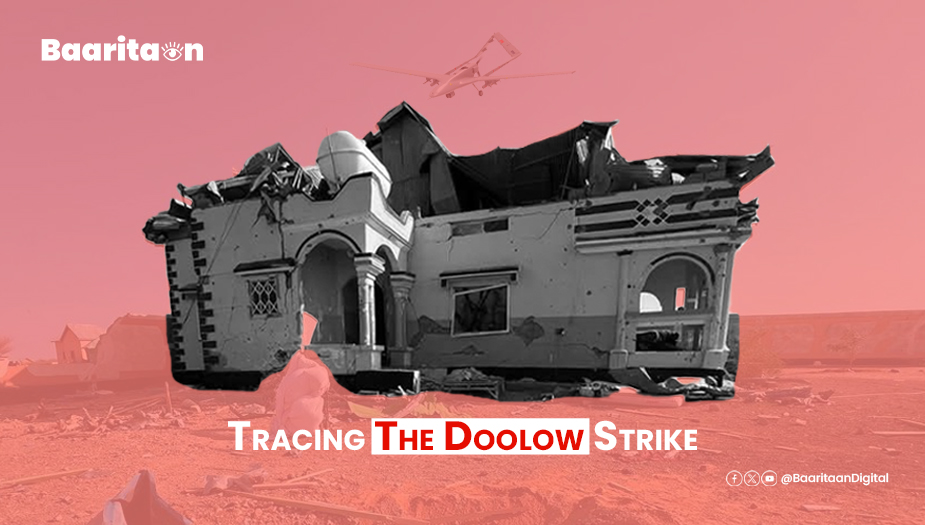

DOOLOW, Somalia — Just before midnight on Thursday, an explosion ripped through the home of General Mahad Abdirahman Adan, the former commander of Somalia’s Custodial Corps, in the southern border town of Doolow.
The attack wounded Mahad, known as General Shub, and several people around him, according to local sources and Jubaland officials. The blast damaged the residence and turned what had been a relatively quiet town into the latest scene of Somalia’s widening political confrontation.
But almost immediately, the question of what happened at the house became inseparable from a larger question: who ordered the attack?
Jubaland says Turkish military aircraft carried out the strike at the request of Somalia’s federal government. Mogadishu denies involvement and says preliminary findings suggest the explosions may have come from explosive materials being prepared inside the house. Türkiye has not publicly acknowledged conducting the operation, and no independent investigation has yet established who was responsible.
Baaritaan Digital has examined accounts from political and security sources, including information provided to the outlet about the alleged planning of the operation, the presence of suspected intermediaries in Doolow and physical evidence said to have been recovered from the site.
Taken together, the accounts point to a disturbing possibility: that a political struggle already being fought with troops and competing claims to constitutional authority may now be drawing foreign military capabilities directly into the contest.
A general caught in the middle
General Shub is not an ordinary former official.
He served as commander of Somalia’s Custodial Corps and has become closely associated with former South West President Abdiaziz Hassan Mohamed Laftagareen, whose political and military confrontation with President Hassan Sheikh Mohamud has intensified in recent months.
Shub had been staying in Doolow after the political crisis around Baidoa deepened. According to people familiar with his movements, the town offered a measure of security away from the fighting and political pressure surrounding the South West capital. That calculation changed Thursday night.
Jubaland says two missiles were fired and that one struck Shub’s residence, while another hit the home of the Doolow district commissioner. Other accounts describe a single missile striking the compound. Shub was injured but survived.
The precise number of casualties remains disputed. Jubaland reported that Shub and four civilians were wounded. Other local reports have described additional casualties, including claims of deaths.
Two explanations for one explosion
The federal government’s account is starkly different.
Somalia’s authorities have said preliminary security information indicates that explosive materials being prepared inside a house may have caused the blasts. The government has said it intends to form a fact-finding committee to establish what happened and who was responsible.
The statement did not publicly identify the occupants of the house or release evidence supporting the preliminary assessment.
Jubaland, by contrast, says the residence was deliberately targeted from the air. It accused Türkiye and the federal government of involvement and called for international scrutiny, including by the United Nations, African Union, IGAD, the United States and European Union.
An externally delivered munition should leave a different forensic signature from an explosion originating inside a building. Investigators can examine the location of the crater or impact point, fragmentation patterns, structural damage, residue and recovered debris.
They can also examine videos recorded around the time of the blast, satellite imagery, aviation data and communications records. The credibility of the government’s promised investigation will depend heavily on whether that evidence is preserved and made available for independent examination.
The evidence Baaritaan has been told about
Several sources familiar with the investigation have told Baaritaan Digital that suspected remnants of the munition were recovered from the site and that investigators believe the fragments are consistent with a Turkish-manufactured precision weapon.
That distinction is important. Sources also told Baaritaan Digital that several people were detained in Doolow in connection with allegations that they acted as guides or facilitators for the operation.
However, arrests and communications between people on the ground and an aircraft crew could provide an important link between the physical evidence and the alleged chain of command. For now, the alleged arrests remain part of an investigative lead rather than established evidence.
An allegation involving Parliament speaker
Information obtained by Baaritaan Digital alleges that two Turkish nationals and a Somali citizen may have played roles in organising or facilitating the operation, including activities connected to identifying the target.
Baaritaan Digital has also received allegations from sources aligned with Laftagareen that Speaker of Somalia’s House of the People Abdikadir Mohamed Jama was among senior political figures involved in ordering or facilitating the operation. Jama has a close political and institutional relationship with Türkiye.
If investigators are examining the chain of command behind the attack, however, the question of who authorised the operation is unavoidable. That inquiry should apply equally to civilian political officials, security commanders and foreign personnel.
A proper investigation would need to establish whether any senior Somali official communicated with Turkish personnel before the strike, whether an intelligence package identifying Shub was transmitted, and whether any Somali authority formally requested or approved an operation.
Türkiye’s expanding role
Türkiye’s alleged involvement is especially sensitive because Ankara has become one of Mogadishu’s most important security partners.Over the past decade, Türkiye has trained Somali forces, provided military assistance and established a major defence relationship with the federal government.
Turkish-made unmanned aircraft have also become part of Somalia’s campaign against Al-Shabaab. That cooperation has generally been presented as part of Somalia’s effort to rebuild its security forces and defeat the militant group. The political landscape, however, has changed.
Somalia’s federal government is now locked in an increasingly bitter confrontation with several political and regional actors, including Puntland, Jubaland and supporters of Laftagareen. Critics of President Hassan Sheikh argue that security institutions and foreign military assistance are being used to strengthen Villa Somalia’s position in domestic political disputes.
Jubaland has gone further, accusing Türkiye of abandoning the neutrality it previously sought to maintain in Somali politics. However, the Doolow incident has made it harder to separate Somalia’s counterterrorism partnership with Türkiye from the country’s internal political crisis.
The Connection of Baidoa and Doolow
The timing is difficult to ignore. The Doolow attack followed renewed fighting around Baidoa between forces aligned with Laftagareen and forces supporting the federal administration. Sources described the political confrontation over South West State as part of a broader dispute involving the legitimacy of the federal government’s political and constitutional agenda.
Laftagareen’s supporters have alleged that Turkish aircraft were also involved in military operations around Baidoa. The use of same foreign military capability against a Somali political faction, the implications would be profound.
The issue would no longer be simply whether Türkiye is helping Somalia fight Al-Shabaab. It would become a question of whether a foreign military partner is being drawn into an internal struggle over political power.
A political crisis becoming a military one
The Doolow attack has also exposed the extent to which Somalia’s constitutional dispute has become militarised. President Hassan Sheikh Mohamud’s original four-year mandate was due to expire in May 2026. Constitutional changes extended the terms of the presidency and parliament, but opposition figures and several federal member states have rejected the changes as illegitimate.
The federal government maintains that the amendments are lawful. The result has been a struggle over who possesses legitimate political authority — and, increasingly, who controls armed forces. For Somalia’s foreign partners, that creates an uncomfortable dilemma.
Military assistance designed to strengthen the state can become politically explosive if one side of an internal dispute is perceived to control that assistance. Türkiye now faces precisely that scrutiny.
A test for Somalia’s institutions
The Doolow strike has become a test not only for the federal government and Türkiye but for Somalia’s institutions. The government has promised a fact-finding committee. The credibility of that committee will depend on whether it can investigate the government’s own agencies without interference.
The international partners named by Jubaland face a similar choice. Calls for an investigation cannot simply become another political statement. Investigators would need access to the site, witnesses and physical evidence.
For the people of Doolow, the immediate issue is simpler. A town that had largely escaped the worst of Somalia’s recent political violence has now been drawn into a confrontation whose weapons, according to competing accounts, may have come from hundreds of kilometres away.
General Shub survived. But the unanswered questions remain. Who selected his house? Who provided the information that put him there? Who ordered the strike? And, if a foreign military capability was used, who gave it permission to enter Somalia’s internal political battlefield?
Until those questions are answered with evidence rather than competing accusations, Doolow will remain less a concluded military operation than an unresolved warning about where Somalia’s political crisis may be heading.