

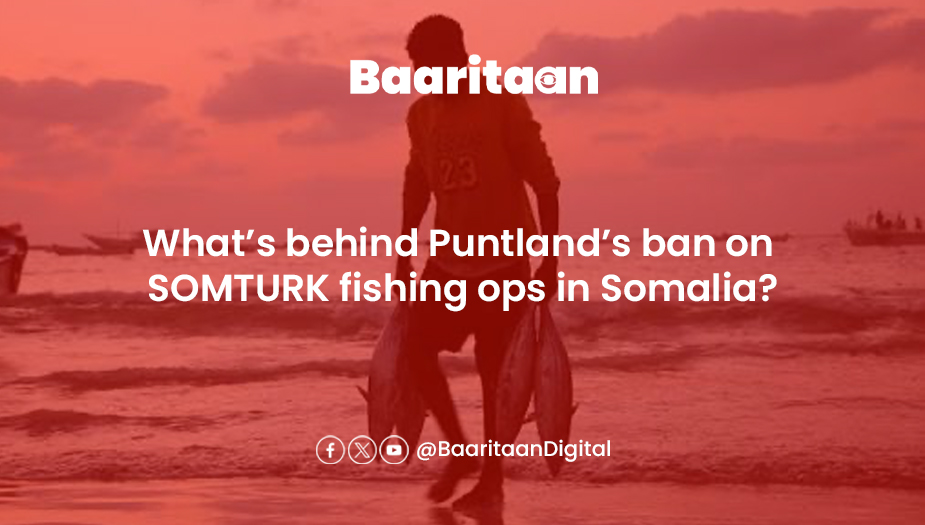

Garowe/Mogadishu — A dispute over a Turkish-linked fishing initiative known as SOMTURK has triggered renewed tensions between Somalia’s federal government and Puntland, with conflicting claims emerging about maritime authority, resource control, and political influence.
A closer review of available documentation shows that while the company’s establishment and Puntland’s objections are grounded in verified developments, several wider allegations circulating around the dispute remain unsubstantiated.
SOMTURK is a joint Somali–Turkish fisheries management company established in December 2025 under an agreement between Somalia’s Ministry of Fisheries and Blue Economy and Turkey’s OYAK group, a major military pension and investment institution. The initiative was publicly presented as part of Somalia’s efforts to modernize its fisheries sector, combat illegal, unreported and unregulated fishing, and regulate licensing across its Exclusive Economic Zone, which is considered among the richest tuna-producing waters in the Indian Ocean region.
The agreement was signed in Mogadishu as part of broader cooperation between Somalia and Turkey in maritime security and economic development. Turkish involvement in Somalia’s maritime sector has expanded in recent years through defense and naval cooperation frameworks aimed at strengthening Somalia’s capacity to manage its waters and protect marine resources.
However, Puntland authorities in Garowe have rejected aspects of the SOMTURK arrangement, arguing that the federal government acted without adequate consultation with federal member states. Puntland has long maintained that it retains administrative authority over its coastal waters and that agreements involving natural resources must be agreed jointly under Somalia’s federal system.
The dispute reflects a deeper and unresolved constitutional tension in Somalia over maritime jurisdiction, particularly the balance of power between Mogadishu and regional administrations. Analysts note that fisheries governance has repeatedly been a flashpoint in Somalia’s federal system, where legal frameworks exist but enforcement and political consensus remain inconsistent.
At the same time, Somalia’s broader maritime sector is under pressure from illegal fishing and weak enforcement capacity, issues that both federal authorities and international partners have sought to address through new licensing and monitoring systems. Supporters of the SOMTURK initiative argue it is designed to increase transparency and state revenue in a sector historically affected by foreign exploitation and regulatory gaps.
Alongside the verified dispute over licensing authority, social media commentary and some political narratives have escalated the issue into broader claims of military build-ups, external interference, and coordinated efforts to destabilize Puntland. Supporters of Puntland also made allegations of troop movements targeting Puntland, arms transfers to proxy militias, or externally driven plans to remove regional leadership.
The Puntland administration itself has also experienced rising tensions with the federal government in recent years, including political disagreements over constitution and election reforms, security cooperation, and territorial authority in disputed regions. These tensions have in some cases led to institutional breakdowns and competing claims of legitimacy between the two sides.
While political rhetoric has intensified, including accusations exchanged between Mogadishu and Garowe, observers caution that many of the more extreme interpretations circulating online go beyond available evidence and should be treated as political framing rather than confirmed fact.
In reality, the SOMTURK dispute highlights a familiar structural challenge in Somalia’s federal system: competing claims over natural resources in a country where governance frameworks remain incomplete, enforcement capacity is limited, and political trust between federal and regional authorities remains fragile.