

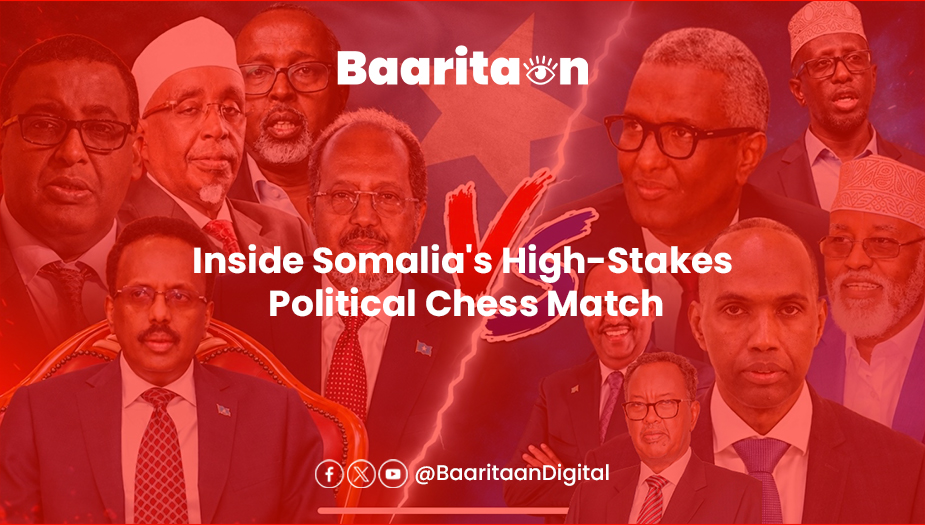

MOGADISHU — Somalia’s political crisis is no longer merely a dispute over elections. It has become a contest over who will determine the rules of the post-transition political order. Since May 15, 2026, when President Hassan Sheikh Mohamud’s constitutionally mandated four-year term expired, the country has entered an unprecedented constitutional gray zone.
Opposition leaders have deliberately referred to him as the country’s “former president,” arguing that his constitutional legitimacy ended with the expiration of his mandate and that any authority exercised thereafter lacks legal foundation.
Yet the symbolic declaration has failed to resolve the central question confronting Somalia: Who governs the transition, and under what constitutional authority?
Instead, the country has drifted deeper into institutional uncertainty, while negotiations intended to produce a political settlement have repeatedly stalled despite intensive diplomatic engagement by the United States, Britain, Turkey, the European Union, and the United Nations.
Interviews conducted by Baaritaan over the past two weeks with government officials, opposition negotiators, diplomats, intelligence sources, and civil society representatives suggest that the impasse is neither accidental nor simply the product of political disagreement.
Rather, participants describe what appears to be a calculated strategy by Villa Somalia to postpone any comprehensive political agreement until the domestic balance of power becomes more favorable to President Hassan Sheikh.
Whether that strategy succeeds may determine not only the outcome of Somalia’s 2026 elections but also the durability of the country’s fragile federal system.
Negotiations Without Resolution
The latest round of internationally mediated talks has produced an unusual paradox. On paper, both the federal government and the opposition now publicly endorse the principle of direct elections. The real dispute lies elsewhere.
Negotiators remain fundamentally divided over the institutional pathway required to reach those elections: who supervises the transition, how electoral institutions are constituted, and which political actors control the decision-making process during the interim period.
Diplomatic mediation has therefore succeeded in narrowing the rhetorical gap while leaving the underlying political conflict untouched. Several opposition negotiators told Baaritaan that President Hassan Sheikh is not negotiating toward compromise but instead pursuing what one participant described as “strategic delay.”
Their accusation is straightforward: every additional month without a political agreement strengthens Villa Somalia’s leverage. Government officials reject that characterization, arguing that constitutional reforms and political consultations require time to build durable consensus.
Why Hirshabelle and Galmudug Matter
The immediate struggle centers on two federal member states whose elections receive relatively little international attention but may prove decisive nationally. Hirshabelle and Galmudug are expected to elect new regional presidents in the coming months.
According to multiple federal officials and opposition representatives interviewed by Baaritaan, Villa Somalia considers those contests strategically indispensable. Control over both administrations would significantly strengthen Hassan Sheikh’s influence inside the National Consultative Council, the body expected eventually to determine Somalia’s electoral framework.
Several sources familiar with internal government discussions believe the presidency intends to convene the council only after both regional elections conclude.By then, officials say, Villa Somalia expects the political arithmetic inside the room to have shifted decisively.
Two individuals directly involved in negotiations independently reached the same conclusion. “There will be no comprehensive political agreement before Hirshabelle and Galmudug are politically secured,” one said. From the opposition’s perspective, this explains why negotiations repeatedly lose momentum just as discussions appear to approach substantive compromise.
Constitutional Reform—or Constitutional Extension?
Behind the procedural disputes lies a far more consequential constitutional battle. Opposition leaders argue that Hassan Sheikh’s political timetable is inseparable from controversial constitutional amendments passed amid widespread procedural objections.
Those amendments, critics contend, would ultimately legitimize what they describe as an unconstitutional one-year presidential extension. The administration rejects that characterization, insisting the constitutional revisions are lawful reforms designed to complete Somalia’s long-delayed constitutional settlement.
But opposition representatives see a different objective. “Time itself has become a political instrument,” one opposition negotiator told Baaritaan.
“The longer negotiations continue without resolution, the easier it becomes to normalize actions that many Somalis believe lost constitutional legitimacy after May 15.” The disagreement illustrates the broader crisis confronting Somalia today: competing interpretations not simply of political strategy, but of constitutional reality itself.
Dividing the Opposition
If Villa Somalia’s objective has been to weaken its political opponents before reaching a national settlement, evidence suggests it has achieved at least partial success. The opposition coalition that emerged earlier this year has become increasingly fragmented.
Former Prime Minister Omar Abdirashid Ali Sharmarke, former South West President Sharif Hassan Sheikh Aden, and former Information Minister Dahir Mohamud Gelle have all departed the Somali Salvation Council to establish a separate platform known as the Somali Unity Council.
Their subsequent electoral proposal diverged from the broader opposition position. Members of the Somali Future Council argue the initiative reflects deliberate efforts by Villa Somalia to fragment opposition cohesion rather than genuine policy disagreement.
Political analysts caution that such accusations remain difficult to verify. Nevertheless, even government officials privately acknowledge that fragmentation among opposition groups has substantially improved the administration’s negotiating position.
Former President Mohamed Abdullahi Mohamed—Farmaajo—has likewise appeared more receptive to elements of the government’s electoral framework than many other opposition leaders, further complicating efforts to maintain a unified anti-government front.
Foreign Mediation Meets Domestic Strategy
International diplomats have become increasingly visible participants in Somalia’s political crisis. American and British diplomats, alongside Turkish mediators and representatives from the European Union and United Nations, have invested considerable political capital attempting to prevent negotiations from collapsing into renewed violence.
Those efforts intensified after armed confrontations in Mogadishu earlier this year displaced civilians and heightened fears that political tensions could trigger broader conflict. Yet mediation has encountered a structural limitation. Foreign diplomats can facilitate dialogue. They cannot manufacture political trust.
Several participants interviewed by Baaritaan described a widening disconnect between the urgency displayed by international mediators and the incentives facing domestic political actors.According to intelligence and diplomatic sources, geopolitical competition may also be complicating mediation efforts.
One source alleged that a participating mediation state believes another Arab government exercises significant influence over parts of the opposition coalition and has quietly supported efforts to politically weaken those actors. Baaritaan could not independently verify those claims.
The Politics of Buying Time
Multiple officials familiar with the negotiations argue that Villa Somalia increasingly prefers technical discussions over leader-to-leader political dialogue. On the surface, technical negotiations project continued diplomatic engagement.
In practice, several negotiators say, they also delay politically binding decisions. One senior federal official offered a revealing assessment.
“Hassan Sheikh believes that if he personally enters direct political negotiations now, a settlement could emerge quickly,” the official said. “But entering negotiations before securing a favorable political balance would unnecessarily reduce his leverage.”
Whether viewed as prudent statecraft or calculated obstruction depends largely on one’s political perspective. Either way, delay has become a governing strategy rather than merely a consequence of disagreement.
Somalia’s Narrowing Political Window
Somalia’s crisis increasingly reflects a broader reality confronting fragile democracies. Political institutions function only when competing actors accept both the legitimacy of the rules and the legitimacy of one another.
Today, neither condition exists.
The opposition questions the constitutional legitimacy of Hassan Sheikh’s continued presidency. The government questions the opposition’s willingness to participate constructively in state-building.International mediation has prevented total collapse but has not bridged that widening deficit of trust.
If negotiations remain stalled while uncertainty surrounding the future of the African Union security mission deepens, Somalia may soon face converging political and security crises simultaneously. The country’s next chapter may therefore be decided not by the election itself, but by the political maneuvering taking place long before Somalis ever reach the ballot box.