

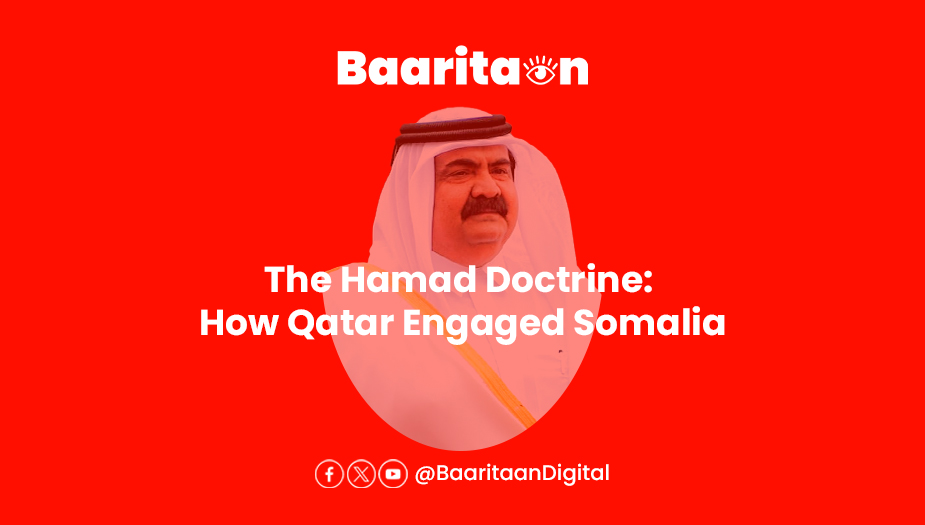

MOGADISHU – When Sheikh Hamad bin Khalifa Al Thani transformed Qatar’s foreign policy after taking power in 1995, Somalia became one of the arenas where Doha sought to establish itself as a diplomatic actor beyond its size.
Through mediation, humanitarian assistance, and political engagement, Qatar gradually developed a role in Somalia’s complex state-building process, especially during the country’s most turbulent years.
2006: Engaging ICU and Somalia’s Political Crisis
Qatar’s involvement in Somalia intensified in 2006, when the rise of the Islamic Courts Union (ICU) in Mogadishu reshaped the country’s political landscape. As the ICU gained control of much of the capital and challenged the authority of the internationally backed Transitional Federal Government (TFG), Doha opened channels of communication with Somali actors and promoted dialogue rather than military confrontation.
Qatar’s approach reflected Sheikh Hamad’s broader foreign policy strategy: using mediation to increase Doha’s diplomatic relevance in regional conflicts. While other powers focused on security concerns and counterterrorism, Qatar presented itself as a possible intermediary between competing Somali factions.
2007: Humanitarian Presence in Mogadishu
In 2007, the Qatar Red Crescent established a presence in Mogadishu, expanding Qatar’s humanitarian engagement as Somalia faced displacement, insecurity, and worsening social conditions.
The move allowed Qatar to combine humanitarian assistance with diplomatic outreach. Aid programs focused on emergency relief, healthcare, and support for vulnerable communities, strengthening Qatar’s visibility among Somali civilians during a period when international access to parts of the country was extremely limited.
2008: The Djibouti Peace Process
A major milestone came on 9 June 2008, when Qatar supported the Djibouti Peace Agreement, a UN-backed initiative between Somalia’s Transitional Federal Government and the opposition Alliance for the Re-liberation of Somalia.
The agreement sought to end armed confrontation and create a political framework for reconciliation. Qatar’s involvement reinforced its image as a mediator in regional conflicts, similar to its roles in Lebanon, Sudan, and other diplomatic arenas.
However, Somalia’s instability continued, highlighting the limits of external mediation in a conflict shaped by internal divisions, armed groups, and competing regional interests.
2011: Responding to the Famine Crisis
During the 2011 Horn of Africa famine, Qatar expanded humanitarian assistance to Somalia as millions faced hunger and displacement. Through Qatari aid organizations, Doha supported food distribution, medical assistance, and relief projects.
The humanitarian response strengthened Qatar’s soft power in Somalia while addressing an urgent crisis. It also demonstrated how Gulf states were increasingly using humanitarian diplomacy as part of broader foreign policy strategies in Africa.
2012: Supporting Somalia’s Federal Transition
On 10 September 2012, Somalia entered a new political phase with the establishment of the Federal Government of Somalia after the end of the transitional period. Qatar welcomed the transition and pledged continued political and development support.
For Doha, Somalia represented both a humanitarian commitment and a strategic relationship in the Horn of Africa, a region increasingly important due to maritime routes, security concerns, and competition among Gulf powers.
2013: The End of Sheikh Hamad’s Rule
On 25 June 2013, Sheikh Hamad bin Khalifa Al Thani abdicated in favor of his son, Sheikh Tamim bin Hamad Al Thani. By the end of his rule, Qatar had established itself as one of the external actors involved in Somalia’s political and humanitarian landscape.
Analysis: Qatar’s Somalia Strategy
Sheikh Hamad’s Somalia policy reflected a broader Qatari strategy: leverage diplomacy, mediation, and humanitarian assistance to gain influence disproportionate to the country’s size.
Unlike traditional military-backed approaches, Qatar relied on dialogue and aid as instruments of foreign policy. In Somalia, this approach helped Doha build relationships with multiple actors and raise its profile internationally.
Yet Qatar’s influence faced the same challenges confronting all external actors in Somalia: fragmented politics, security threats, and the difficulty of transforming diplomatic engagement into lasting stability.
Under Sheikh Hamad, Somalia became an important example of Qatar’s emergence as a small state with ambitious regional diplomacy — using negotiation and humanitarian action as tools of influence in one of the world’s most complex conflicts.