

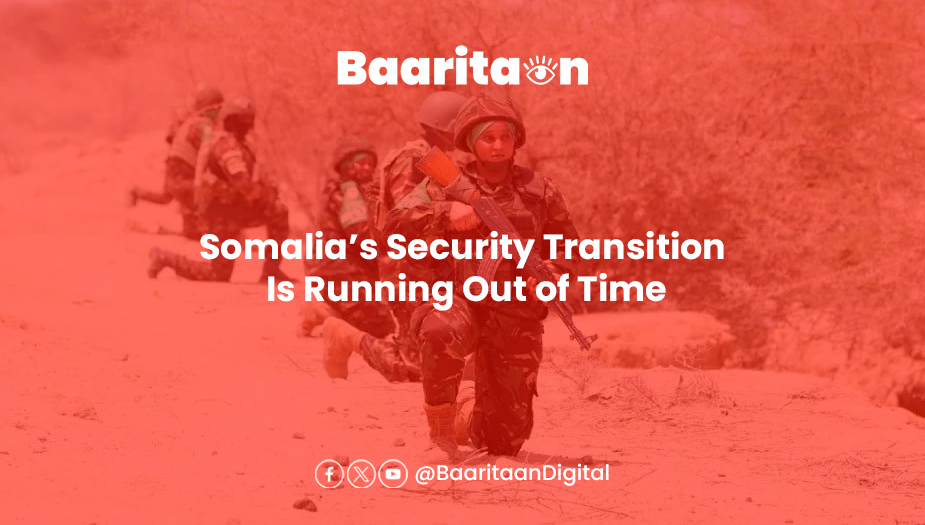

MOGADISHU – For years, Somalia’s security effort has depended on something that is rarely visible from the battlefield: the long chain of logistics that keeps soldiers supplied, wounded troops evacuated and remote bases operating. Now that chain is under threat.
A decision by the United States not to support the continuation of the United Nations Support Office in Somalia (UNSOS) beyond the current authorization period of the African Union Support and Stabilization Mission in Somalia (AUSSOM) has opened a new and uncertain chapter for Somalia’s security transition.
The decision does not formally end the African Union mission. Washington has said it would not object to renewing AUSSOM’s Chapter VII mandate under the United Nations Charter. But the implications are profound. Without UNSOS, Somalia could face the prospect of an internationally mandated mission without the logistical foundation required to function.
A policy brief by Balqiis Insights, a non-partisan think-and-do tank advancing peace, security, and human rights in the Horn of Africa, argues that the crisis is not simply about funding. It is about whether Somalia’s international security architecture can survive the loss of the support system that has sustained it for nearly two decades.
A mission built on outside support
Since African Union forces entered Somalia in 2007, the country’s security campaign has relied on an unusual international arrangement. African states provided the troops. The United Nations provided logistics. European partners financed troop allowances. Western allies provided military assistance, training and counterterrorism support.
The arrangement helped prevent Al-Shabaab from capturing Mogadishu and created space for Somalia’s institutions to rebuild. But the model also produced a difficult dependency. What was intended as a short-term intervention became a 19-year operation, with critical capabilities remaining controlled and financed outside Somalia. The Balqiis Insights brief describes this as a system built on “borrowed pillars” that have weakened over time. The first cracks appeared years ago.
European funding for African Union troop stipends became increasingly uncertain. Efforts to establish more predictable international financing stalled. The United States later reduced its support for the UN logistics structure before moving to oppose its continuation. The current crisis, the report argues, is therefore not a sudden shock. It is the consequence of a transition that was delayed for too long.
The invisible battlefield
Military operations are often measured by territory captured or lost. But in Somalia, the ability to sustain forces has been equally decisive. UNSOS has provided the infrastructure behind the mission: fuel deliveries, food supplies, water, aviation support, engineering services, communications, accommodation, casualty evacuation and medical evacuation.
These are the systems that determine whether troops can remain deployed after the fighting ends. The proposed UNSOS budget for 2025–2026 exceeded $500m, demonstrating the scale of support required to sustain operations across Somalia’s challenging security environment.
Replacing that capability would be neither simple nor immediate. The African Union does not currently possess the same logistical infrastructure, procurement systems or aviation capacity. The Somali government, despite progress in building national security institutions, is not yet positioned to assume those responsibilities alone.
A fragile political moment
The security debate is unfolding during one of Somalia’s most politically sensitive periods in years. Relations between the Federal Government and some Federal Member States have deteriorated over constitutional changes, elections and questions of authority.
Puntland and Jubaland have suspended cooperation with Mogadishu, increasing tensions over the future shape of the Somali state. Those political disputes have direct consequences for security.
A military transition requires agreement over who commands forces, who funds them and who is responsible for holding territory after operations. The Balqiis Insights analysis warns that Somalia’s security challenges cannot be separated from its political divisions. A country divided over governance will struggle to build a unified security system.
Al-Shabaab is watching
The timing of the international debate is particularly dangerous. Al-Shabaab remains capable of exploiting political uncertainty and operational gaps.
The group’s 2025 offensive reversed some territorial gains made during previous campaigns and exposed the risks of transferring responsibility before Somali forces have the capacity to sustain operations independently.
ISIS-Somalia has also continued to develop a presence, particularly in Puntland. The concern among security analysts is not simply that militant groups can launch attacks.
It is that they can exploit moments of transition. History shows that armed groups often expand when states and international partners are distracted by political disputes or institutional change.
A new American calculation
The US decision reflects a wider shift in international attitudes toward long-running security commitments. Washington has not abandoned Somalia. It continues counterterrorism operations and maintains strategic interests in the Horn of Africa.
But the model is changing. The United States appears increasingly focused on targeted security engagement rather than financing large multinational support structures. That approach may reduce costs and increase flexibility.
But it also raises questions about who will provide the long-term support required to stabilize areas affected by insurgency. Military strikes can remove threats. They cannot build institutions. They cannot maintain supply lines. They cannot replace governance.
The search for a managed exit
Somalia and its partners now face difficult choices. One option is to preserve UNSOS in its current form, but political support for that approach has weakened. Another is to replace the UN system with an African-led alternative. This would advance continental ownership but would require resources and capabilities that do not currently exist.
A third option is to accelerate the handover of security responsibilities to Somali forces. That would satisfy calls for sovereignty but could create dangerous gaps if undertaken before national institutions are ready. Balqiis Insights recommends a fourth path: a negotiated transition compact.
The proposal would maintain essential logistics through a reconfigured mechanism financed by Somalia, African institutions and willing international partners while setting clear benchmarks for political cooperation, security reform and operational readiness. The aim would not be to preserve foreign dependency. It would be to prevent a disorderly collapse while creating a realistic route toward Somali control.
A test of international responsibility
Somalia’s security transition has always been about more than military operations. It is a test of whether international support can help create lasting national capacity rather than indefinite reliance. For Somali leaders, the moment requires political compromise and stronger coordination between federal and regional authorities.
For international partners, it requires acknowledging that responsible withdrawal is not the same as rapid departure. The end of foreign support must not become the beginning of a new security crisis. After 19 years of international involvement, Somalia stands at a crossroads.
The country is closer than ever to taking greater responsibility for its own security. But whether it reaches that point successfully may depend on whether the world helps it cross the final distance—or leaves the bridge unfinished.