

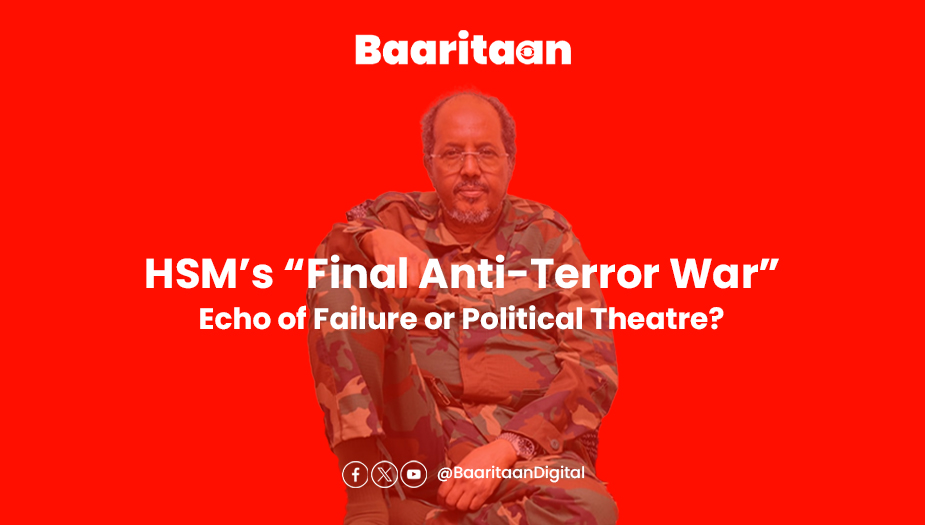

MOGADISHU, Somalia – President Hassan Sheikh Mohamud has once again promised a “final new military offensive” against Al-Shabaab, as his government seeks to regain momentum in a war that has dragged on for nearly two decades with no decisive end in sight.
The announcement comes at a politically sensitive moment, with Somalia’s international security support under growing uncertainty and fresh analysis suggesting that recent battlefield gains against the militant group have not been sustained.
The United States is reported to be preparing to phase out funding linked to the African Union’s stabilization mission in Somalia by December 2026, a move that could significantly weaken logistical and financial support for African Union-backed operations. The mission, which remains a key pillar of Somalia’s security architecture, has long depended on external funding and coordination.
At the same time, a recent assessment by the International Crisis Group warns that the conflict remains in a state of stalemate. According to the report, Somali forces, alongside allied militias and international partners, were able to push Al-Shabaab out of several areas during the 2022–2023 offensives. However, the gains proved difficult to hold, with some districts later slipping back under militant influence or becoming contested once again.
The report’s findings reflect a broader pattern that has shaped Somalia’s war for years: territorial advances followed by gradual reversals, with neither side able to secure lasting control over large parts of the countryside.
Against this backdrop, the president’s repeated use of the term “final offensive” has drawn skepticism from sections of the public and political observers, many of whom have heard similar declarations in previous phases of the war that did not deliver a conclusive outcome.
For ordinary Somalis, especially in areas affected by shifting frontlines, the language of “final battles” often feels distant from daily reality. Security remains fragile, with Al-Shabaab still capable of carrying out attacks in Mogadishu and other regions despite sustained military pressure.
Critics argue that the government’s counterinsurgency strategy has been undermined by internal political tensions, limited coordination between federal and regional authorities, and difficulties in maintaining control over recaptured territory. They say these structural challenges have repeatedly weakened long-term gains on the battlefield.
Supporters of the government, however, insist that Somalia is engaged in a long and complex war against a deeply embedded insurgency, and that continued military pressure—backed by international partners—remains necessary to gradually weaken Al-Shabaab’s operational capacity.
What is clear is that the war has entered yet another uncertain phase. While officials speak of a decisive push, independent assessments suggest a conflict that is neither advancing toward resolution nor returning to outright escalation, but instead continuing in a prolonged and costly stalemate.
For now, Somalia’s latest “final offensive” joins a long list of previous campaigns that promised an endgame—but delivered, instead, another chapter in an unfinished war.