

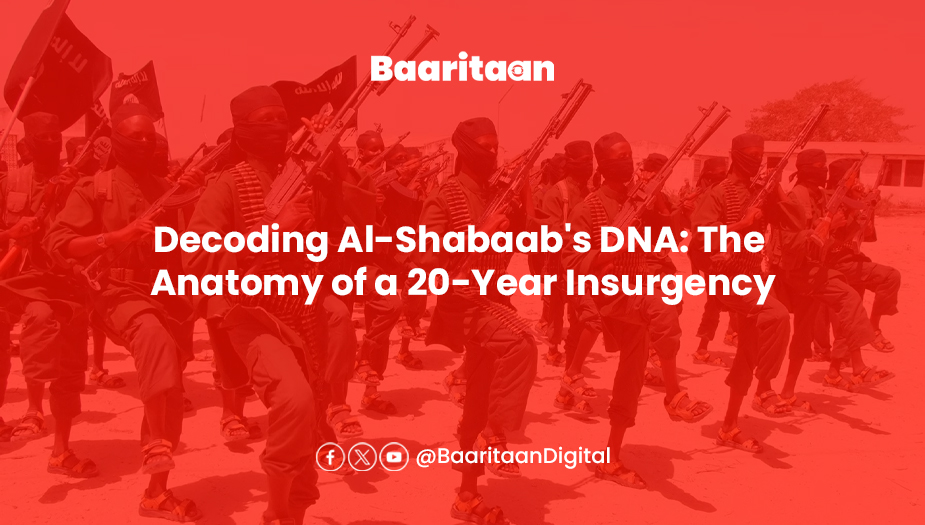

MOGADISHU, Somalia — For nearly two decades, Somalia’s battle against al-Shabaab has been measured in familiar metrics: territory retaken, militant commanders killed, and military offensives launched. A new report argues those benchmarks tell only part of the story.
A study released this week by the Saldhig Institute contends that the jihadist group’s most consequential transformation has occurred not on the battlefield, but inside the organization itself. Rather than surviving despite years of military pressure, the report argues, al-Shabaab has repeatedly converted setbacks into opportunities to become a more adaptive, decentralized and resilient insurgency.
The report, “Al-Shabaab’s Evolution: Strategic or Forced?”, examines nearly twenty years of the group’s development, asking whether its evolution has been driven by deliberate long-term strategy or by necessity in response to relentless military campaigns.
Drawing on interviews with current and former al-Shabaab members, intelligence officials, security personnel, clan elders, business figures and regional specialists, researchers conclude that the answer lies somewhere between the two.
Many of the organization’s defining changes, they argue, began as reactions to military offensives, African Union operations, international airstrikes and shifting political conditions. Over time, however, those adjustments became institutionalized into a long-term strategy focused less on holding territory than on ensuring organizational survival.
“The group’s evolution cannot be understood as purely strategic or purely reactive,” the report concludes. “Its resilience stems from its ability to transform external pressure into internal adaptation.”
That conclusion arrives at a particularly consequential moment for Somalia’s security landscape.
After the federal government’s offensive in 2022 and 2023 succeeded in reclaiming large areas of central Somalia, the conflict has increasingly settled into what many analysts describe as a strategic stalemate. While government forces continue to conduct operations against the insurgency, al-Shabaab has demonstrated an ability to regroup, launch complex attacks and maintain influence across large rural areas despite years of sustained military pressure.
The report argues that this endurance reflects a profound shift in the organization’s strategic thinking.
Researchers say al-Shabaab has gradually abandoned an approach centered on controlling territory through conventional warfare in favor of what they describe as a “long-war strategy” emphasizing patience, flexibility and institutional resilience.
Instead of measuring success by the amount of territory under its control, the group increasingly prioritizes preserving leadership structures, maintaining operational freedom and embedding itself within local political, economic and social networks.
That strategy, according to the study, has been accompanied by substantial investment in intelligence gathering, communications, financial administration and governance.
In areas under its influence, al-Shabaab operates taxation systems, dispute-resolution mechanisms, courts, educational programs and limited public services, allowing it to exercise authority beyond its military presence.
The report also documents changes in the group’s military doctrine.
Rather than relying primarily on conventional assaults or indiscriminate violence, researchers argue that al-Shabaab has increasingly favored intelligence-driven operations, carefully planned raids, targeted assassinations and attacks against military installations and government infrastructure.
Technology has likewise become central to the organization’s evolution.
The study describes growing reliance on encrypted communications, mobile financial platforms, drones, digital propaganda and increasingly sophisticated media operations, all of which have strengthened the group’s ability to coordinate, recruit and finance its activities.
Beyond military capabilities, the report concludes that al-Shabaab has continued investing in relationships with local communities through a combination of coercion, service provision, ideological messaging and engagement with traditional elders and religious leaders.
Researchers argue that these efforts have expanded the organization’s recruitment base and strengthened its influence in areas where government institutions remain weak or absent.
The report also revisits one of the region’s emerging security concerns: al-Shabaab’s evolving relationship with Yemen’s Houthi movement.
Building on previous Saldhig Institute research, the authors argue that the relationship is increasingly defined by pragmatic military cooperation rather than ideological affinity, reflecting a broader organizational willingness to pursue partnerships based on operational interests.
The findings come as Somalia and its international partners confront growing uncertainty over the future of regional security assistance.
The African Union’s stabilization mission is facing renewed financial questions after the United States signaled it would end support for U.N.-funded logistical assistance beginning next year, raising concerns among diplomats and security analysts that any reduction in international support could create opportunities for al-Shabaab to exploit.
Against that backdrop, the report argues that military victories alone are unlikely to produce a lasting defeat of the insurgency.
Instead, it recommends strengthening governance, disrupting financial networks, improving state responsiveness, consolidating military gains through effective civilian administration and addressing the political and economic conditions that continue to enable militant recruitment.
Ultimately, the study suggests that al-Shabaab’s future will depend as much on the Somali state’s capacity to reform as on the insurgency’s own ability to adapt.
The lesson, researchers argue, is that resilience—not territory—has become the organization’s defining strategic advantage. And unless Somalia’s institutions evolve as quickly as the insurgency they are fighting, the conflict may remain less a contest over land than a competition over endurance.