

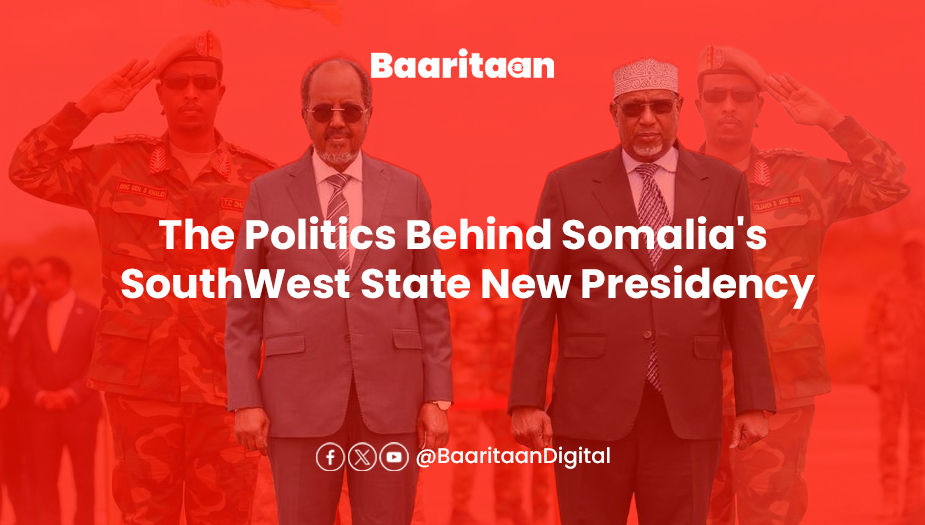

Baidoa/Mogadishu — The inauguration of Aadan Mohamed Nur (Aadan Madobe) as president of Somalia’s Southwest State on Monday was intended to project political authority. Instead, it underscored how contested power has become across Somalia’s federal system.
Twenty-six days after lawmakers elected him in a June 10 vote, Aadan Madobe was formally sworn into office during a ceremony secured by an unusually heavy military presence that included Turkish F-16 fighter jets supporting air security over Baidoa.
The extraordinary security arrangements reflected the fragile environment in which the new regional administration takes power. Southwest State remains politically fractured following the military campaign that removed former President Abdiaziz Hassan Mohamed (Laftagareen) from power earlier this year, leaving armed loyalists still operating around Baidoa and challenging the authority of the new government.
The inauguration also highlighted a broader struggle unfolding in Somalia: whether political competition will continue to be resolved through negotiated consensus—the model that has largely characterized the country’s post-conflict transition—or through increasingly centralized exercises of state power backed by military force.
In his inaugural speech, Aadan Madobe defended his continued use of the title “Leader” (“Hogaamiye”) in official government communications, insisting the designation reflects constitutional amendments adopted during his tenure as Speaker of Somalia’s Lower House. Those constitutional revisions remain among the country’s most contentious political disputes, with opposition figures questioning both the process through which they were approved and their legal legitimacy.
The new Southwest president also used the occasion to criticize opponents of the Federal Government, accusing them of spreading what he described as “propaganda” against the electoral process that elevated him to office. His comments appeared aimed at critics who argue that the regional election took place under overwhelming federal military influence rather than through a genuinely competitive political process.
President Hassan Sheikh Mohamud, speaking at the ceremony, reiterated his commitment to implementing direct elections based on his long-standing “one person, one vote” agenda—a proposal that has become the defining fault line in Somali politics.
Supporters describe universal suffrage as an overdue democratic reform capable of ending decades of elite bargaining over political power. Critics counter that the political and security conditions necessary for such elections do not yet exist, warning that attempting to impose the model without broad consensus risks deepening instability rather than strengthening democratic institutions.
Those competing visions are expected to dominate negotiations scheduled to begin this week in Mogadishu between the Federal Government and opposition leaders grouped under the Future Council. The talks, supported by international diplomatic partners, aim to address the increasingly disputed framework for Somalia’s next federal presidential election.
Governing a State Still at War With Itself
For Aadan Madobe, the ceremony marked the beginning—not the resolution—of a difficult political transition.
His first task will be assembling a cabinet capable of governing a region where security remains precarious.
Federal forces seized Baidoa on March 30 after a military campaign that began in Buur Hakaba and resulted in Laftagareen’s removal from office. Yet his political and military influence has not disappeared.
Armed groups loyal to the former president continue to operate on the outskirts of Baidoa, conducting attacks against government security positions while insisting that Laftagareen was removed through an unconstitutional process.
That continuing resistance means the Southwest administration enters office without the political cohesion normally expected after a transfer of power.
According to information obtained by Baaritaan, divisions have also begun emerging among politicians who previously supported Laftagareen’s removal. Several influential figures reportedly boycotted Monday’s inauguration, suggesting that dissatisfaction extends beyond the former president’s loyalists.
Political reconciliation may therefore become the defining test of Aadan Madobe’s presidency. Without successfully engaging rival political factions, analysts warn that security gains could prove temporary and administrative governance increasingly difficult.
The consequences are already becoming visible. Some humanitarian organizations and development agencies have suspended portions of their operations in Southwest State because of deteriorating security conditions.
A Regional Contest With National Implications
The significance of Baidoa extends well beyond Southwest State.
The inauguration comes as Somalia approaches one of its most consequential political transitions in years. Although President Hassan Sheikh Mohamud’s constitutional term expired on May 15, the federal government continues pursuing its broader political roadmap, including leadership transitions in Galmudug and Hirshabelle before determining the framework for national elections.
For opposition leaders, the coming negotiations represent perhaps the final opportunity to secure agreement on an electoral model acceptable to all major political stakeholders.
Failure would raise the prospect of competing claims to legitimacy, parallel political processes, or even renewed confrontation between rival factions.
Somalia has repeatedly demonstrated that unresolved constitutional disputes rarely remain confined to parliamentary debate. They often migrate into security crises.
That reality makes the political negotiations beginning in Mogadishu arguably more consequential than Monday’s carefully choreographed inauguration in Baidoa.
The ceremony successfully installed a new regional president.
Whether Somalia’s political class can now negotiate a mutually accepted path toward national elections may determine whether the country moves closer to democratic consolidation—or toward another period of institutional confrontation with unpredictable security consequences.