

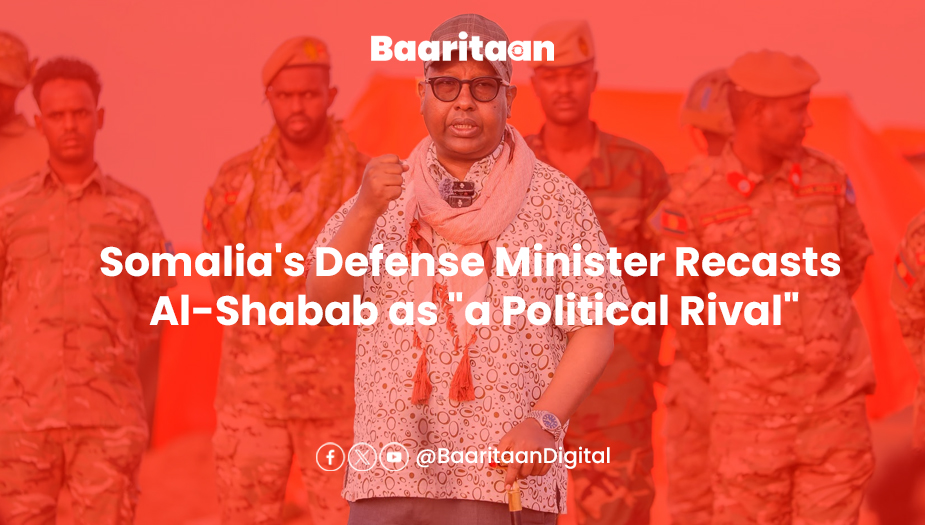

MOGADISHU, Somalia — At first glance, it appeared to be an off-the-cuff remark delivered to soldiers preparing for combat. In reality, it may become one of the most politically consequential statements made by a senior Somali official this year.
Speaking to government troops in the frontline town of Wargaadhi on July 6, Somalia’s Defense Minister, Ahmed Moallim Fiqi, described the country’s political contest as one between “two parties”: President Hassan Sheikh Mohamud’s Justice and Solidarity Party (JSP) and the al-Qaida-linked militant group al-Shabab.
“The two parties competing for this country are JSP and al-Shabab,” Fiqi told assembled soldiers. “Everyone else is irrelevant.”
He then added an even more striking remark, saying that “they should be given part of what they are asking for,” referring to al-Shabab, which the Somali government officially labels Khawarij, or religious deviants.
Whether intended as political rhetoric, psychological warfare, or an inadvertent acknowledgment of a broader strategy, the comments immediately transformed what should have been a routine military visit into a national political controversy.
More importantly, they reopened one of the most sensitive questions in Somali politics: Can the country’s nearly two-decade war against al-Shabab still be won through military force alone?
A Shift in Political Language
For years, successive Somali governments have framed al-Shabab exclusively as a terrorist organization to be defeated militarily.
Fiqi’s characterization of the group as one of Somalia’s two principal political competitors represents a notable departure from that messaging.
Governments engaged in long-running insurgencies often avoid recognizing armed groups as political actors, fearing such language could inadvertently confer legitimacy. Yet counterinsurgency scholars have long argued that insurgent movements frequently combine military violence with political objectives, regardless of whether governments choose to acknowledge them.
Fiqi’s remarks therefore raise a fundamental question: Was he merely describing political reality, or signaling that Mogadishu increasingly views the conflict through a political—as well as military—lens? The government has offered no clarification.
Puntland Sees Confirmation of Long-Held Suspicions
Opposition figures wasted little time interpreting the statement in the most politically damaging way possible.
Puntland State Minister for Information Najib Barkhadle Warsame argued that Fiqi had effectively acknowledged “a previously hidden understanding between the Federal Government and al-Shabab”.
Writing on Facebook, Hirsi alleged that the remarks validated longstanding suspicions that federal authorities coordinated indirectly with the militant group during the military campaign that removed former Southwest State President Abdiaziz Hassan Mohamed (Laftagareen) earlier this year.
The Puntland administration has repeatedly accused Mogadishu of centralizing power through military means, accusations the Federal Government has consistently rejected.
No evidence has been presented publicly supporting Hirsi’s allegations, and federal officials have not responded to his latest claims.
Nevertheless, the speed with which Puntland seized upon the remarks illustrates the profound erosion of political trust between Somalia’s federal institutions and several regional administrations.
Negotiation, Fragmentation—or Psychological Warfare?
The location of the speech may be as significant as its content.
Fiqi addressed troops preparing for operations against al-Shabab in Middle Shabelle, one of the conflict’s most active frontlines. Senior officials rarely introduce politically ambiguous language while addressing forces heading into combat unless doing so serves a deliberate strategic purpose.
Several explanations are possible.
One interpretation is that the minister was attempting to frame al-Shabab as a political rival rather than an existential military force, reinforcing confidence among government troops by portraying the insurgency as ultimately defeatable through state-building rather than battlefield victories alone.
Another possibility is more consequential.
Governments confronting resilient insurgencies have historically sought to divide militant organizations by encouraging defections, exploiting internal rivalries, or opening discreet channels to factions willing to abandon violence. Somalia itself has periodically pursued programs encouraging defections from al-Shabab, though never formal political negotiations with the movement’s senior leadership.
Some Somali analysts therefore view Fiqi’s comments as potentially preparing public opinion for a more politically nuanced approach aimed at fragmenting—not necessarily negotiating with—the insurgency.
At present, however, no public evidence indicates that formal talks with al-Shabab are underway.
A War Entering a New Phase
The controversy arrives as Somalia’s counterinsurgency campaign faces mounting challenges.
Despite years of military offensives supported by the African Union, the United States, the United Kingdom, Türkiye, and other international partners, al-Shabab remains capable of mounting sophisticated attacks while retaining influence across significant rural territory.
International donors have likewise grown increasingly frustrated by slow progress in security-sector reform and persistent political divisions within Somalia’s federal system.
Those frustrations coincide with broader uncertainty surrounding the country’s constitutional future and preparations for national elections, creating a political environment in which even carefully chosen words from senior officials can carry strategic significance.
Whether Fiqi intended to signal a policy shift or merely employed unusually provocative language may ultimately prove less important than the debate his remarks have unleashed.
They have exposed a question that has lingered beneath Somalia’s military campaign for years but has rarely been discussed openly: if outright battlefield victory remains elusive after nearly two decades of conflict, what combination of military pressure, political engagement, and institutional reform—if any—offers a viable path toward ending Africa’s longest-running jihadist insurgency?
For now, Mogadishu has offered no answer.
But one speech from the country’s defense minister has ensured that the question is no longer confined to private policy discussions.